VinFast seeks green clearance for EV plant in Thoothukudi
ECONOMY & POLICY

VinFast seeks green clearance for EV plant in Thoothukudi

VinFast Auto India, a Vietnamese electric vehicle (EV) manufacturer, expressed its intention to commence EV production in Tamil Nadu and to establish its Phase-1 plant in SIPCOT Industrial Estate in Sillanatham in Thoothukudi district. The company planned to invest Rs 160 billion to construct the integrated EV facility, as announced during the third edition of the Global Investors Meet held in Chennai in January.

It was conveyed in an application to the Tamil Nadu State Environmental Impact Assessment Authority (SEIAA) that VinFast had previously sought Consent To Establish (CTE) from the Tamil Nadu Pollution Control Board (TNPCB). However, the TNPCB instructed the company to obtain environmental clearance before proceeding with the CTE.

The submission for the EC took place on May 27 and is currently in the stage of 'under examination'. Once the SEIAA approves the application, it will be forwarded to the Ministry of Environment, Forest and Climate Change for final endorsement.

The Phase-1 manufacturing plant was proposed to have a built-up area of 96,432 sqm within a total plant area of 113.69 acre. It was highlighted that the Tamil Nadu government and VinFast had signed a Memorandum of Understanding (MoU) during the Global Investors Meet (GIM) held in Chennai in January.

The Phase-1 plant was projected to cost Rs 4.25 billion. The entire plant, on the other hand, would be developed on 380 acres with an initial investment of Rs 40 billion.

"VinFast and the state government will collaborate towards a total investment of up to USD 2 billion, with an initial commitment of $ 500 million for the first phase of the project, spanning five years from the commencement date. This indicates a significant move in VinFast's expansion into the world's third-largest vehicle market," stated a recent release from VinFast.

Additionally, it was estimated that VinFast's Thoothukudi plant would provide employment to 3,000 to 3,500 individuals from the region, with an annual production capacity of up to 1,50,000 EVs. The Phase-1 plant alone would manufacture 50,000 EVs.

According to the proposal, construction of the Phase-1 plant was scheduled to commence in January 2025 and conclude by December 2028. Furthermore, the plant area would include a green belt of 9.76 hectares, where 60,000 trees would be planted.

VinFast Auto India, a Vietnamese electric vehicle (EV) manufacturer, expressed its intention to commence EV production in Tamil Nadu and to establish its Phase-1 plant in SIPCOT Industrial Estate in Sillanatham in Thoothukudi district. The company planned to invest Rs 160 billion to construct the integrated EV facility, as announced during the third edition of the Global Investors Meet held in Chennai in January. It was conveyed in an application to the Tamil Nadu State Environmental Impact Assessment Authority (SEIAA) that VinFast had previously sought Consent To Establish (CTE) from the Tamil Nadu Pollution Control Board (TNPCB). However, the TNPCB instructed the company to obtain environmental clearance before proceeding with the CTE. The submission for the EC took place on May 27 and is currently in the stage of 'under examination'. Once the SEIAA approves the application, it will be forwarded to the Ministry of Environment, Forest and Climate Change for final endorsement. The Phase-1 manufacturing plant was proposed to have a built-up area of 96,432 sqm within a total plant area of 113.69 acre. It was highlighted that the Tamil Nadu government and VinFast had signed a Memorandum of Understanding (MoU) during the Global Investors Meet (GIM) held in Chennai in January. The Phase-1 plant was projected to cost Rs 4.25 billion. The entire plant, on the other hand, would be developed on 380 acres with an initial investment of Rs 40 billion. VinFast and the state government will collaborate towards a total investment of up to USD 2 billion, with an initial commitment of $ 500 million for the first phase of the project, spanning five years from the commencement date. This indicates a significant move in VinFast's expansion into the world's third-largest vehicle market, stated a recent release from VinFast. Additionally, it was estimated that VinFast's Thoothukudi plant would provide employment to 3,000 to 3,500 individuals from the region, with an annual production capacity of up to 1,50,000 EVs. The Phase-1 plant alone would manufacture 50,000 EVs. According to the proposal, construction of the Phase-1 plant was scheduled to commence in January 2025 and conclude by December 2028. Furthermore, the plant area would include a green belt of 9.76 hectares, where 60,000 trees would be planted.

Related Stories

Gold Stories

Next Story
Infrastructure Urban

KONE Opens India's First Digital Experience Centre in Pune

KONE, a global elevator and escalator manufacturer, has inaugurated its first Digital Experience Centre (DEC) in India, located in Pune. The facility aims to showcase how artificial intelligence (AI), connectivity and data-driven technologies can enhance customer experiences and improve building operations.The centre was inaugurated by Jussi Herlin, Executive Vice Chair, KONE Corporation; Philippe Delorme, President and CEO, KONE; and Nandan Nilekani, Co-founder and Chairman of the Board, Infosys.Designed as an interactive customer environment, the facility demonstrates digital solutions cover..

Next Story
Infrastructure Urban

CII GreenCo Launches Circularity Guidelines for Indian Industry

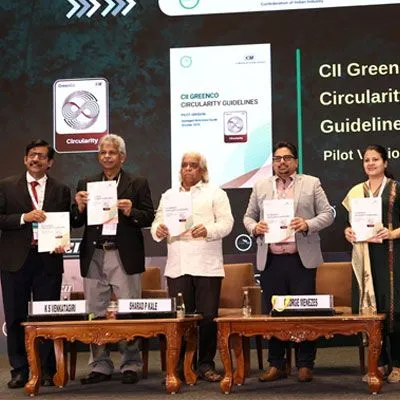
The Confederation of Indian Industry (CII) GreenCo Council has launched the CII GreenCo Circularity Guidelines – Pilot Version at the 17th CII GreenCo Waste & Resource Management Summit 2026 in Chennai. The initiative aims to strengthen resource efficiency, waste reduction and circular economy practices across Indian manufacturing and process industries.The guidelines introduce a structured framework with circularity indices covering raw materials, consumables, packaging and other resource inputs. These indicators will help industries assess existing practices, identify opportunities to ..

Next Story
Infrastructure Energy

Global Electronics Association Launches IPC-1783-CO2E Standard

The Global Electronics Association has introduced IPC-1783-CO2E, a new international standard aimed at improving consistency, transparency and comparability in product carbon footprint reporting across the electronics manufacturing industry.The standard, titled International Standard for Data Collection and Reporting of CO2 Equivalent (CO2e) Emissions for the Electronics Manufacturing Supply Chain, provides industry-specific guidance for collecting, estimating and reporting carbon emissions data.With increasing regulatory requirements and customer expectations, electronics manufacturers face c..

Advertisement

Subscribe to Our Newsletter

Get daily newsletters around different themes from Construction world.

STAY CONNECTED

Advertisement

SPECIAL OFFER
QR Code