DGCA And Gati Shakti Vishwavidyalaya Sign MoU To Train Aviation Workforce
AVIATION & AIRPORTS

DGCA And Gati Shakti Vishwavidyalaya Sign MoU To Train Aviation Workforce

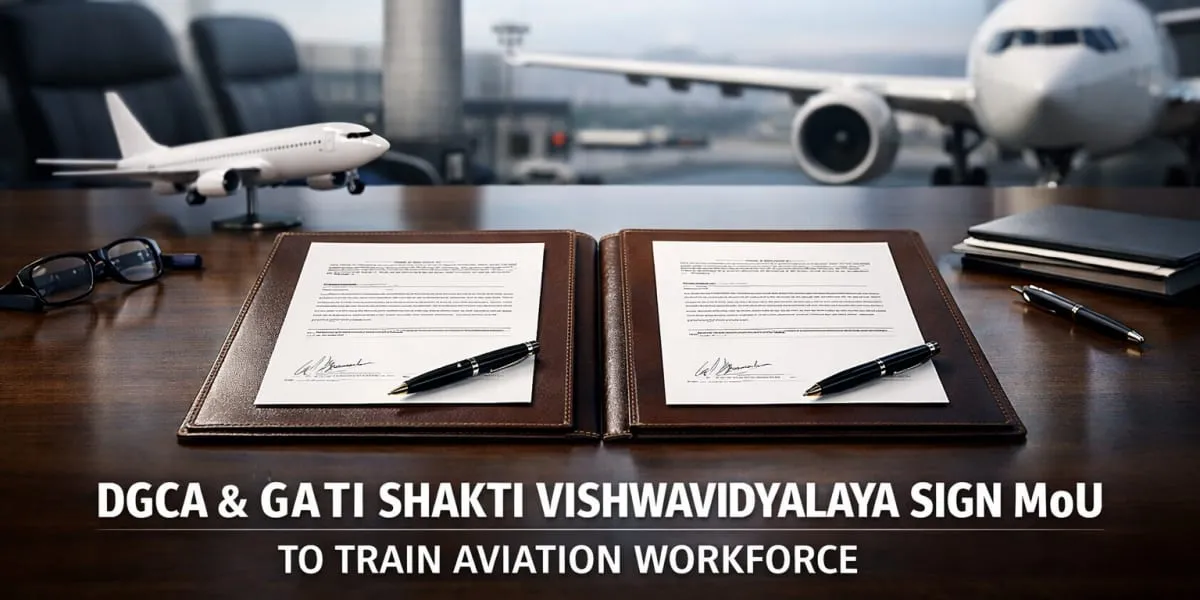
Directorate General of Civil Aviation (DGCA) and Gati Shakti Vishwavidyalaya (GSV) signed a memorandum of understanding to share and enhance knowledge and skills in aviation, aviation engineering and aviation management. The agreement was signed by DGCA head Faiz Ahmed Kidwai and GSV vice chancellor Manoj Choudhury in the presence of senior government officials. The partnership aims to create industry?aligned training pathways and research linkages.

The primary objective is to promote quality manpower for the aviation and maintenance, repair and overhaul (MRO) sector through an undergraduate degree in Aviation Maintenance Engineering (AME) and enhanced industry?academia partnerships. The three?year B.Sc. (AME) curriculum will be implemented from the academic year 2026-27, commencing in August 2026, and will be jointly designed by DGCA and GSV.

GSV will act as a research and knowledge partner in sustainable aviation fuels, aircraft maintenance and parts manufacturing and will support capacity building for DGCA officers. The university has collaboration with 62 industry partners and has been asked to consider a centre of excellence for precision manufacturing engineering to strengthen domestic manufacturing capability.

Officials said that building an aviation manufacturing ecosystem is central to sectoral growth and noted that MRO capacity has expanded from around 160 to more than 240 in the past five years. They cited around 1,700 aircraft on order, representing nearly two times the current fleet, and suggested fleet size could reach 3,000 aircraft by 2036. Projections indicate a requirement for between 10,000 and 12,000 pilots over the next 10 years.

The MoU is expected to create a structured bridge between regulation, academia and industry, with DGCA maintaining licensing standards under CAR-66 and CAR-147 while GSV functions as a national academic anchor for curriculum innovation, apprenticeship models and research integration. By embedding hands?on MRO training, simulation labs and OEM partnerships into AME education, the collaboration aims to develop a future?ready workforce to support expanding fleets and position India as a competitive global MRO and aircraft manufacturing destination.

Directorate General of Civil Aviation (DGCA) and Gati Shakti Vishwavidyalaya (GSV) signed a memorandum of understanding to share and enhance knowledge and skills in aviation, aviation engineering and aviation management. The agreement was signed by DGCA head Faiz Ahmed Kidwai and GSV vice chancellor Manoj Choudhury in the presence of senior government officials. The partnership aims to create industry?aligned training pathways and research linkages. The primary objective is to promote quality manpower for the aviation and maintenance, repair and overhaul (MRO) sector through an undergraduate degree in Aviation Maintenance Engineering (AME) and enhanced industry?academia partnerships. The three?year B.Sc. (AME) curriculum will be implemented from the academic year 2026-27, commencing in August 2026, and will be jointly designed by DGCA and GSV. GSV will act as a research and knowledge partner in sustainable aviation fuels, aircraft maintenance and parts manufacturing and will support capacity building for DGCA officers. The university has collaboration with 62 industry partners and has been asked to consider a centre of excellence for precision manufacturing engineering to strengthen domestic manufacturing capability. Officials said that building an aviation manufacturing ecosystem is central to sectoral growth and noted that MRO capacity has expanded from around 160 to more than 240 in the past five years. They cited around 1,700 aircraft on order, representing nearly two times the current fleet, and suggested fleet size could reach 3,000 aircraft by 2036. Projections indicate a requirement for between 10,000 and 12,000 pilots over the next 10 years. The MoU is expected to create a structured bridge between regulation, academia and industry, with DGCA maintaining licensing standards under CAR-66 and CAR-147 while GSV functions as a national academic anchor for curriculum innovation, apprenticeship models and research integration. By embedding hands?on MRO training, simulation labs and OEM partnerships into AME education, the collaboration aims to develop a future?ready workforce to support expanding fleets and position India as a competitive global MRO and aircraft manufacturing destination.

Next Story
Infrastructure Urban

Centre Disburses Over Rs 24,610 mn in XV Finance Commission Grants

The Union Government has released XV Finance Commission tied grants during the financial year 2025–26 to rural local bodies in Chhattisgarh, Gujarat, Madhya Pradesh, Punjab and Sikkim and has released withheld portions of tied and untied grants to Himachal Pradesh, Odisha and Tripura. The total disbursal exceeded Rs 24,610 mn, with figures expressed in million (mn) thereafter. The releases cover allocations pertaining to different financial years and aim to strengthen rural local governance. State-wise disbursements included Rs 3,324.6 mn for Punjab, Rs 9,432.7 mn for Madhya Pradesh, Rs 3,47..

Next Story
Infrastructure Urban

Centre Releases Over Rs 15 bn as XV FC Grants to Rural Bodies

The Union Government has released over Rs 15 bn in grants recommended by the Fifteenth Finance Commission (XV FC) to strengthen Panchayati Raj Institutions (PRIs) and Rural Local Bodies (RLBs) in six states. The funds comprise tied and untied grants disbursed in FY 2025–26. Telangana received Rs 2.48 bn as the first instalment of untied grants for FY 2025–26, benefitting 12600 Gram Panchayats (GPs). Uttarakhand received Rs 913.1 mn as the second instalment and an additional Rs 18.4 mn of a withheld first instalment was released to a further 216 GPs. Mizoram is included among beneficiary st..

Next Story
Infrastructure Energy

Government Assures Fuel Supplies And Seafarer Safety Amid West Asia Developments

The Government of India has stepped up coordinated measures to maintain stability in critical sectors as developments in West Asia continue to unfold. It has prioritised uninterrupted energy supplies, safeguarded maritime operations and extended consular assistance to nationals. Central authorities are working with State and Union territory administrations to ensure timely information dissemination and operational continuity. Refineries are reported to be operating at high capacity with adequate inventories of petrol and diesel, and domestic LPG production has been increased to support consump..

Advertisement

Subscribe to Our Newsletter

Get daily newsletters around different themes from Construction world.

STAY CONNECTED

Advertisement

Advertisement

Advertisement