India EU Trade Pact to Boost Domestic Auto Manufacturing
ECONOMY & POLICY

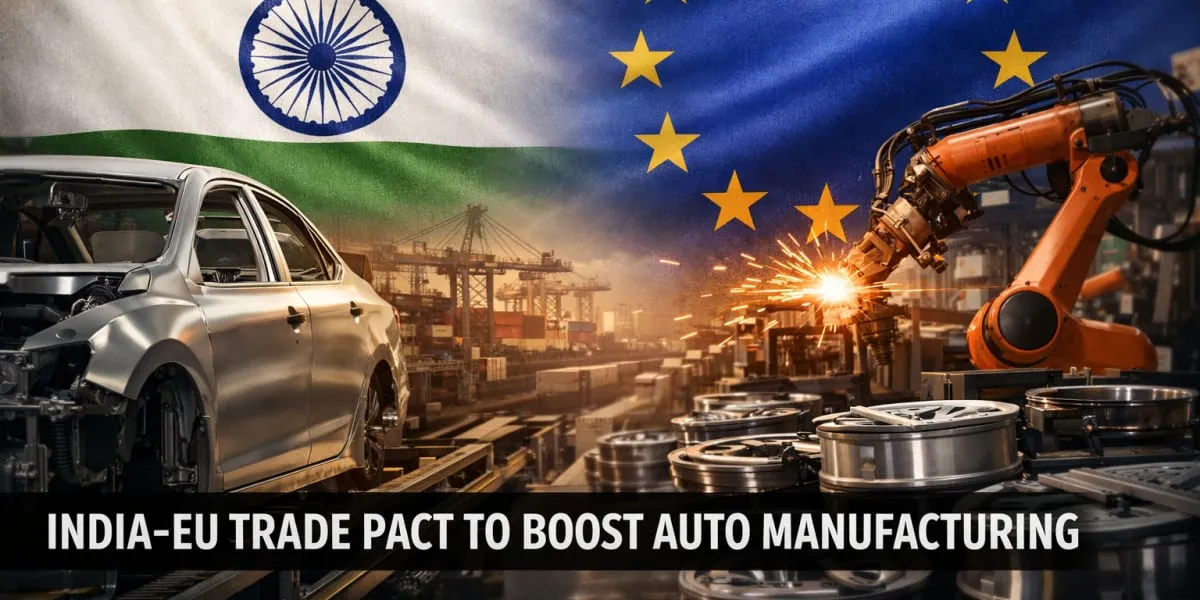
India EU Trade Pact to Boost Domestic Auto Manufacturing

The India-European Union free trade agreement, whose negotiations concluded on January 27, is expected to attract greater investment into India and to boost automobile manufacturing, Additional Secretary in the commerce ministry Darpan Jain said while addressing a conference organised by the industry chamber Ficci. The official said the pact may come into force from next year and will help integrate India into the EU value chain. He added that this is intended to expand manufacturing in India and increase exports to third countries.

Jain indicated that the auto sector posed challenging issues during negotiations because of high Indian import duties, but that those challenges were converted into structured opportunities within the agreement. India offered quota-based, long phasing of concessions so that European producers gain market access while the domestic industry retains adequate protection. He noted the pact will reduce duties gradually, bringing tariffs to 10 per cent from 110 per cent for zero point two five million (mn) vehicles a year, a quota that is over six times the amount offered to the UK.

On social security agreements with EU members, Jain explained that India already has pacts with 14 out of 27 member states, with seven under negotiation and six more planned. He said these arrangements prevent double social security contributions by Indian professionals working for a limited period in EU countries and allow them to retain benefits that would otherwise be inaccessible. The government has therefore created a facilitative mechanism to enter into additional bilateral social security agreements with member states.

Jain further observed that the EU has more than 40 free trade agreements covering some 70 nations, presenting opportunities for Indian exporters to benefit from those arrangements. FICCI Secretary General Anant Swarup noted that the EU accounts for about 12 per cent of India's total merchandise trade and that the immediate task is to convert such agreements into practical gains for exporters, micro, small and medium enterprises and service providers. The overall expectation is greater investment and deeper engagement in global value chains.

The India-European Union free trade agreement, whose negotiations concluded on January 27, is expected to attract greater investment into India and to boost automobile manufacturing, Additional Secretary in the commerce ministry Darpan Jain said while addressing a conference organised by the industry chamber Ficci. The official said the pact may come into force from next year and will help integrate India into the EU value chain. He added that this is intended to expand manufacturing in India and increase exports to third countries. Jain indicated that the auto sector posed challenging issues during negotiations because of high Indian import duties, but that those challenges were converted into structured opportunities within the agreement. India offered quota-based, long phasing of concessions so that European producers gain market access while the domestic industry retains adequate protection. He noted the pact will reduce duties gradually, bringing tariffs to 10 per cent from 110 per cent for zero point two five million (mn) vehicles a year, a quota that is over six times the amount offered to the UK. On social security agreements with EU members, Jain explained that India already has pacts with 14 out of 27 member states, with seven under negotiation and six more planned. He said these arrangements prevent double social security contributions by Indian professionals working for a limited period in EU countries and allow them to retain benefits that would otherwise be inaccessible. The government has therefore created a facilitative mechanism to enter into additional bilateral social security agreements with member states. Jain further observed that the EU has more than 40 free trade agreements covering some 70 nations, presenting opportunities for Indian exporters to benefit from those arrangements. FICCI Secretary General Anant Swarup noted that the EU accounts for about 12 per cent of India's total merchandise trade and that the immediate task is to convert such agreements into practical gains for exporters, micro, small and medium enterprises and service providers. The overall expectation is greater investment and deeper engagement in global value chains.

Next Story
Infrastructure Transport

MMRDA advances 250 m on Orange Gate–Marine Drive tunnel

The Mumbai Metropolitan Region Development Authority (MMRDA) has completed 250 m of underground tunnelling for the Orange Gate–Marine Drive Urban Road Tunnel using India’s largest slurry shield tunnel boring machine (TBM) deployed for an urban road project.The project involves twin tunnels extending over 7 km beneath critical transport corridors, including Central Railway, Western Railway and Metro Line 3. The work requires high-precision engineering to navigate densely developed urban infrastructure.Once completed, the tunnel is expected to reduce travel time between Orange Gate and Marin..

Next Story
Infrastructure Urban

Hindustan Zinc Pays Rs 188.46 Billion in FY26

Hindustan Zinc contributed Rs 188.46 billion to the public exchequer in FY 2025-26, according to its 9th Tax Transparency Report. The contribution, equivalent to 46 per cent of the company’s revenue, included direct and indirect taxes, government royalties, dividends to the Government of India, withholding taxes and other statutory levies.The company’s five-year cumulative contribution to the exchequer stood at Rs 915.72 billion. In FY26, Hindustan Zinc reported revenue of Rs 408.44 billion, EBITDA of Rs 221.62 billion and profit after tax of Rs 138.32 billion. It also achieved its highest..

Next Story
Infrastructure Urban

World of Concrete India 2026 Opens in Mumbai

Informa Markets in India will host the 12th edition of World of Concrete India 2026 from 3–5 June 2026 at the Bombay Exhibition Centre, Mumbai. The specialised B2B exhibition will bring together manufacturers, suppliers, contractors, developers, architects, consultants, infrastructure companies, project leaders and government stakeholders.The event is expected to feature over 350 brands and more than 18,000 trade professionals. It will cover concrete and cement, dry mortar, precast technologies, formwork, construction chemicals, industrial and commercial flooring, scaffolding, safety solutio..

Advertisement

Subscribe to Our Newsletter

Get daily newsletters around different themes from Construction world.

STAY CONNECTED

Advertisement

Advertisement

Advertisement

-->