+
DoT Orders Navi Mumbai Airport To Grant RoW To Telcos
AVIATION & AIRPORTS

DoT Orders Navi Mumbai Airport To Grant RoW To Telcos

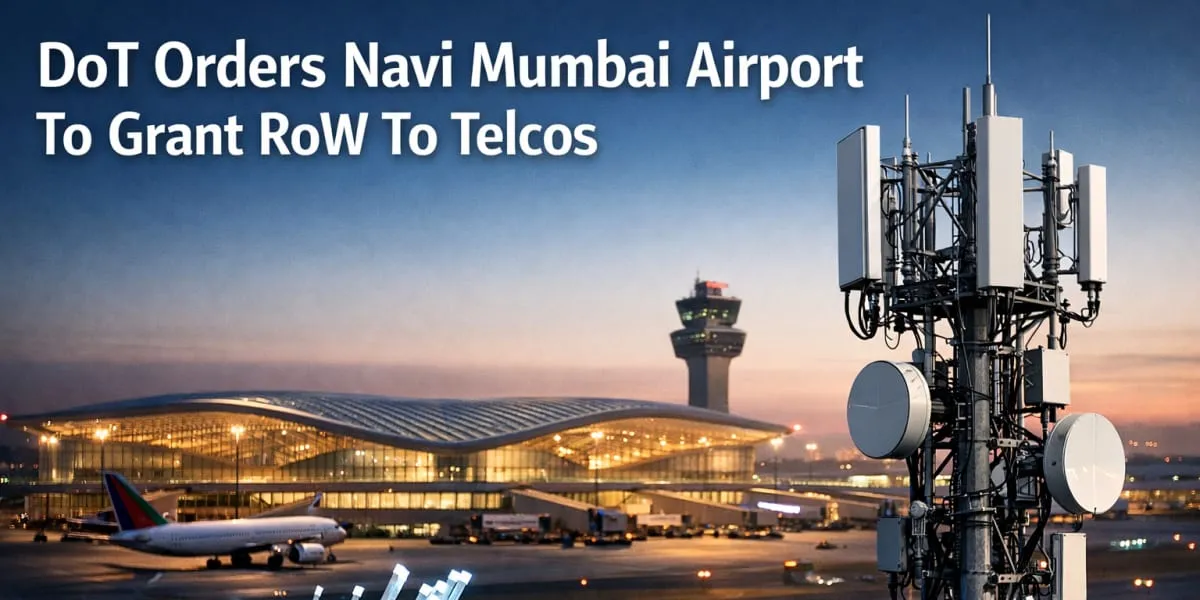
The Department of Telecommunications (DoT) has directed Navi Mumbai International Airport (NMIA) to grant Right of Way (RoW) permissions to licensed telecom service providers, resolving a prolonged dispute over network access within airport premises. The instruction was issued in a letter dated 16 February to Arun Bansal, chief executive officer of Adani Airports Holdings Limited, which operates the airport, and it emphasised compliance with the Telecommunications Act, 2023 and the Telecommunications Right of Way Rules, 2024. The DoT set out that the statutory framework mandates non-discriminatory, fair and transparent processing of RoW applications within prescribed timelines.

The move followed complaints from the Cellular Operators Association of India (COAI) in December 2025, in which major carriers reported difficulties in setting up infrastructure at the airport. NMIA had installed an in-building solution-neutral telecom network for use by operators, but telecom companies said the airport had demanded Rs 441.6 mn per year from each operator to access that network, a charge they described as excessive and costlier than building their own systems. The airport maintained that its rates were in line with those at other public private partnership airports.

The dispute had resulted in limited mobile network coverage inside the terminal, with passengers largely dependent on airport WiFi for connectivity and services such as app-based taxi coordination. Industry sources said Airtel and Bharat Sanchar Nigam Limited (BSNL) had begun trial runs of their networks at the airport as operators prepared to establish equipment. The DoT letter categorised the airport as a public entity under the Act and instructed airport authorities to facilitate establishment of telecom infrastructure in accordance with the statutory framework. A formal response from NMIA was awaited.

The DoT action comes as a similar dispute over access unfolds along the underground Metro three corridor, signalling broader tensions over infrastructure control in the city. The intervention is expected to clear procedural obstacles and allow telecom operators to move forward with network roll out inside the airport.

The Department of Telecommunications (DoT) has directed Navi Mumbai International Airport (NMIA) to grant Right of Way (RoW) permissions to licensed telecom service providers, resolving a prolonged dispute over network access within airport premises. The instruction was issued in a letter dated 16 February to Arun Bansal, chief executive officer of Adani Airports Holdings Limited, which operates the airport, and it emphasised compliance with the Telecommunications Act, 2023 and the Telecommunications Right of Way Rules, 2024. The DoT set out that the statutory framework mandates non-discriminatory, fair and transparent processing of RoW applications within prescribed timelines. The move followed complaints from the Cellular Operators Association of India (COAI) in December 2025, in which major carriers reported difficulties in setting up infrastructure at the airport. NMIA had installed an in-building solution-neutral telecom network for use by operators, but telecom companies said the airport had demanded Rs 441.6 mn per year from each operator to access that network, a charge they described as excessive and costlier than building their own systems. The airport maintained that its rates were in line with those at other public private partnership airports. The dispute had resulted in limited mobile network coverage inside the terminal, with passengers largely dependent on airport WiFi for connectivity and services such as app-based taxi coordination. Industry sources said Airtel and Bharat Sanchar Nigam Limited (BSNL) had begun trial runs of their networks at the airport as operators prepared to establish equipment. The DoT letter categorised the airport as a public entity under the Act and instructed airport authorities to facilitate establishment of telecom infrastructure in accordance with the statutory framework. A formal response from NMIA was awaited. The DoT action comes as a similar dispute over access unfolds along the underground Metro three corridor, signalling broader tensions over infrastructure control in the city. The intervention is expected to clear procedural obstacles and allow telecom operators to move forward with network roll out inside the airport.

Related Stories

Gold Stories

Next Story
Infrastructure Urban

KONE Opens India's First Digital Experience Centre in Pune

KONE, a global elevator and escalator manufacturer, has inaugurated its first Digital Experience Centre (DEC) in India, located in Pune. The facility aims to showcase how artificial intelligence (AI), connectivity and data-driven technologies can enhance customer experiences and improve building operations.The centre was inaugurated by Jussi Herlin, Executive Vice Chair, KONE Corporation; Philippe Delorme, President and CEO, KONE; and Nandan Nilekani, Co-founder and Chairman of the Board, Infosys.Designed as an interactive customer environment, the facility demonstrates digital solutions cover..

Next Story
Infrastructure Urban

CII GreenCo Launches Circularity Guidelines for Indian Industry

The Confederation of Indian Industry (CII) GreenCo Council has launched the CII GreenCo Circularity Guidelines – Pilot Version at the 17th CII GreenCo Waste & Resource Management Summit 2026 in Chennai. The initiative aims to strengthen resource efficiency, waste reduction and circular economy practices across Indian manufacturing and process industries.The guidelines introduce a structured framework with circularity indices covering raw materials, consumables, packaging and other resource inputs. These indicators will help industries assess existing practices, identify opportunities to ..

Next Story
Infrastructure Energy

Global Electronics Association Launches IPC-1783-CO2E Standard

The Global Electronics Association has introduced IPC-1783-CO2E, a new international standard aimed at improving consistency, transparency and comparability in product carbon footprint reporting across the electronics manufacturing industry.The standard, titled International Standard for Data Collection and Reporting of CO2 Equivalent (CO2e) Emissions for the Electronics Manufacturing Supply Chain, provides industry-specific guidance for collecting, estimating and reporting carbon emissions data.With increasing regulatory requirements and customer expectations, electronics manufacturers face c..

Advertisement

Subscribe to Our Newsletter

Get daily newsletters around different themes from Construction world.

STAY CONNECTED

Advertisement

SPECIAL OFFER
QR Code