India's 10 Largest Airport Projects
AVIATION & AIRPORTS

India's 10 Largest Airport Projects

According to GlobalData's building database, India has one of the world's fastest expanding aviation sectors and is estimated to have the third greatest passenger volume.

It should come as no surprise that India has the second-most lucrative pipeline of airport development projects in Asia, behind only China, and the most valuable in South Asia, with a value of over $32 billion.

Here are India's 10 largest airport projects, along with a description of each, a list of those involved, and an estimated completion date.

10: Chennai International Airport Upgrade, Chennai: $345m (Rs28bn)
The first project in the top ten concerns the fifth-busiest airport in India, which is also one of the oldest because it has been in use since 1930. The Airports Authority of India owns Chennai International, which has two runways and three terminals, one of which just ended the first phase of construction in April 2023.

Upon completion of its second stage, the new integrated terminal will replace the airport's current aging terminals 2 and 3 and increase annual passenger capacity to 23 million. There had also been intentions to add a third runway to the airport, but those plans were shelved when Parandur, a nearby greenfield airfield, was suggested.

A new integrated freight terminal will also boost the airport's cargo capacity by enlarging its cargo space from 35,920m2 to 54,620m2, in addition to the new passenger-focused developments. Construction on the entire project is anticipated to be completed by the end of 2024.

9: Mysore Airport Runway Expansion, Mysore: $420m (Rs34bn)
Although the current terminal opened for business in 2010, the history of Mysore Airport dates back to the 1940s when it was built by the Kingdom of Mysore. However, due to poor passenger response, flights ceased until the Indian government launched its regional airport project.

Mysore's runway will be extended from 1,740 meters to 2,750 meters and then 2,795 meters as part of the extension, enabling the airport to accommodate well-liked larger jet aircraft like the Boeing 737 and Airbus A320. The existence of a railway line at the runway's western end and a national highway at its eastern end, which would need to be diverted, has hindered the second extension, though.

8: Bhogapuram Greenfield International Airport, Vizianagaram: $593m (Rs49bn)
Bhogapuram Airport, also known as GMR Visakhapatnam International Airport, is the first entirely new airport development in the top ten, and work on it started in May 2023. It is anticipated to be finished in early 2025.

The airport will have one terminal and one 3,800 m-long runway spread across an area of 2,203 acres. After Phase 1 is finished, it will serve 6 million passengers annually, and after Phase 3, 18 million.

The project, which is owned by GMR Group, will be constructed through a public-private partnership between the Andhra Pradesh Airports Development Corporation (APADCL) and the state's administration. Additionally, the Indian Navy and APADCL have a memorandum of agreement in which they commit to transfer the current Visakhapatnam Airport civil enclave to Bhogapuram.

7: Rajiv Gandhi International Airport Expansion, Hyderabad: $700m (Rs57bn)
Rajiv Gandhi International Airport, India's first greenfield airport constructed through a public-private partnership and the fourth busiest airport in the nation, has been in operation since 2008 and sees about 20 million passengers annually.

The airport's extension, which is scheduled to be finished later in 2023, will increase its capacity to 30 million passengers. On behalf of the airport's principal owner, GMR Group, Larsen and Toubro and Megawide Construction Corporation have been working on the expansion.

Rajiv Gandhi International Airport now offers 83 parking spaces instead of just 57, thanks to recent construction on the airport's two runways and massive integrated passenger terminal.

6: Lalitpur Airport Development, Lalitpur: $1bn (Rs82bn)
The Lalitpur Airport development is a long-running initiative that aims to utilize an airfield that was constructed in Lalitpur during World War II but has remained idle ever since.

The property has been the subject of numerous development proposals, but none have been authorized by the Uttar Pradesh government until March 2021. Although it will initially serve as a domestic airport site for smaller planes, it is believed that the location may eventually develop into an international one.

The facility, which is owned by the Airports Authority of India, will be about 90 hectares large and act as the fourth airport in the Bundelkhand region, giving it a boost.

5: Indira Gandhi International Airport Expansion, Delhi: $1.4bn (Rs115bn)
The expansion of Indira Gandhi International has increased its capacity even more, with 65 million passengers expected to pass through the three terminals in 2022, making it the busiest airport in India and the ninth busiest in the world.

The third terminal opened in 2010, a cargo terminal was erected, and a fourth parallel runway is projected to be finished in September 2023. The expansion is overseen by the airport's owner GMR Group.

In order to reduce traffic at Indira Gandhi International Airport, Noida International Airport is also being built.

4: Kempegowda International Airport Expansion, Bengaluru: $1.9bn (Rs156bn)
The expansion of Indira Gandhi International has increased its capacity even more, with 65 million passengers expected to pass through the three terminals in 2022, making it the busiest airport in India and the ninth busiest in the world.

The third terminal opened in 2010, a cargo terminal was erected, and a fourth parallel runway is projected to be finished in September 2023. The expansion is overseen by the airport's owner GMR Group.

In order to reduce traffic at Indira Gandhi International Airport, Noida International Airport is also being built.

3: Navi Mumbai International Airport, Mumbai: $2.3bn (Rs189bn)
The Navi Mumbai International Airport, a brand-new airport for Mumbai, would replace the current Chhatrapati Shivaji Maharaj International Airport, the second busiest airport in India, as the secondary airport serving the metropolitan area.

The new location will span 1,160 hectares and include two runways, a domestic and international freight port, and three passenger terminals. Upon completion of the first phase of development in 2025 and after the third phase, it will be able to accommodate 90 million passengers annually.

The project is being built by City and Industrial Development Corporation and Adani Airports Holdings Limited. An additional component of the proposed Mumbai-Hyderabad high-speed rail network is Navi Mumbai International.

2: Sardar Vallabhbhai Patel International Airport Expansion, Ahmedabad: $2.4bn (Rs197bn)
In order to accommodate the increasing number of passengers, the Sardar Vallabhbhai Patel International Airport will undergo a significant expansion that will add a third passenger terminal and a new cargo terminal to the airport's grounds.

The parent company of the airport, Adani Airport Holdings, hired Suroj Buildcon Pvt. as the construction contractor, and work on the project is scheduled to begin in mid-2022 and be completed in 2026.

In order to assist relieve traffic at Sardar Vallabhbhai Patel, which is anticipated to remain busy even after the expansion is finished, the Airports Authority of India will be building another airport in the nearby city of Dholera due to a lack of space at the Ahmedabad airport site.

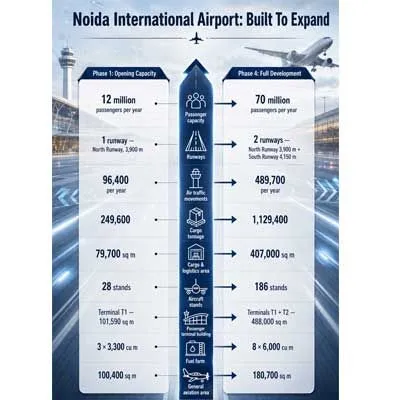
1: Noida International Airport, Jewar: $4.2bn (Rs345bn)
The Noida International Airport, which is unquestionably the largest airport project now under construction in India, is scheduled to reach completion in 2040 after breaking ground in 2021. Yamuna International Airport Private Limited, a division of Zurich Airport International AG, is creating it.

The enormous project, also known as Jewar International Airport, will include two runways initially to accommodate 12 million passengers annually by 2024 before gradually expanding over the following three decades to become a six-runway airport capable of handling 60 to 120 million passengers annually, making it the fourth largest airport in the world and the largest in Asia.

See also:
L&T, NCC bids for Rs 56.88 bn Hyderabad Airport Metro project
Bagdogra Airport expansion set to begin soon



According to GlobalData's building database, India has one of the world's fastest expanding aviation sectors and is estimated to have the third greatest passenger volume. It should come as no surprise that India has the second-most lucrative pipeline of airport development projects in Asia, behind only China, and the most valuable in South Asia, with a value of over $32 billion. Here are India's 10 largest airport projects, along with a description of each, a list of those involved, and an estimated completion date. 10: Chennai International Airport Upgrade, Chennai: $345m (Rs28bn) The first project in the top ten concerns the fifth-busiest airport in India, which is also one of the oldest because it has been in use since 1930. The Airports Authority of India owns Chennai International, which has two runways and three terminals, one of which just ended the first phase of construction in April 2023. Upon completion of its second stage, the new integrated terminal will replace the airport's current aging terminals 2 and 3 and increase annual passenger capacity to 23 million. There had also been intentions to add a third runway to the airport, but those plans were shelved when Parandur, a nearby greenfield airfield, was suggested. A new integrated freight terminal will also boost the airport's cargo capacity by enlarging its cargo space from 35,920m2 to 54,620m2, in addition to the new passenger-focused developments. Construction on the entire project is anticipated to be completed by the end of 2024. 9: Mysore Airport Runway Expansion, Mysore: $420m (Rs34bn) Although the current terminal opened for business in 2010, the history of Mysore Airport dates back to the 1940s when it was built by the Kingdom of Mysore. However, due to poor passenger response, flights ceased until the Indian government launched its regional airport project. Mysore's runway will be extended from 1,740 meters to 2,750 meters and then 2,795 meters as part of the extension, enabling the airport to accommodate well-liked larger jet aircraft like the Boeing 737 and Airbus A320. The existence of a railway line at the runway's western end and a national highway at its eastern end, which would need to be diverted, has hindered the second extension, though. 8: Bhogapuram Greenfield International Airport, Vizianagaram: $593m (Rs49bn) Bhogapuram Airport, also known as GMR Visakhapatnam International Airport, is the first entirely new airport development in the top ten, and work on it started in May 2023. It is anticipated to be finished in early 2025. The airport will have one terminal and one 3,800 m-long runway spread across an area of 2,203 acres. After Phase 1 is finished, it will serve 6 million passengers annually, and after Phase 3, 18 million. The project, which is owned by GMR Group, will be constructed through a public-private partnership between the Andhra Pradesh Airports Development Corporation (APADCL) and the state's administration. Additionally, the Indian Navy and APADCL have a memorandum of agreement in which they commit to transfer the current Visakhapatnam Airport civil enclave to Bhogapuram. 7: Rajiv Gandhi International Airport Expansion, Hyderabad: $700m (Rs57bn) Rajiv Gandhi International Airport, India's first greenfield airport constructed through a public-private partnership and the fourth busiest airport in the nation, has been in operation since 2008 and sees about 20 million passengers annually. The airport's extension, which is scheduled to be finished later in 2023, will increase its capacity to 30 million passengers. On behalf of the airport's principal owner, GMR Group, Larsen and Toubro and Megawide Construction Corporation have been working on the expansion. Rajiv Gandhi International Airport now offers 83 parking spaces instead of just 57, thanks to recent construction on the airport's two runways and massive integrated passenger terminal. 6: Lalitpur Airport Development, Lalitpur: $1bn (Rs82bn) The Lalitpur Airport development is a long-running initiative that aims to utilize an airfield that was constructed in Lalitpur during World War II but has remained idle ever since. The property has been the subject of numerous development proposals, but none have been authorized by the Uttar Pradesh government until March 2021. Although it will initially serve as a domestic airport site for smaller planes, it is believed that the location may eventually develop into an international one. The facility, which is owned by the Airports Authority of India, will be about 90 hectares large and act as the fourth airport in the Bundelkhand region, giving it a boost. 5: Indira Gandhi International Airport Expansion, Delhi: $1.4bn (Rs115bn) The expansion of Indira Gandhi International has increased its capacity even more, with 65 million passengers expected to pass through the three terminals in 2022, making it the busiest airport in India and the ninth busiest in the world. The third terminal opened in 2010, a cargo terminal was erected, and a fourth parallel runway is projected to be finished in September 2023. The expansion is overseen by the airport's owner GMR Group. In order to reduce traffic at Indira Gandhi International Airport, Noida International Airport is also being built. 4: Kempegowda International Airport Expansion, Bengaluru: $1.9bn (Rs156bn) The expansion of Indira Gandhi International has increased its capacity even more, with 65 million passengers expected to pass through the three terminals in 2022, making it the busiest airport in India and the ninth busiest in the world. The third terminal opened in 2010, a cargo terminal was erected, and a fourth parallel runway is projected to be finished in September 2023. The expansion is overseen by the airport's owner GMR Group. In order to reduce traffic at Indira Gandhi International Airport, Noida International Airport is also being built. 3: Navi Mumbai International Airport, Mumbai: $2.3bn (Rs189bn) The Navi Mumbai International Airport, a brand-new airport for Mumbai, would replace the current Chhatrapati Shivaji Maharaj International Airport, the second busiest airport in India, as the secondary airport serving the metropolitan area. The new location will span 1,160 hectares and include two runways, a domestic and international freight port, and three passenger terminals. Upon completion of the first phase of development in 2025 and after the third phase, it will be able to accommodate 90 million passengers annually. The project is being built by City and Industrial Development Corporation and Adani Airports Holdings Limited. An additional component of the proposed Mumbai-Hyderabad high-speed rail network is Navi Mumbai International. 2: Sardar Vallabhbhai Patel International Airport Expansion, Ahmedabad: $2.4bn (Rs197bn) In order to accommodate the increasing number of passengers, the Sardar Vallabhbhai Patel International Airport will undergo a significant expansion that will add a third passenger terminal and a new cargo terminal to the airport's grounds. The parent company of the airport, Adani Airport Holdings, hired Suroj Buildcon Pvt. as the construction contractor, and work on the project is scheduled to begin in mid-2022 and be completed in 2026. In order to assist relieve traffic at Sardar Vallabhbhai Patel, which is anticipated to remain busy even after the expansion is finished, the Airports Authority of India will be building another airport in the nearby city of Dholera due to a lack of space at the Ahmedabad airport site. 1: Noida International Airport, Jewar: $4.2bn (Rs345bn) The Noida International Airport, which is unquestionably the largest airport project now under construction in India, is scheduled to reach completion in 2040 after breaking ground in 2021. Yamuna International Airport Private Limited, a division of Zurich Airport International AG, is creating it. The enormous project, also known as Jewar International Airport, will include two runways initially to accommodate 12 million passengers annually by 2024 before gradually expanding over the following three decades to become a six-runway airport capable of handling 60 to 120 million passengers annually, making it the fourth largest airport in the world and the largest in Asia. See also: L&T, NCC bids for Rs 56.88 bn Hyderabad Airport Metro projectBagdogra Airport expansion set to begin soon

Next Story
Infrastructure Urban

Jyoti Structures FY26 profit rises 56.5%

Jyoti Structures (JSL) recently reported strong financial results for the quarter and year ended 31 March 2026, driven by disciplined execution, cost management and steady progress across its order book.For Q4 FY2025-26, total income rose 44.2 per cent to Rs 2.41 billion from Rs 1.67 billion in Q4 FY2024-25. EBITDA increased 58.6 per cent to Rs 237 million, while EBITDA margin improved by 89 basis points to 9.84 per cent. Profit before tax grew 53.3 per cent to Rs 188.5 million, and net profit rose 51.9 per cent to Rs 181.4 million.For FY2025-26, total income grew 53.1 per cent to Rs 7.72 bill..

Next Story
Infrastructure Energy

Cat BEPU to Power Doppstadt Separator at IFAT 2026

Caterpillar’s Cat Battery Electric Power Unit (BEPU) has been selected by Doppstadt to power its SWS 6 Spiral Shaft Separator, which will be showcased for the first time at IFAT 2026 in Munich, Germany, from 4–7 May.The compact plug-and-play BEPU is designed to replace a diesel engine within the same space, using the same mounting locations and relative machine position. It integrates the battery, motor, inverter, onboard charging, cooling and controls, enabling OEMs to electrify existing chassis platforms without extensive redesign.Caterpillar and Cat dealer Zeppelin Power Systems have be..

Next Story
Infrastructure Urban

VECV sales rise 6.9% in April 2026

VE Commercial Vehicles, a joint venture between Volvo Group and Eicher Motors, recorded sales of 7,318 units in April 2026, compared to 6,846 units in April 2025, registering 6.9 per cent growth. The total included 7,159 units under the Eicher brand and 159 units under the Volvo brand.Eicher branded trucks and buses reported sales of 7,159 units during the month, up 6.6 per cent from 6,717 units in April 2025. In the domestic commercial vehicle market, Eicher sales rose 8.6 per cent to 6,797 units from 6,257 units a year earlier.Exports declined 21.3 per cent, with VECV recording 362 units in ..

Advertisement

Subscribe to Our Newsletter

Get daily newsletters around different themes from Construction world.

STAY CONNECTED

Advertisement

Advertisement

Advertisement