Barrier-less Tolling to Reduce Lanes on New Highways
ROADS & HIGHWAYS

Barrier-less Tolling to Reduce Lanes on New Highways

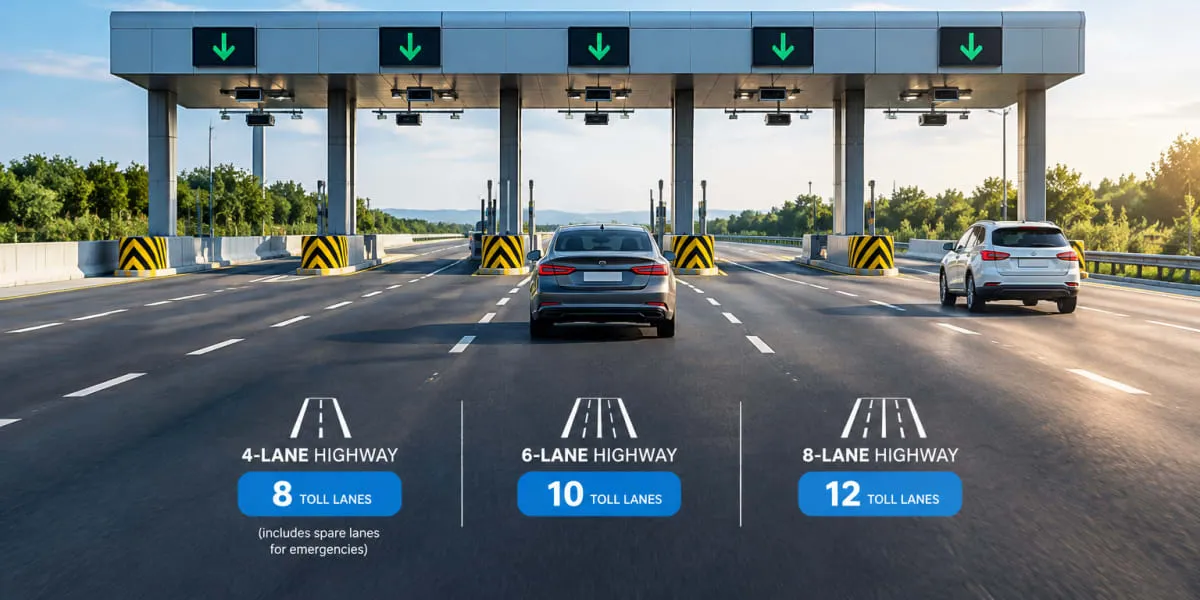
The multi-lane free flow (MLFF), or barrier-less tolling system, will reduce the number of lanes required at toll plazas on newly built and under-construction national highways. Guidelines issued by the National Highway Authority of India (NHAI) have standardised the layout for highways with 4, 6 and 8 lanes.

Under the new arrangement, a 4-lane highway will have eight fee plaza lanes, including spare lanes for emergencies. Highways with 6 and 8 lanes will have 10 and 12 toll lanes respectively. Officials said the system would reduce congestion because vehicles would not need to stop to pay the user fee, removing the need for additional lanes beyond the specified numbers.

The earlier 2021 guidelines required a minimum of six toll lanes for 2-lane highways, eight for 4-lane highways and 12 for 6-lane highways. As a result, Urban Extension Road-II in Delhi, despite being a 4-lane highway, has a toll plaza with more than 20 lanes, while the 8-lane Dwarka Expressway has a 32-lane plaza built under the former boom-barrier system.

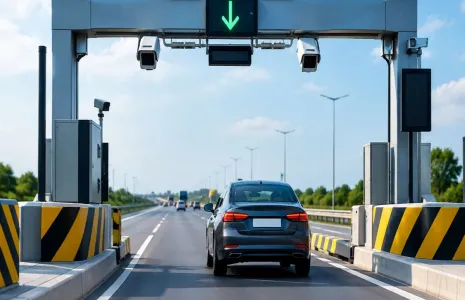
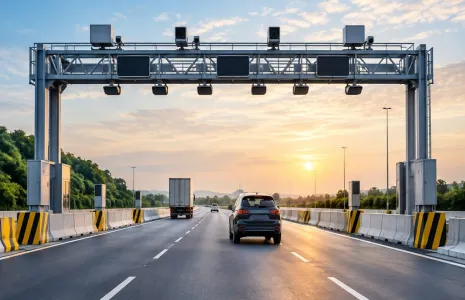
The toll lane at the payment gantry will be 3.5 metres wide to provide lateral clearance for vehicles travelling at free-flow speed and to support reliable data capture. The system will use gantry-mounted radio-frequency identification (RFID) readers, automatic number plate recognition (ANPR) cameras and related equipment to identify moving vehicles and deduct the applicable user fee through FASTag.

Vehicles without a valid and functioning FASTag will generate an electronic notice under Rule 14 of the National Highways Fee (Determination of Rates and Collection) Rules, 2008. A backup gantry will be installed beyond the payment gantry on both sides of the carriageway. Advance signs and high-mast lighting will mark and illuminate the barrier-less plaza, improving night-time safety and supporting ANPR cameras, readers and sensors.

The multi-lane free flow (MLFF), or barrier-less tolling system, will reduce the number of lanes required at toll plazas on newly built and under-construction national highways. Guidelines issued by the National Highway Authority of India (NHAI) have standardised the layout for highways with 4, 6 and 8 lanes. Under the new arrangement, a 4-lane highway will have eight fee plaza lanes, including spare lanes for emergencies. Highways with 6 and 8 lanes will have 10 and 12 toll lanes respectively. Officials said the system would reduce congestion because vehicles would not need to stop to pay the user fee, removing the need for additional lanes beyond the specified numbers. The earlier 2021 guidelines required a minimum of six toll lanes for 2-lane highways, eight for 4-lane highways and 12 for 6-lane highways. As a result, Urban Extension Road-II in Delhi, despite being a 4-lane highway, has a toll plaza with more than 20 lanes, while the 8-lane Dwarka Expressway has a 32-lane plaza built under the former boom-barrier system. The toll lane at the payment gantry will be 3.5 metres wide to provide lateral clearance for vehicles travelling at free-flow speed and to support reliable data capture. The system will use gantry-mounted radio-frequency identification (RFID) readers, automatic number plate recognition (ANPR) cameras and related equipment to identify moving vehicles and deduct the applicable user fee through FASTag. Vehicles without a valid and functioning FASTag will generate an electronic notice under Rule 14 of the National Highways Fee (Determination of Rates and Collection) Rules, 2008. A backup gantry will be installed beyond the payment gantry on both sides of the carriageway. Advance signs and high-mast lighting will mark and illuminate the barrier-less plaza, improving night-time safety and supporting ANPR cameras, readers and sensors.

Related Stories

Gold Stories

Next Story
Infrastructure Urban

Jupiter Wagons Wins Rs. 3.24 bn ACT2 Wagon Orders from Private Firms

Jupiter Wagons has secured private-sector orders worth more than Rs. 3.24 bn from GATX India and Chetak International for its ACT2 automobile carrier wagons. The company announced the orders on 2 November 2026, saying the contracts would strengthen its business with private wagon-leasing and logistics operators. GATX India has issued a Letter of Intent (LOI) for the manufacture and supply of 10 rakes comprising 270 ACT2 wagons. The LOI is valued at Rs. 2.15 bn and covers the production and delivery of the company’s new-design automobile carrier platform. Chetak International has separately p..

Next Story
Infrastructure Urban

Tata Motors Takes Control of Iveco with 89.42 Per Cent Stake

Tata Motors has taken control of Italian commercial-vehicle maker Iveco after acquiring an 89.42 per cent stake for approximately €3.43 bn, or Rs. 363.87 bn. The transaction gives India’s largest commercial-vehicle manufacturer control of a European business with annual revenue of Rs. 1.42 tn, while shifting attention to integration, cash-flow generation and repayment of acquisition debt. TML CV Holdings B.V., Tata Motors’ indirect wholly owned subsidiary, acquired 238.16 mn common shares at €14.40 apiece. The holding represents 89.42 per cent of Iveco’s common share capital, excludi..

Next Story
Building Material

Ambuja Cements to Invest Rs. 145 bn to Raise Capacity by FY30

Ambuja Cements will invest Rs. 145 bn to expand its cement capacity to 155 mn tonnes per annum by fiscal 2030. The planned investment, equivalent to $1.53 bn, will increase production capacity from the company’s current level of 113.5 MTPA. The company expects capacity to reach 119 MTPA by March 2027, with the wider expansion programme adding facilities across several major cement markets. The investment is intended to support the company’s long-term growth and strengthen its manufacturing network in India. The new capacity will be developed across Assam, Bihar, Jharkhand, Gujarat, Maharas..

Advertisement

Subscribe to Our Newsletter

Get daily newsletters around different themes from Construction world.

STAY CONNECTED

Advertisement

SPECIAL OFFER
QR Code