+
Government Approves Renovation of Bascule Bridge at Kolkata Port
ROADS & HIGHWAYS

Government Approves Renovation of Bascule Bridge at Kolkata Port

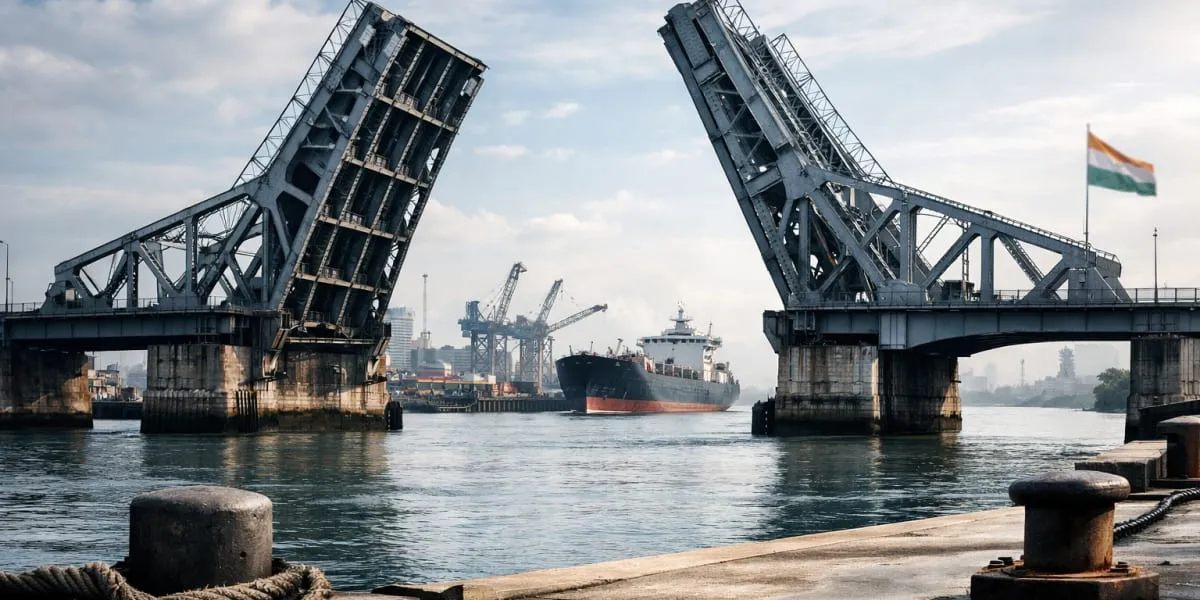
The Ministry of Ports, Shipping and Waterways (the ministry) has approved the renovation of the historic bascule bridge at Syama Prasad Mookerjee Port, Kolkata (SPMP, Kolkata) at a cost of Rs1175.4 million (Rs1175.4 mn) to enhance safety and operational efficiency at the Kolkata Dock System. The Union minister for ports, shipping and waterways gave assent to the proposal and indicated that the work aligns with a policy of preserving heritage while advancing modern infrastructure to ensure safer and faster port operations.

The project will modernise the nearly six-decade-old double-leaf bascule bridge originally built by Wagner-Biro Bridge Systems AG and will include comprehensive structural strengthening together with electro-mechanical upgrades to improve reliability and operational safety. Officials described the work as a combination of conservation and technical enhancement aimed at extending the useful life of the structure while reducing the likelihood of operational disruptions. The scheme is intended to support day to day movement of vessels and road traffic within the port precinct.

The proposal was appraised by the Delegated Investment Board (DIB) chaired by the Secretary, Ministry of Ports, Shipping and Waterways, during a meeting held on 16 February 2026 and received endorsement for implementation. Financial assistance of around Rs410 million (Rs410 mn) will be provided under the Sagarmala Programme, the Government of India’s flagship initiative for port led development. The project will be implemented by Rail Vikas Nigam Limited (RVNL) and the contract for works has been awarded to the Mumbai based firm H & H Fressinet.

Once completed, the upgraded bridge is expected to facilitate safer, faster and more efficient movement of cargo and vehicles within the port premises, thereby strengthening logistics operations at one of India’s oldest and busiest ports. The modernisation is also intended to preserve a key piece of maritime heritage while equipping the crossing with contemporary engineering systems to support growing trade volumes. Officials said the combination of conservation and technical upgrade will bolster resilience of port infrastructure.

The Ministry of Ports, Shipping and Waterways (the ministry) has approved the renovation of the historic bascule bridge at Syama Prasad Mookerjee Port, Kolkata (SPMP, Kolkata) at a cost of Rs1175.4 million (Rs1175.4 mn) to enhance safety and operational efficiency at the Kolkata Dock System. The Union minister for ports, shipping and waterways gave assent to the proposal and indicated that the work aligns with a policy of preserving heritage while advancing modern infrastructure to ensure safer and faster port operations. The project will modernise the nearly six-decade-old double-leaf bascule bridge originally built by Wagner-Biro Bridge Systems AG and will include comprehensive structural strengthening together with electro-mechanical upgrades to improve reliability and operational safety. Officials described the work as a combination of conservation and technical enhancement aimed at extending the useful life of the structure while reducing the likelihood of operational disruptions. The scheme is intended to support day to day movement of vessels and road traffic within the port precinct. The proposal was appraised by the Delegated Investment Board (DIB) chaired by the Secretary, Ministry of Ports, Shipping and Waterways, during a meeting held on 16 February 2026 and received endorsement for implementation. Financial assistance of around Rs410 million (Rs410 mn) will be provided under the Sagarmala Programme, the Government of India’s flagship initiative for port led development. The project will be implemented by Rail Vikas Nigam Limited (RVNL) and the contract for works has been awarded to the Mumbai based firm H & H Fressinet. Once completed, the upgraded bridge is expected to facilitate safer, faster and more efficient movement of cargo and vehicles within the port premises, thereby strengthening logistics operations at one of India’s oldest and busiest ports. The modernisation is also intended to preserve a key piece of maritime heritage while equipping the crossing with contemporary engineering systems to support growing trade volumes. Officials said the combination of conservation and technical upgrade will bolster resilience of port infrastructure.

Next Story
Infrastructure Urban

Implementation Status of Jal Jeevan Mission

Since August 2019 the Government has implemented Jal Jeevan Mission to provide assured potable water through household tap connections in rural India. At the start of the mission only 32.3 million (mn) rural households, representing 16.7 per cent, were reported to have tap water connections. States and union territories have reported that 125.8 mn additional rural households have since been provided with tap connections. As a result, of about 193.6 mn rural households roughly 158.2 mn, or 81.71 per cent, are reported to have tap water supply at home.\n\nThe State, district and village level st..

Next Story
Infrastructure Urban

Jal Jeevan Mission Reaches Eighty One Per Cent Rural Coverage

The Government reported substantial progress under the Jal Jeevan Mission, launched in August 2019 to provide tap water to every rural household. At launch only 32.3 million (mn) rural households had tap connections and states and Union territories reported provision of 125.8 mn additional households by March 2026. Consequently, out of about 193.6 mn rural households around 158.2 mn, or 81.71 per cent, are reported to have tap water at home. The Finance Minister announced extension of the mission until 2028 in the 2025-26 budget speech. The Swachh Bharat Mission Grameen, launched in October 20..

Next Story
Infrastructure Urban

Empowering Local Governance for Sustainable Rural Water Supply

The Ministry of Jal Shakti has aligned the Jal Jeevan Mission (JJM) with the 73rd Amendment to strengthen village level planning and community ownership of water supply. Gram Panchayats, village water and sanitation committees and Pani Samitis are to plan, implement, manage and maintain piped water systems, with gram sabha processes formalising handover and oversight. Implementation support agencies including non government organisations, community based organisations and self help groups have been empanelled to train local committees and promote women participation. Under JJM, the department ..

Advertisement

Subscribe to Our Newsletter

Get daily newsletters around different themes from Construction world.

STAY CONNECTED

Advertisement

Advertisement

Advertisement