+
NHAI Sees Strong Bids for Four-Laning of NH-56 Sections
ROADS & HIGHWAYS

NHAI Sees Strong Bids for Four-Laning of NH-56 Sections

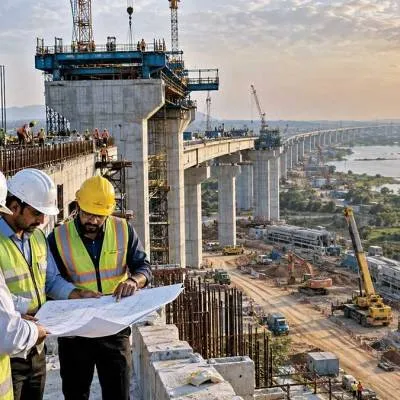
NHAI received an overwhelming response from bidders for four-laning of the 47.46 km Dhamasiya–Bitada/Movi section and the 60.21 km Nasarpore–Malotha section of NH-56 in Gujarat, to be implemented on Hybrid Annuity Model. The Cabinet Committee on Economic Affairs, chaired by the Prime Minister, approved the project in February 2026 with a total length of 107.6 km and a capital cost of Rs 45,836 million (mn). Bids were invited and the Dhamasiya–Bitada/Movi section drew six bids while the Nasarpore–Malotha section drew seven, reflecting robust competition. The contract award is expected in the current financial year.

The projects will be designed for 100 km/h and to enable an average speed of 70 km/h, which is expected to reduce travel time by forty per cent from two point five to one point five hours. Once completed, the works will provide continuous four-lane connectivity from Bodeli to Malotha, easing congestion on NH-56 and improving linkages to NH-53, NH-48 and the Delhi–Mumbai Expressway. The improvements are intended to strengthen regional connectivity and support economic growth along the corridor.

With a total length of 107.6 km, the projects are expected to generate about 1.938 mn man-days of direct employment and 2.282 mn man-days of indirect employment, and to induce further job opportunities through increased economic activity in adjacent areas. The alignment passes through the Aspirational District of Narmada and will improve access to tribal areas in Dahod, Chhota Udepur, Tapi and Bharuch, supporting local development. The works are also anticipated to boost tourism by improving access to the Statue of Unity near Kevadia village, located about 11 km from NH-56.

Implementation on the Hybrid Annuity Model aims to balance risk and financing between the authority and developers and to attract continued interest from national highway contractors. Environmental and social safeguards along the corridor will be addressed during detailed design and construction phases to mitigate impacts and ensure sustainable outcomes. The authority intends to finalise contractual arrangements and commence preparatory works following award.

NHAI received an overwhelming response from bidders for four-laning of the 47.46 km Dhamasiya–Bitada/Movi section and the 60.21 km Nasarpore–Malotha section of NH-56 in Gujarat, to be implemented on Hybrid Annuity Model. The Cabinet Committee on Economic Affairs, chaired by the Prime Minister, approved the project in February 2026 with a total length of 107.6 km and a capital cost of Rs 45,836 million (mn). Bids were invited and the Dhamasiya–Bitada/Movi section drew six bids while the Nasarpore–Malotha section drew seven, reflecting robust competition. The contract award is expected in the current financial year. The projects will be designed for 100 km/h and to enable an average speed of 70 km/h, which is expected to reduce travel time by forty per cent from two point five to one point five hours. Once completed, the works will provide continuous four-lane connectivity from Bodeli to Malotha, easing congestion on NH-56 and improving linkages to NH-53, NH-48 and the Delhi–Mumbai Expressway. The improvements are intended to strengthen regional connectivity and support economic growth along the corridor. With a total length of 107.6 km, the projects are expected to generate about 1.938 mn man-days of direct employment and 2.282 mn man-days of indirect employment, and to induce further job opportunities through increased economic activity in adjacent areas. The alignment passes through the Aspirational District of Narmada and will improve access to tribal areas in Dahod, Chhota Udepur, Tapi and Bharuch, supporting local development. The works are also anticipated to boost tourism by improving access to the Statue of Unity near Kevadia village, located about 11 km from NH-56. Implementation on the Hybrid Annuity Model aims to balance risk and financing between the authority and developers and to attract continued interest from national highway contractors. Environmental and social safeguards along the corridor will be addressed during detailed design and construction phases to mitigate impacts and ensure sustainable outcomes. The authority intends to finalise contractual arrangements and commence preparatory works following award.

Next Story
Infrastructure Urban

Implementation Status of Jal Jeevan Mission

Since August 2019 the Government has implemented Jal Jeevan Mission to provide assured potable water through household tap connections in rural India. At the start of the mission only 32.3 million (mn) rural households, representing 16.7 per cent, were reported to have tap water connections. States and union territories have reported that 125.8 mn additional rural households have since been provided with tap connections. As a result, of about 193.6 mn rural households roughly 158.2 mn, or 81.71 per cent, are reported to have tap water supply at home.\n\nThe State, district and village level st..

Next Story
Infrastructure Urban

Jal Jeevan Mission Reaches Eighty One Per Cent Rural Coverage

The Government reported substantial progress under the Jal Jeevan Mission, launched in August 2019 to provide tap water to every rural household. At launch only 32.3 million (mn) rural households had tap connections and states and Union territories reported provision of 125.8 mn additional households by March 2026. Consequently, out of about 193.6 mn rural households around 158.2 mn, or 81.71 per cent, are reported to have tap water at home. The Finance Minister announced extension of the mission until 2028 in the 2025-26 budget speech. The Swachh Bharat Mission Grameen, launched in October 20..

Next Story
Infrastructure Urban

Empowering Local Governance for Sustainable Rural Water Supply

The Ministry of Jal Shakti has aligned the Jal Jeevan Mission (JJM) with the 73rd Amendment to strengthen village level planning and community ownership of water supply. Gram Panchayats, village water and sanitation committees and Pani Samitis are to plan, implement, manage and maintain piped water systems, with gram sabha processes formalising handover and oversight. Implementation support agencies including non government organisations, community based organisations and self help groups have been empanelled to train local committees and promote women participation. Under JJM, the department ..

Advertisement

Subscribe to Our Newsletter

Get daily newsletters around different themes from Construction world.

STAY CONNECTED

Advertisement

Advertisement

Advertisement