NHAI To Deploy Smart Survey Vehicles Across 23 States
ROADS & HIGHWAYS

NHAI To Deploy Smart Survey Vehicles Across 23 States

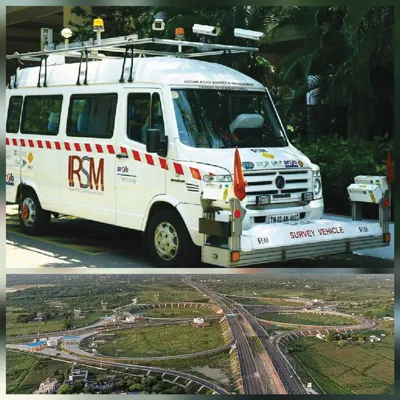
To enhance the riding experience for commuters on National Highways, the National Highways Authority of India (NHAI) will deploy Network Survey Vehicles (NSVs) across 23 states, covering 20,933 kilometres. The initiative aims to collect, process, and analyse road inventory and pavement condition data for improved maintenance and safety.

The deployment of NSVs will enable NHAI to gather essential data on road inventory and pavement conditions, including details of surface cracking, potholes, and patches. Insights from these surveys will help identify deficiencies in road quality, prompting timely corrective measures to improve the overall upkeep of National Highways.

The data collected through NSV surveys will be uploaded to NHAI’s AI-based platform, Data Lake, where a team of experts will analyse it to generate actionable insights. In line with Government of India guidelines, this data will be stored in the Road Asset Management System for future technical reference and infrastructure planning.

The pavement condition surveys will be conducted using 3D laser-based NSV systems equipped with advanced technologies such as high-resolution 360-degree cameras, Differential Global Positioning Systems (DGPS), Inertial Measurement Units (IMU), and Distance Measuring Indicators (DMI). These systems automatically detect and report road defects without human intervention, supported by sophisticated data acquisition and processing software for precise measurement.

Data will be collected for all projects involving 2-, 4-, 6-, and 8-lane highways before the commencement of work and subsequently at six-month intervals. To operationalise the initiative, NHAI has invited bids from qualified companies for the supply and deployment of NSVs.

The Network Survey Vehicle system serves as a specialised infrastructure management tool designed to collect detailed information about the condition and inventory of National Highways. This data supports informed decision-making in pavement maintenance, asset management, and infrastructure planning, thereby improving the safety, efficiency, and quality of India’s National Highway network.

To enhance the riding experience for commuters on National Highways, the National Highways Authority of India (NHAI) will deploy Network Survey Vehicles (NSVs) across 23 states, covering 20,933 kilometres. The initiative aims to collect, process, and analyse road inventory and pavement condition data for improved maintenance and safety. The deployment of NSVs will enable NHAI to gather essential data on road inventory and pavement conditions, including details of surface cracking, potholes, and patches. Insights from these surveys will help identify deficiencies in road quality, prompting timely corrective measures to improve the overall upkeep of National Highways. The data collected through NSV surveys will be uploaded to NHAI’s AI-based platform, Data Lake, where a team of experts will analyse it to generate actionable insights. In line with Government of India guidelines, this data will be stored in the Road Asset Management System for future technical reference and infrastructure planning. The pavement condition surveys will be conducted using 3D laser-based NSV systems equipped with advanced technologies such as high-resolution 360-degree cameras, Differential Global Positioning Systems (DGPS), Inertial Measurement Units (IMU), and Distance Measuring Indicators (DMI). These systems automatically detect and report road defects without human intervention, supported by sophisticated data acquisition and processing software for precise measurement. Data will be collected for all projects involving 2-, 4-, 6-, and 8-lane highways before the commencement of work and subsequently at six-month intervals. To operationalise the initiative, NHAI has invited bids from qualified companies for the supply and deployment of NSVs. The Network Survey Vehicle system serves as a specialised infrastructure management tool designed to collect detailed information about the condition and inventory of National Highways. This data supports informed decision-making in pavement maintenance, asset management, and infrastructure planning, thereby improving the safety, efficiency, and quality of India’s National Highway network.

Next Story
Infrastructure Urban

Mount Expands Tumkur Facility with New Automated Panel, PEB Lines

Mount Roofing & Structures Private Limited, one of India's fastest-growing manufacturers in PUF and a leading solutions provider across pre-engineered building (PEB) and polycarbonate sheets, simultaneously inaugurated its second fully automated continuous sandwich panel manufacturing line and a new PEB manufacturing plant at its integrated campus in Tumkur.The milestone expansion, part of a total investment of Rs 250 crore, marks a significant advancement in the company's commitment to engineered performance, manufacturing scale, and industrial growth. The integrated facility spans approx..

Next Story
Infrastructure Transport

India Becomes First to Produce Bio-Bitumen for Roads

India has become the first country in the world to commercially produce bio-bitumen for use in road construction, according to Road, Transport and Highways Minister Nitin Gadkari. Bitumen, a black and viscous hydrocarbon derived from crude oil, is a key binding material in road building, and the bio-based alternative is expected to significantly improve the sector’s environmental footprint.Addressing the CSIR Technology Transfer Ceremony in New Delhi, Mr Gadkari congratulated Council of Scientific and Industrial Research on achieving the milestone, noting that the initiative would help curb ..

Next Story
Infrastructure Urban

HILT Policy Seen Boosting Telangana Revenue Sharply

The Hyderabad Industrial Land Transformation (HILT) Policy is expected to generate around Rs 1.08 billion in revenue for the Telangana state exchequer, according to Deputy Chief Minister Bhatti Vikramarka Mallu. Speaking in the Telangana Legislative Assembly, he said the policy would be implemented within a six-month timeframe in a transparent manner, with uniform rules applicable to all stakeholders. Mr Vikramarka noted that without the HILT Policy, the state would have earned only about Rs 1.2 million per acre. Under the new framework, however, revenue is projected to rise sharply to Rs 70 ..

Advertisement

Subscribe to Our Newsletter

Get daily newsletters around different themes from Construction world.

STAY CONNECTED

Advertisement

Advertisement

Advertisement

Advertisement

Open In App