Visakhapatnam Port Rs 3,348.9 mn Flyover To Bypass Nine Rail Crossings
ROADS & HIGHWAYS

Visakhapatnam Port Rs 3,348.9 mn Flyover To Bypass Nine Rail Crossings

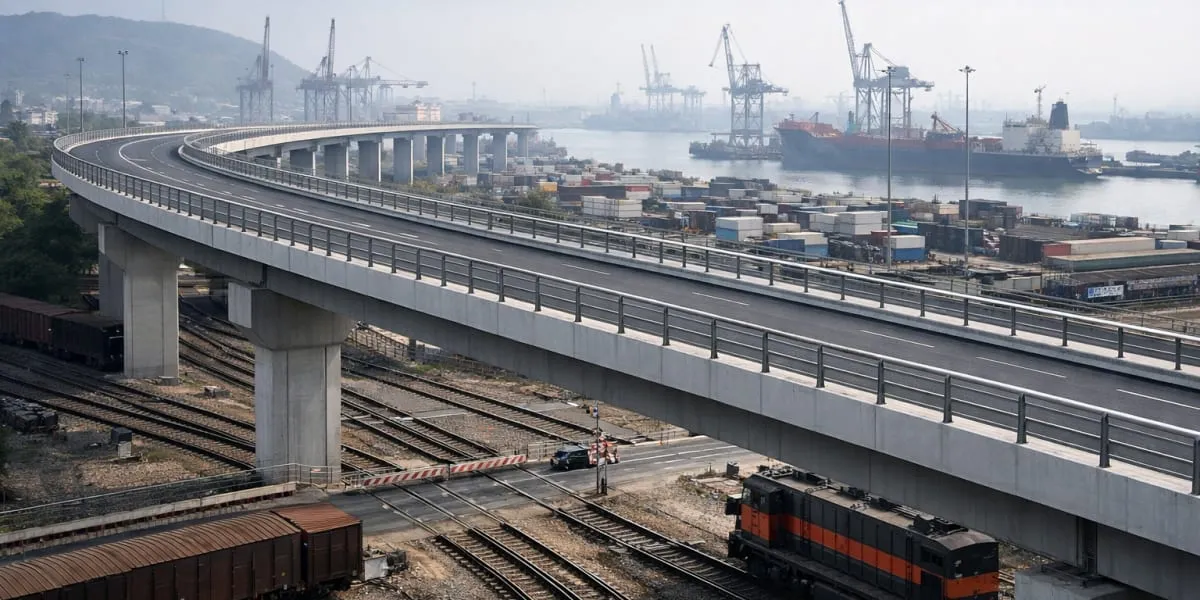
The Ministry of Ports, Shipping and Waterways (MoPSW) has approved an elevated corridor at Visakhapatnam Port to ease internal cargo movement. The project is estimated at Rs 3,348.9 million (mn) and will link Convent Junction with the Dock Area over a stretch of 3,584 metres. The corridor has been designed to carry road traffic above existing rail lines and to address recurring delays caused by level crossings. Construction is scheduled to be completed within 30 months of commencement.

At present road traffic within the port must pass through nine railway level crossings, and gates are closed around 18 times a day because of train movements, forcing vehicles to wait before continuing to different sections. These repeated stoppages increase journey time and fuel consumption for cargo vehicles and complicate internal evacuation schedules. The elevated route aims to create a more direct link for heavy vehicles.

The proposed flyover will allow vehicles to bypass the railway crossings and reduce the need to halt at gates along the route. Separation of road and rail movements is expected to improve the flow of trains as well as road traffic in shared areas. For port operators, the upgrade should make internal cargo movement more predictable.

Fewer stoppages could translate into lower vehicle operating costs and better utilisation of the port road network, supporting faster turnaround for cargo evacuation. The corridor forms part of an internal connectivity upgrade intended to remove a major road–rail bottleneck within the port. Authorities have set the project timeline but have not provided a detailed schedule of construction phases.

Once completed the elevated link is expected to provide a faster connection between Convent Junction and the Dock Area and to reduce the impact of railway gate closures on cargo traffic. The approval by the ministry follows assessments of delay causes and internal transport needs at the port. Stakeholders will monitor progress as the scheme moves towards execution.

The Ministry of Ports, Shipping and Waterways (MoPSW) has approved an elevated corridor at Visakhapatnam Port to ease internal cargo movement. The project is estimated at Rs 3,348.9 million (mn) and will link Convent Junction with the Dock Area over a stretch of 3,584 metres. The corridor has been designed to carry road traffic above existing rail lines and to address recurring delays caused by level crossings. Construction is scheduled to be completed within 30 months of commencement. At present road traffic within the port must pass through nine railway level crossings, and gates are closed around 18 times a day because of train movements, forcing vehicles to wait before continuing to different sections. These repeated stoppages increase journey time and fuel consumption for cargo vehicles and complicate internal evacuation schedules. The elevated route aims to create a more direct link for heavy vehicles. The proposed flyover will allow vehicles to bypass the railway crossings and reduce the need to halt at gates along the route. Separation of road and rail movements is expected to improve the flow of trains as well as road traffic in shared areas. For port operators, the upgrade should make internal cargo movement more predictable. Fewer stoppages could translate into lower vehicle operating costs and better utilisation of the port road network, supporting faster turnaround for cargo evacuation. The corridor forms part of an internal connectivity upgrade intended to remove a major road–rail bottleneck within the port. Authorities have set the project timeline but have not provided a detailed schedule of construction phases. Once completed the elevated link is expected to provide a faster connection between Convent Junction and the Dock Area and to reduce the impact of railway gate closures on cargo traffic. The approval by the ministry follows assessments of delay causes and internal transport needs at the port. Stakeholders will monitor progress as the scheme moves towards execution.

Related Stories

Gold Stories

Next Story
Real Estate

WSB Real Estate Partners Exits Six Housing Investments

WSB Real Estate Partners recently announced the successful exit of six residential investments across Bengaluru, Mumbai Metropolitan Region (MMR) and National Capital Region (NCR), delivering an average internal rate of return (IRR) of 19–21 per cent and an overall investment return of 1.4 times.The real estate-focused investment firm invested approximately Rs 7 billion across six mid-affordable housing projects over the past four years. All six investments were fully repaid between April and November 2026, several months ahead of their original investment tenures.WSB collaborated with sever..

Next Story
Infrastructure Transport

Aluminium Industry Seeks Policy Support for Rs 4 Trillion Investment

The Aluminium Association of India (AAI) has recently urged the government to introduce supportive policy measures to safeguard the sector’s proposed Rs 4 trillion investment pipeline. The association highlighted the need for a predictable policy framework to strengthen domestic manufacturing, expand production capacity and reduce import dependence.AAI submitted its recommendations for the Union Budget 2027-28 to the Ministries of Finance, Commerce and Industry, and Mines, along with the Department for Promotion of Industry and Internal Trade (DPIIT).India’s aluminium demand is projected t..

Next Story
Technology

ABB Unveils Intelligent Motor to Accelerate Industrial AI Adoption

ABB recently launched Intelleqt, which it describes as the world’s first low-voltage motor with factory-integrated intelligence, at the SPS trade fair in Germany. Designed to deliver real-time operational insights from its first rotation, the motor enables industrial operators to integrate equipment-level data into existing digital platforms while retaining full ownership of their data.The launch addresses growing challenges in scaling artificial intelligence (AI) across industrial operations, particularly data quality and availability. According to Deloitte, while 84 per cent of manufacture..

Subscribe to Our Newsletter

Get daily newsletters around different themes from Construction world.

STAY CONNECTED

Advertisement

SPECIAL OFFER
QR Code