Indian Railways hits record 1512 MT freight loading in FY 2022-23
RAILWAYS & METRO RAIL

Indian Railways hits record 1512 MT freight loading in FY 2022-23

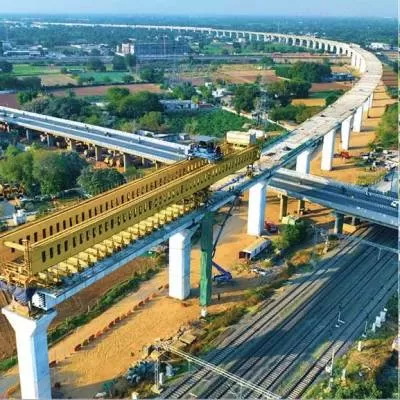
The Indian Railways marked a significant accomplishment by attaining the highest-ever freight loading in history. This stands as one of the most notable achievements for the national transporter since gaining independence. In the fiscal year 2022-23, a freight loading of 1512 Metric Tonnes (MT) was recorded, showcasing an incremental increase of 94 MT from the previous fiscal year, FY 2021-22, during which the railways achieved a freight loading of 1418 MT.

A retrospective examination of freight loading over the past six financial years reveals a consistent upward trajectory. In FY 2017-18, the national transporter achieved a freight loading of 1161 MT, followed by 1223 MT in FY 2018-19, 1210 MT in FY 2019-20, 1233 MT in FY 2020-21, 1418 MT in FY 2021-22, and culminating in the highest recorded figure of 1512 MT in the preceding fiscal year. Consequently, the railways experienced a growth streak spanning 31 consecutive months of the best-ever monthly freight loading, a trend that commenced in September 2020.

The exceptional performance in freight loading can be attributed to various factors. Notably, one key factor was the sustained efforts of Indian Railways in the supply of coal to powerhouses throughout the country. This endeavour was carried out in close coordination with the Ministry of Power and Coal. In the last financial year, the loading of coal exhibited a substantial growth of 84 MT compared to FY 2021-22.

The Indian Railways marked a significant accomplishment by attaining the highest-ever freight loading in history. This stands as one of the most notable achievements for the national transporter since gaining independence. In the fiscal year 2022-23, a freight loading of 1512 Metric Tonnes (MT) was recorded, showcasing an incremental increase of 94 MT from the previous fiscal year, FY 2021-22, during which the railways achieved a freight loading of 1418 MT. A retrospective examination of freight loading over the past six financial years reveals a consistent upward trajectory. In FY 2017-18, the national transporter achieved a freight loading of 1161 MT, followed by 1223 MT in FY 2018-19, 1210 MT in FY 2019-20, 1233 MT in FY 2020-21, 1418 MT in FY 2021-22, and culminating in the highest recorded figure of 1512 MT in the preceding fiscal year. Consequently, the railways experienced a growth streak spanning 31 consecutive months of the best-ever monthly freight loading, a trend that commenced in September 2020. The exceptional performance in freight loading can be attributed to various factors. Notably, one key factor was the sustained efforts of Indian Railways in the supply of coal to powerhouses throughout the country. This endeavour was carried out in close coordination with the Ministry of Power and Coal. In the last financial year, the loading of coal exhibited a substantial growth of 84 MT compared to FY 2021-22.

Related Stories

Gold Stories

Next Story
Infrastructure Urban

KONE Opens India's First Digital Experience Centre in Pune

KONE, a global elevator and escalator manufacturer, has inaugurated its first Digital Experience Centre (DEC) in India, located in Pune. The facility aims to showcase how artificial intelligence (AI), connectivity and data-driven technologies can enhance customer experiences and improve building operations.The centre was inaugurated by Jussi Herlin, Executive Vice Chair, KONE Corporation; Philippe Delorme, President and CEO, KONE; and Nandan Nilekani, Co-founder and Chairman of the Board, Infosys.Designed as an interactive customer environment, the facility demonstrates digital solutions cover..

Next Story
Infrastructure Urban

CII GreenCo Launches Circularity Guidelines for Indian Industry

The Confederation of Indian Industry (CII) GreenCo Council has launched the CII GreenCo Circularity Guidelines – Pilot Version at the 17th CII GreenCo Waste & Resource Management Summit 2026 in Chennai. The initiative aims to strengthen resource efficiency, waste reduction and circular economy practices across Indian manufacturing and process industries.The guidelines introduce a structured framework with circularity indices covering raw materials, consumables, packaging and other resource inputs. These indicators will help industries assess existing practices, identify opportunities to ..

Next Story
Infrastructure Energy

Global Electronics Association Launches IPC-1783-CO2E Standard

The Global Electronics Association has introduced IPC-1783-CO2E, a new international standard aimed at improving consistency, transparency and comparability in product carbon footprint reporting across the electronics manufacturing industry.The standard, titled International Standard for Data Collection and Reporting of CO2 Equivalent (CO2e) Emissions for the Electronics Manufacturing Supply Chain, provides industry-specific guidance for collecting, estimating and reporting carbon emissions data.With increasing regulatory requirements and customer expectations, electronics manufacturers face c..

Advertisement

Subscribe to Our Newsletter

Get daily newsletters around different themes from Construction world.

STAY CONNECTED

Advertisement

SPECIAL OFFER
QR Code