





DAC Approves Rs. 2.12 tn Defence Procurement Package
DEFENSE

DAC Approves Rs. 2.12 tn Defence Procurement Package

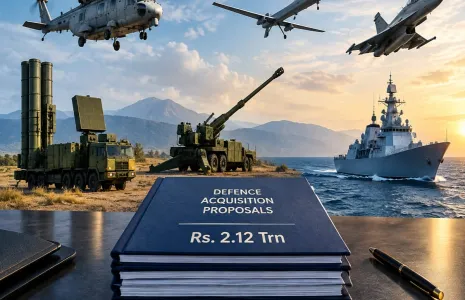
On 26 October 2026, the Defence Acquisition Council (DAC), chaired by Defence Minister Rajnath Singh, approved Acceptance of Necessity (AoN) for capital acquisition proposals valued at approximately Rs. 2.12 tn for the Indian Armed Forces. About 82 per cent of the proposed procurement value is earmarked for sourcing from Indian industry. AoN is an in-principle clearance and does not represent a signed contract or confirmation that equipment has been delivered.

The DAC is the Ministry of Defence’s highest decision-making body for capital acquisitions. Its approval allows proposals to move to subsequent stages of the defence procurement process, while contract awards and deliveries require further action. The package covers platforms, weapons and surveillance systems for the Indian Army, Indian Navy and Indian Air Force.

Army approvals include High Mobility Vehicles, Self-Propelled Tracked Gun Systems, Gun Shot Response Systems, Very Short-Range Air Defence Systems, counter-unmanned aerial systems, surveillance unmanned aerial vehicles and long-range kamikaze drones. The Gun Shot Response System is designed to detect and locate hostile gunfire, while the air-defence and counter-drone systems are intended to address aerial threats.

The Indian Navy received AoN for Active Offboard Decoy Systems, which create false targets to counter anti-ship missile threats, along with other major naval platforms. Air Force proposals include Special Utility Helicopters, air-defence systems, weapons and Mobile X-Band Doppler Weather Radar Systems for localised weather surveillance.

The package also includes nearly 200 Light Multi-Role Helicopters for the Army and Air Force, with an estimated proposal value of Rs. 200 bn. The helicopters will support reconnaissance, surveillance, combat, search and rescue, and humanitarian assistance missions. Production is mandated in India, and the aircraft are intended to partly replace ageing Cheetah and Chetak fleets. The domestic sourcing requirement supports the Aatmanirbhar Bharat objective and covers land, maritime and air capabilities across the three services.

On 26 October 2026, the Defence Acquisition Council (DAC), chaired by Defence Minister Rajnath Singh, approved Acceptance of Necessity (AoN) for capital acquisition proposals valued at approximately Rs. 2.12 tn for the Indian Armed Forces. About 82 per cent of the proposed procurement value is earmarked for sourcing from Indian industry. AoN is an in-principle clearance and does not represent a signed contract or confirmation that equipment has been delivered. The DAC is the Ministry of Defence’s highest decision-making body for capital acquisitions. Its approval allows proposals to move to subsequent stages of the defence procurement process, while contract awards and deliveries require further action. The package covers platforms, weapons and surveillance systems for the Indian Army, Indian Navy and Indian Air Force. Army approvals include High Mobility Vehicles, Self-Propelled Tracked Gun Systems, Gun Shot Response Systems, Very Short-Range Air Defence Systems, counter-unmanned aerial systems, surveillance unmanned aerial vehicles and long-range kamikaze drones. The Gun Shot Response System is designed to detect and locate hostile gunfire, while the air-defence and counter-drone systems are intended to address aerial threats. The Indian Navy received AoN for Active Offboard Decoy Systems, which create false targets to counter anti-ship missile threats, along with other major naval platforms. Air Force proposals include Special Utility Helicopters, air-defence systems, weapons and Mobile X-Band Doppler Weather Radar Systems for localised weather surveillance. The package also includes nearly 200 Light Multi-Role Helicopters for the Army and Air Force, with an estimated proposal value of Rs. 200 bn. The helicopters will support reconnaissance, surveillance, combat, search and rescue, and humanitarian assistance missions. Production is mandated in India, and the aircraft are intended to partly replace ageing Cheetah and Chetak fleets. The domestic sourcing requirement supports the Aatmanirbhar Bharat objective and covers land, maritime and air capabilities across the three services.

Related Stories

Next Story
Building Material

PureSil Paints Develops Mineral Coatings from Industrial Waste

PureSil Paints, a brand of Relic Coatings LLP, has developed an indigenous mineral-based coating technology aimed at reducing dependence on petrochemical-derived raw materials in the paints and coatings industry. Its proprietary Silicification Technology uses agricultural and industrial by-products to manufacture architectural coatings as an alternative to conventional acrylic paints.Developed in-house by Dr Nikhil Dhote, Founder and Chief Technologist, Relic Coatings LLP, the technology uses silicate binders derived from upcycled rice husk ash and industrial coal fly ash. The formulation is d..
Next Story
Infrastructure Energy

Vedanta Eyes AI to Accelerate Mineral Exploration

Vedanta Group is exploring the use of artificial intelligence (AI) to significantly improve efficiency in mineral exploration, geological analysis and resource modelling. The company aims to reduce exploration processes that traditionally take three to four months to just six to seven days through AI-driven technologies.The proposed approach involves AI-led geological analysis and mineral block modelling to accelerate mineral resource assessment and support faster, more cost-efficient development of domestic mineral reserves. The initiative aligns with India's growing focus on critical mineral..

Next Story
Technology

NXP Launches Unified Robotics Platform for Physical AI

NXP Semiconductors has launched a unified robotics platform designed to accelerate the development and deployment of trusted physical artificial intelligence (AI) systems. Built on the company's neural axis architecture, the platform integrates AI processing, connectivity, motor control, security and energy management within a common hardware and software ecosystem.The platform combines an open-source, modular software development kit (SDK) with pre-validated reference designs, enabling developers to build robotic systems more efficiently. It supports development ranging from individual subsys..

Advertisement

Subscribe to Our Newsletter

Get daily newsletters around different themes from Construction world.

STAY CONNECTED

Advertisement

SPECIAL OFFER
QR Code