Chhattisgarh Reports Over 88,000 Completed Works Under JSJB 2.0
WATER & WASTE

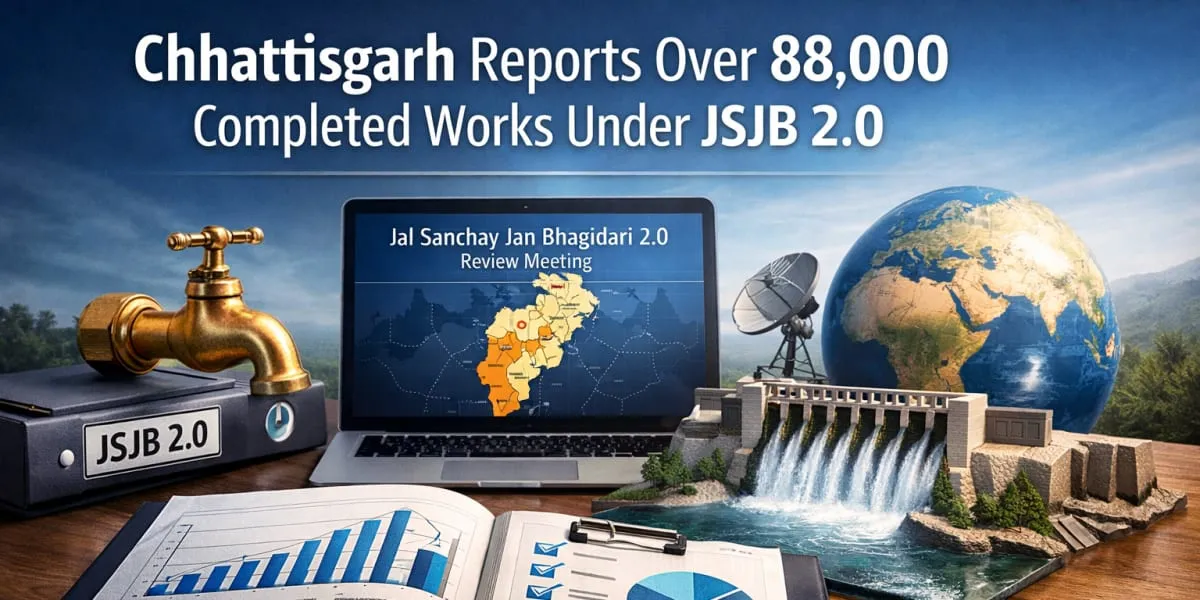
Chhattisgarh Reports Over 88,000 Completed Works Under JSJB 2.0

The Union Minister of Jal Shakti, C. R. Patil, and the Chief Minister of Chhattisgarh, Vishnu Deo Sai, chaired a review of Jal Sanchay Jan Bhagidari 2.0 with the state’s district collectors. The National Water Mission, Department of Water Resources, River Development and Ganga Rejuvenation, Ministry of Jal Shakti organised the meeting in collaboration with the Government of Chhattisgarh. Senior central and state officials attended and district level implementation plans were discussed.

District collectors from Durg, Bilaspur and Surajpur presented progress, innovative practices and community led conservation initiatives under JSJB 2.0. The presentations highlighted large scale mobilisation, scheme convergence and the focused implementation of low cost groundwater recharge structures. Officials noted increased local ownership and improved operational delivery.

Chhattisgarh secured the second position nationally during JSJB 1.0 by creating more than 0.4 million (mn) recharge structures in a short period and several districts were honoured for their performance. Under JSJB 2.0 the state has reported over 88,000 completed works and more than 42,000 ongoing works, showing sustained momentum. The meeting reviewed district wise data and urged continuation of the gains.

The review examined models such as the CREDAI Raipur low cost recharge scheme with Raipur Municipal Corporation and the Korea district five per cent model where farmers dedicated part of their land for rainwater recharge. Officials said that locally suitable, low cost measures backed by community participation can deliver meaningful groundwater recharge results. The models were recommended for replication.

The Chief Minister reaffirmed the state government’s commitment to intensify water conservation under JSJB 2.0 and to make district performance a benchmark for other states. The Union Minister emphasised the need to create adequate rainwater recharge capacity before the monsoon, urged optimal utilisation of MGNREGA funds before 31 March 2026 and called for focussed action in critical districts with regular monitoring and timely data uploads. Officials were congratulated and urged to accelerate efforts to set new benchmarks.

The Union Minister of Jal Shakti, C. R. Patil, and the Chief Minister of Chhattisgarh, Vishnu Deo Sai, chaired a review of Jal Sanchay Jan Bhagidari 2.0 with the state’s district collectors. The National Water Mission, Department of Water Resources, River Development and Ganga Rejuvenation, Ministry of Jal Shakti organised the meeting in collaboration with the Government of Chhattisgarh. Senior central and state officials attended and district level implementation plans were discussed. District collectors from Durg, Bilaspur and Surajpur presented progress, innovative practices and community led conservation initiatives under JSJB 2.0. The presentations highlighted large scale mobilisation, scheme convergence and the focused implementation of low cost groundwater recharge structures. Officials noted increased local ownership and improved operational delivery. Chhattisgarh secured the second position nationally during JSJB 1.0 by creating more than 0.4 million (mn) recharge structures in a short period and several districts were honoured for their performance. Under JSJB 2.0 the state has reported over 88,000 completed works and more than 42,000 ongoing works, showing sustained momentum. The meeting reviewed district wise data and urged continuation of the gains. The review examined models such as the CREDAI Raipur low cost recharge scheme with Raipur Municipal Corporation and the Korea district five per cent model where farmers dedicated part of their land for rainwater recharge. Officials said that locally suitable, low cost measures backed by community participation can deliver meaningful groundwater recharge results. The models were recommended for replication. The Chief Minister reaffirmed the state government’s commitment to intensify water conservation under JSJB 2.0 and to make district performance a benchmark for other states. The Union Minister emphasised the need to create adequate rainwater recharge capacity before the monsoon, urged optimal utilisation of MGNREGA funds before 31 March 2026 and called for focussed action in critical districts with regular monitoring and timely data uploads. Officials were congratulated and urged to accelerate efforts to set new benchmarks.

Next Story
Infrastructure Transport

Tunnelling Begins for Thane, Borivali twin tunnel project

Tunnelling work has commenced for the 11.84-km Thane–Borivali Twin Tunnel, set to be India’s longest urban road tunnel, marking a key milestone in Mumbai’s infrastructure development.As per a post shared by Mumbai Metropolitan Region Development Authority on social media platform X, the tunnel boring machine (TBM) ‘Nayak’—the country’s largest single-shield hard rock TBM for an urban tunnel—was launched by Devendra Fadnavis on Tuesday. The event was attended by Eknath Shinde and Sunetra Pawar, among other dignitaries. A second TBM, ‘Arjuna’, is expected to be launched so..

Next Story
Infrastructure Transport

Large Format Store Planned At M G Road Metro Station

M G Road station in Bengaluru is set to host the city’s first large-format commercial and experience space, with planning led by Bangalore Metro Rail Corporation Limited. BMRCL has invited proposals to develop and operate a central business district destination at the Purple?Pink Line interchange. The plan positions the station as a commercial hub designed to serve a broad commuter base across the city. The proposal is part of a broader effort to activate transit nodes commercially. Tender documents set a minimum monthly rental of Rs 0.944 million (mn), inclusive of GST, for the large-format..

Next Story
Infrastructure Energy

Government Cancels Auction Of Eleven Critical Mineral Blocks

The government has cancelled the auction of 11 critical and strategic mineral blocks after receiving a poor investor response and failing to attract a sufficient number of qualified bidders. The decision represents a setback to plans to ramp up domestic exploration and production of critical minerals amid global supply chain disruptions and rising demand for materials used in clean energy and advanced technologies. The mines ministry issued an annulment notice setting out the reasons for the cancellations. The annulment notice indicated that the auction process for five mineral blocks was canc..

Advertisement

Subscribe to Our Newsletter

Get daily newsletters around different themes from Construction world.

STAY CONNECTED

Advertisement

Advertisement

Advertisement