




IIT Guwahati Develops Radiation-Resistant Cement Mortar
Cement

IIT Guwahati Develops Radiation-Resistant Cement Mortar

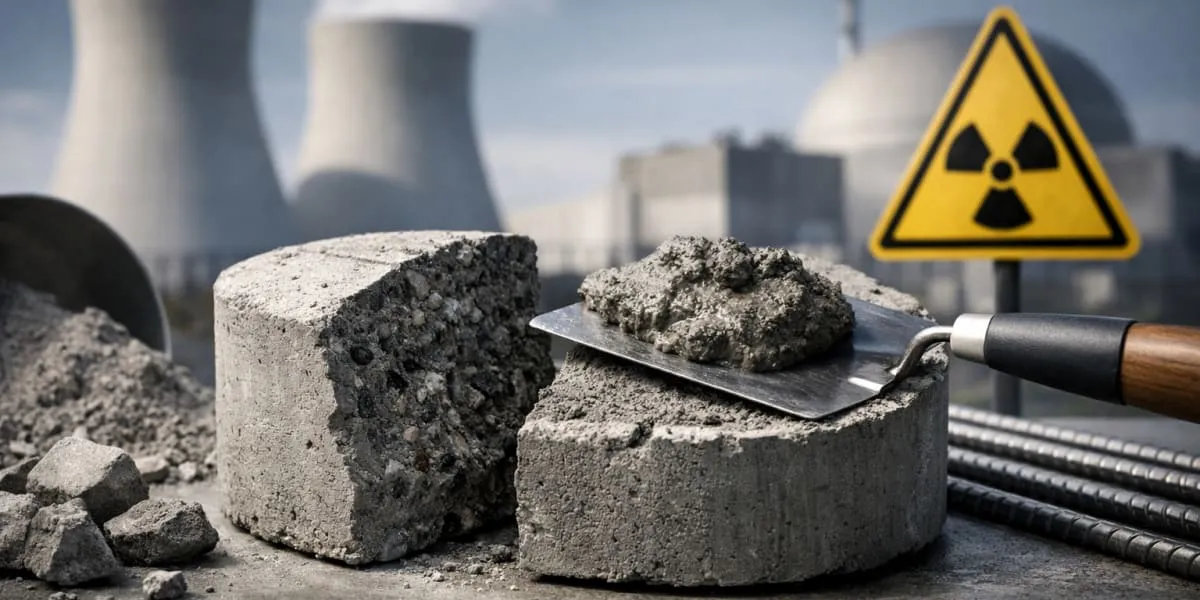
Researchers at the Indian Institute of Technology Guwahati (IIT Guwahati) have developed a cement mortar that is stronger, more durable and more effective at blocking harmful radiation for nuclear facilities. The modified mortar is designed to act as both a structural component and a radiation shielding barrier by increasing density and durability to limit radiation penetration. Concrete made with the enhanced mortar is expected to reduce the risk of radiation leakage and to support protective structures over extended periods.

To achieve this, the team incorporated four types of microparticles into the cement mortar: boron oxide, lead oxide, bismuth oxide and tungsten oxide. These microparticles were added in small quantities to assess their impact on compressive strength after 28 days and on the material's ability to shield mixed radiation fields comprising gamma rays and neutrons. The study reported distinct effects for each microparticle, indicating trade-offs between mechanical strength, workability and radiation attenuation.

Professor Hrishikesh Sharma of the Department of Civil Engineering at IIT Guwahati said the safety of nuclear infrastructure depends on the performance of containment materials under extreme mechanical and radiation environments and that the study showed microparticle modifications can improve structural integrity and shielding. The research offers a framework for developing cement-based materials for nuclear power plants, small modular reactors and medical radiation facilities by enhancing resistance to heat, structural loads and radiation. The study was published in Materials and Structures and was co-authored by Professor Sharma, research scholar Sanchit Saxena and Dr Suman Kumar of CSIR-Central Building Research Institute, Roorkee.

Future work will scale up the developed mortar to a full concrete mix design, conduct structural-level testing of reinforced concrete elements and optimise microparticle dosage to balance mechanical strength, workability, durability and shielding performance. The team is seeking collaborations with nuclear energy agencies, material manufacturers and infrastructure firms for real-world testing and pilot applications. These steps aim to validate performance under simulated field conditions and support safer, more resilient nuclear infrastructure.

Researchers at the Indian Institute of Technology Guwahati (IIT Guwahati) have developed a cement mortar that is stronger, more durable and more effective at blocking harmful radiation for nuclear facilities. The modified mortar is designed to act as both a structural component and a radiation shielding barrier by increasing density and durability to limit radiation penetration. Concrete made with the enhanced mortar is expected to reduce the risk of radiation leakage and to support protective structures over extended periods. To achieve this, the team incorporated four types of microparticles into the cement mortar: boron oxide, lead oxide, bismuth oxide and tungsten oxide. These microparticles were added in small quantities to assess their impact on compressive strength after 28 days and on the material's ability to shield mixed radiation fields comprising gamma rays and neutrons. The study reported distinct effects for each microparticle, indicating trade-offs between mechanical strength, workability and radiation attenuation. Professor Hrishikesh Sharma of the Department of Civil Engineering at IIT Guwahati said the safety of nuclear infrastructure depends on the performance of containment materials under extreme mechanical and radiation environments and that the study showed microparticle modifications can improve structural integrity and shielding. The research offers a framework for developing cement-based materials for nuclear power plants, small modular reactors and medical radiation facilities by enhancing resistance to heat, structural loads and radiation. The study was published in Materials and Structures and was co-authored by Professor Sharma, research scholar Sanchit Saxena and Dr Suman Kumar of CSIR-Central Building Research Institute, Roorkee. Future work will scale up the developed mortar to a full concrete mix design, conduct structural-level testing of reinforced concrete elements and optimise microparticle dosage to balance mechanical strength, workability, durability and shielding performance. The team is seeking collaborations with nuclear energy agencies, material manufacturers and infrastructure firms for real-world testing and pilot applications. These steps aim to validate performance under simulated field conditions and support safer, more resilient nuclear infrastructure.

Next Story
Infrastructure Transport

Noida Emerges as Key Economic Hub: Cushman Report

Cushman & Wakefield’s recent report, Noida Runway for Growth, highlights the city’s emergence as a major economic and real estate hub contributing nearly 10 per cent to Uttar Pradesh’s GSDP. A key driver is the upcoming Noida International Airport, which will be inaugurated by Prime Minister Narendra Modi on March 28 in Gautam Buddha Nagar's Jewar. The project is set to enhance connectivity and reshape the region’s economic and real estate landscape. Noida’s office market has expanded to 43.4 million sq ft, including 26.6 million sq ft of Grade A+ assets, with a 40 per cent..

Next Story
Real Estate

Bent Collective Unveils Sculptural Ravon Chair

Bent Collective has recently introduced the Ravon Chair, a striking design piece that redefines the intersection of art and functionality. Characterised by sharp geometry, bold angles, and a vivid marbled finish, the chair stands out as a sculptural element rather than conventional seating.Designed with a strong architectural language, the Ravon Chair features clean lines and intersecting planes that create a dynamic silhouette. Its distinctive triangular cut-out detail enhances depth and asymmetry, allowing light and shadow to interact across its surface. Finished in a rich red marbled patter..

Next Story
Infrastructure Transport

DP World Opens Golf Clubhouse in Gurugram

DP World has delivered a permanent clubhouse to ZEN Golf Range & Academy in Gurugram, strengthening grassroots golf development in India ahead of the Hero Indian Open. The facility marks the second under its global clubhouse programme, following the first in Cape Town in 2025.Constructed using a repurposed shipping container, the clubhouse provides golf equipment, sheltered training areas, and a dedicated space for young players to build both sporting and life skills. The initiative aligns with DP World’s broader commitment to community development across its global operations.India cont..

Advertisement

Subscribe to Our Newsletter

Get daily newsletters around different themes from Construction world.

STAY CONNECTED

Advertisement

Advertisement

Advertisement