Citi Sees India’s Power Demand Rising Five To Six Per Cent
POWER & RENEWABLE ENERGY

Citi Sees India’s Power Demand Rising Five To Six Per Cent

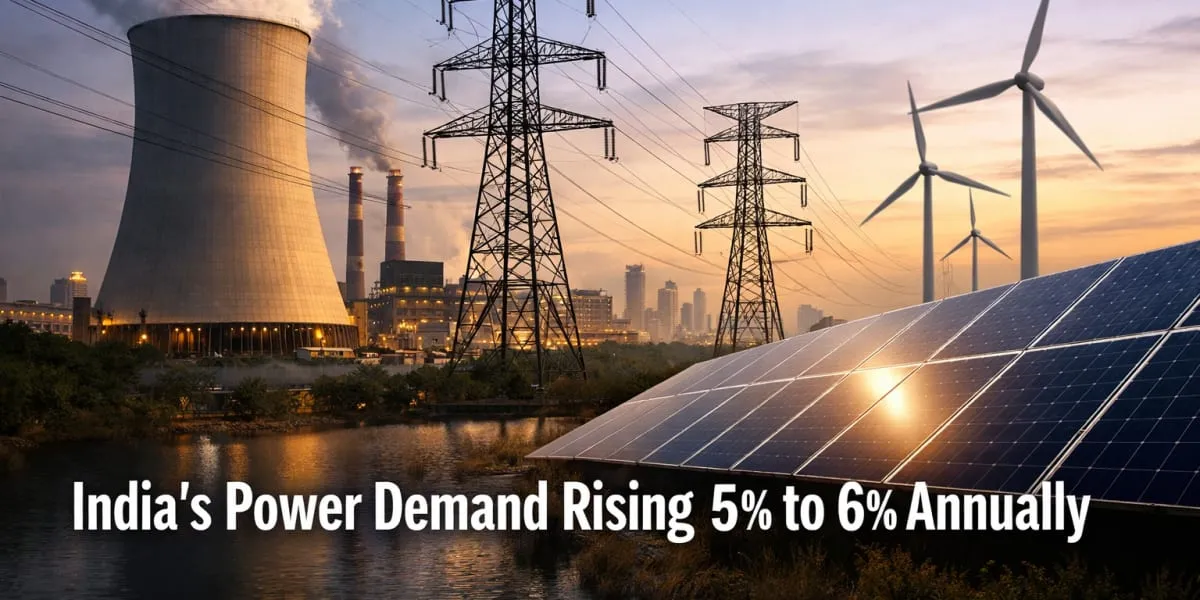
Citi projects India’s power demand will grow five to six per cent annually as the country expands energy infrastructure and industrial activity. The projection reflects rising electricity consumption driven by economic growth, urbanisation and demand from manufacturing, digital infrastructure and transportation. Citi presented the forecast amid ongoing policy and investment efforts to bolster supply across the country.

The bank said the ongoing energy buildout, including renewable energy expansion and grid infrastructure upgrades, is expected to support long-term growth in electricity consumption. Rising use of air conditioning, electric mobility and data centres is contributing to higher demand across regions. Policymakers and utilities are reported to be prioritising generation capacity expansion and transmission strengthening to ensure reliable supply.

India has been increasing renewable capacity while continuing to rely on thermal power to manage baseload requirements, the analysis noted. Investments in battery storage systems, transmission infrastructure and smart grid technologies are gaining momentum as renewable penetration rises. This combination of sources and technologies is central to meeting variable demand patterns.

Industry observers indicated that maintaining reliable supply while integrating large-scale renewables will remain a key sector challenge. Ensuring grid stability and attracting adequate infrastructure investment will be critical as electricity consumption continues to rise. The assessment underlined the need for coordinated planning between regulators, utilities and investors.

The projection highlights the scale of India’s growing energy requirements as the country remains one of the world’s fastest growing major economies. Continued focus on both supply-side capacity and demand-side measures is implied to be necessary to manage the transition. The forecast is likely to shape investment decisions in generation, transmission and storage over the coming years.

"Join industry leaders at RAHSTA Expo, India's premier platform for roads, highways and traffic infrastructure. Register now to explore innovations, network with experts and shape the future of mobility."

Citi projects India’s power demand will grow five to six per cent annually as the country expands energy infrastructure and industrial activity. The projection reflects rising electricity consumption driven by economic growth, urbanisation and demand from manufacturing, digital infrastructure and transportation. Citi presented the forecast amid ongoing policy and investment efforts to bolster supply across the country. The bank said the ongoing energy buildout, including renewable energy expansion and grid infrastructure upgrades, is expected to support long-term growth in electricity consumption. Rising use of air conditioning, electric mobility and data centres is contributing to higher demand across regions. Policymakers and utilities are reported to be prioritising generation capacity expansion and transmission strengthening to ensure reliable supply. India has been increasing renewable capacity while continuing to rely on thermal power to manage baseload requirements, the analysis noted. Investments in battery storage systems, transmission infrastructure and smart grid technologies are gaining momentum as renewable penetration rises. This combination of sources and technologies is central to meeting variable demand patterns. Industry observers indicated that maintaining reliable supply while integrating large-scale renewables will remain a key sector challenge. Ensuring grid stability and attracting adequate infrastructure investment will be critical as electricity consumption continues to rise. The assessment underlined the need for coordinated planning between regulators, utilities and investors. The projection highlights the scale of India’s growing energy requirements as the country remains one of the world’s fastest growing major economies. Continued focus on both supply-side capacity and demand-side measures is implied to be necessary to manage the transition. The forecast is likely to shape investment decisions in generation, transmission and storage over the coming years.

Next Story
Infrastructure Energy

Beyond Backup Power

For decades, diesel gensets occupied a largely functional role in buildings: a mandatory backup system specified to meet statutory requirements and activated only during grid outages. Today, however, this perception is undergoing a profound shift. Across residential, commercial and mission-critical developments, developers, consultants and operators are increasingly viewing gensets as integral to a broader energy resilience strategy. Rising occupant expectations, growing dependence on digital systems and the proliferation of smart technologies mean that uninterrupted power has become essential..

Next Story
Infrastructure Transport

Mumbai-Pune Connecting Link is designed to ensure reliable all-weather, high-speed transport.

Infrastructure connectivity will be one of the keys to achieve Viksit Bharat. And the Mumbai-Pune Connecting Link has been developed as a long-term infrastructure solution for Western India. Dr Anilkumar Gaikwad, Vice Chairman & Managing Director, Maharashtra State Road Development Corporation (MSRDC), a speaker at the RAHSTA Expo 2026, elaborates upon the project and its significance.The Mumbai-Pune Connecting Link has largely been discussed as a travel-time reduction project. From MSRDC’s perspective, what larger infrastructure and mobility problem was this project actually designed to..

Next Story
Infrastructure Transport

Noida International Airport

Noida International Airport (NIA) is not just another capacity addition to India’s aviation map. It is a test case in whether India can build airport infrastructure that is scalable from Day 1, operationally efficient at launch, and resilient enough to grow without the familiar pain points of brownfield expansion.Its significance lies not merely in the first phase but in the way the airport has been planned for its fourth. Scheduled to begin commercial operations on 15 June 2026, NIA’s first phase comprises one runway and one passenger terminal designed to handle 12 million passengers annu..

Advertisement

Subscribe to Our Newsletter

Get daily newsletters around different themes from Construction world.

STAY CONNECTED

Advertisement

Advertisement

Advertisement