Maharashtra Clears Surbana Jurong For Mumbai Three Point Zero Plan
ECONOMY & POLICY

Maharashtra Clears Surbana Jurong For Mumbai Three Point Zero Plan

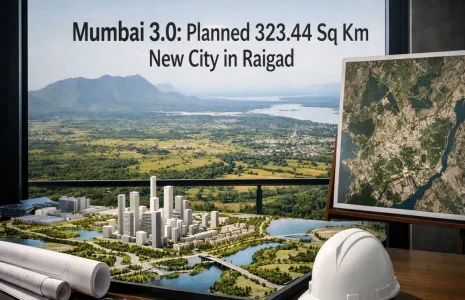
Maharashtra in June 2026 approved the appointment of Surbana Jurong as consultant to prepare the master plan for the proposed Karnala?Sai?Chirner New Town, known as KSC New Town or Mumbai three point zero, and authorised the Mumbai Metropolitan Region Development Authority (MMRDA) to proceed on a government to government basis. The Singapore government planning agency will undertake the assignment and the state cleared a work order of Rs 118.9 million (mn) for phase one, with in principle approval for phase two estimated at Rs 231.2 mn subject to prior consent.

The approval follows a memorandum of understanding signed by MMRDA and Surbana Jurong at Davos in January 2026 under the MMR Growth Hub initiative. KSC New Town is among the key development centres identified under the framework and the order directs MMRDA to execute separate agreements with the consultant for both phases and to complete necessary legal and technical procedures. The order requires submission of a phase one completion report and a completion certificate before phase two proceeds.

The master plan will set out development strategies, land use planning, infrastructure requirements and a long term vision for the township, covering transport networks, public utilities and urban design. The planning exercise is expected to lay the foundation for long term development of the region and to guide future investment and land use decisions within the Mumbai Metropolitan Region (MMR). The state clarified that the entire expenditure for both phases will be borne by MMRDA from its own funds and that no financial assistance will be provided by the state.

The appointment on a government to government basis reflects an intent to leverage international expertise in urban planning for rapid urbanisation challenges. MMRDA will be required to submit progress reports and secure fresh consent from the state before advancing to subsequent work, and the authority has been directed to follow prescribed approval protocols. The announcement underscores an acceleration of planning for new urban centres aimed at supporting future population growth, economic activity and infrastructure expansion across the MMR.

Maharashtra in June 2026 approved the appointment of Surbana Jurong as consultant to prepare the master plan for the proposed Karnala?Sai?Chirner New Town, known as KSC New Town or Mumbai three point zero, and authorised the Mumbai Metropolitan Region Development Authority (MMRDA) to proceed on a government to government basis. The Singapore government planning agency will undertake the assignment and the state cleared a work order of Rs 118.9 million (mn) for phase one, with in principle approval for phase two estimated at Rs 231.2 mn subject to prior consent. The approval follows a memorandum of understanding signed by MMRDA and Surbana Jurong at Davos in January 2026 under the MMR Growth Hub initiative. KSC New Town is among the key development centres identified under the framework and the order directs MMRDA to execute separate agreements with the consultant for both phases and to complete necessary legal and technical procedures. The order requires submission of a phase one completion report and a completion certificate before phase two proceeds. The master plan will set out development strategies, land use planning, infrastructure requirements and a long term vision for the township, covering transport networks, public utilities and urban design. The planning exercise is expected to lay the foundation for long term development of the region and to guide future investment and land use decisions within the Mumbai Metropolitan Region (MMR). The state clarified that the entire expenditure for both phases will be borne by MMRDA from its own funds and that no financial assistance will be provided by the state. The appointment on a government to government basis reflects an intent to leverage international expertise in urban planning for rapid urbanisation challenges. MMRDA will be required to submit progress reports and secure fresh consent from the state before advancing to subsequent work, and the authority has been directed to follow prescribed approval protocols. The announcement underscores an acceleration of planning for new urban centres aimed at supporting future population growth, economic activity and infrastructure expansion across the MMR.

Next Story
Real Estate

AI: The New Recruit

From getting ideas to evaluating designs, presenting concepts to clients and tracking projects, artificial intelligence (AI) is helping architects work better and faster.“AI allows architects to spend more time doing what only they can do: think critically, synthesise complexity and design with intent,” says Dikshu C Kukreja, Managing Principal, CP Kukreja Architects. “Every minute reclaimed from repetitive processes can be invested in creativity, contextual understanding, interdisciplinary collaboration and innovation – the qualities that define meaningful architecture.”To read the ..

Next Story
Real Estate

Redevelopment 2.0

In 2017, Mumbai identified 160,000 ageing buildings due for structural audit. Close to half of these were in the Western Suburbs. Redeveloping the oldest and structurally weakest of these would help unlock new housing, much needed given the city’s growing population density and constant developed area of 437.7 sq km. At 30,600 people per sq km in 2024, Mumbai’s density was almost thrice that of Gurugram, and 60 per cent higher than Bengaluru’s.Essentially, Mumbai’s realty market has demand. It has capital. It has realty development potential.Fast forward to 2026. Mumbai has 1,094 regis..

Next Story
Technology

Cost intelligence will become a strategic contributor to project success

As India's construction industry accelerates its digital transformation, integrated platforms, AI and connected data are becoming essential to improving cost certainty, project efficiency and sustainability. Ravi Kumar, Sales Director – India, RIB Software India, shares how digital workflows are reshaping project planning, commercial management and decision-making across the construction value chain.India's construction sector is embracing digital technologies at an unprecedented pace. From your perspective, what are the biggest shifts driving this transformation and how is RIB Software enab..

Advertisement

Subscribe to Our Newsletter

Get daily newsletters around different themes from Construction world.

STAY CONNECTED

Advertisement

Advertisement

Advertisement