


India And United States Advance Interim Trade Talks
ECONOMY & POLICY

India And United States Advance Interim Trade Talks

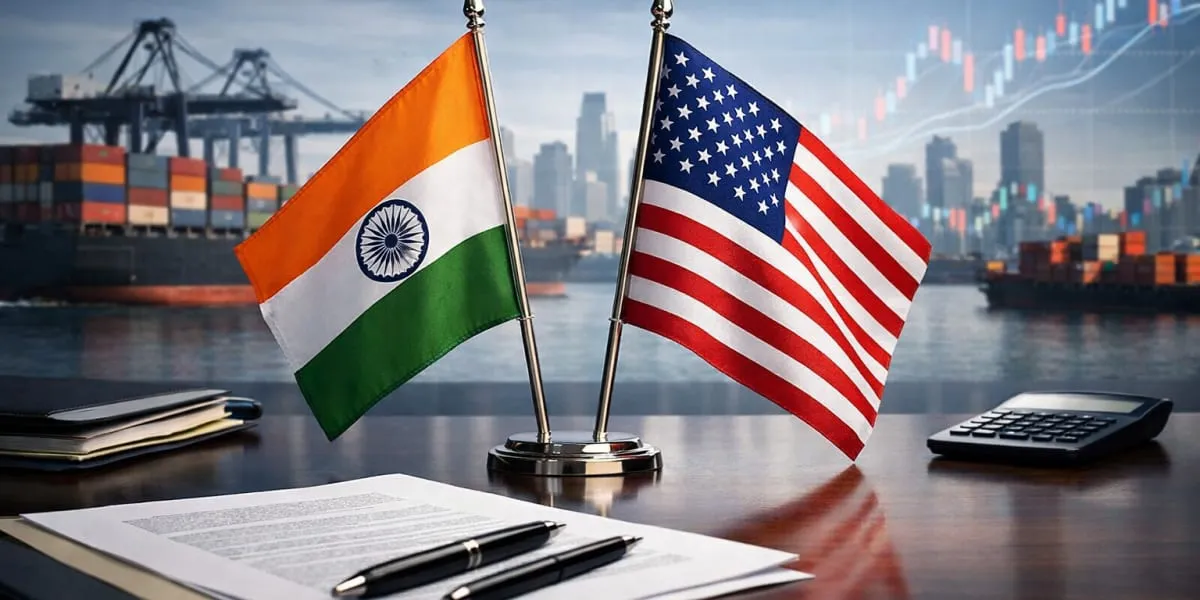
India and the United States issued a joint statement on the seventh of February 2026 setting out a framework for an interim agreement on reciprocal and mutually beneficial trade, and reaffirming their commitment to the broader India-United States Bilateral Trade Agreement negotiations. The framework was described as a roadmap to address immediate trade barriers while preserving progress on the wider pact. The interim arrangement aims to create more predictable conditions for traders while preserving momentum on the comprehensive negotiations.

A delegation from the Office of the United States Trade Representative (USTR), led by the chief negotiator, visited India from the first to the fourth of June 2026 to advance those discussions. Indian negotiators and the USTR team engaged in a series of meetings in New Delhi to review technical and policy positions and to identify areas of convergence. Discussions included exchange of technical papers and bilateral consultations aimed at narrowing differences on specific provisions.

The delegations held constructive and positive discussions across a wide range of issues covering trade in goods, non-tariff measures, customs and trade facilitation, economic security alignment and other areas of mutual interest. The talks were conducted in a spirit of cooperation and pragmatism with an emphasis on translating the framework into implementable measures and timelines. Participants explored practical steps to harmonise standards, enhance transparency in regulatory measures and streamline documentation processes.

Both sides reaffirmed their commitment to concluding a mutually beneficial agreement that strengthens bilateral trade and economic ties and to sustaining an intensive dialogue to resolve outstanding matters. Officials indicated that the recent engagements would inform subsequent negotiating rounds under the Bilateral Trade Agreement process and that technical working groups would continue to refine modalities and implementation plans. Both sides agreed on the need for regular information exchange and for coordinating timelines to bring the interim measures into effect.

India and the United States issued a joint statement on the seventh of February 2026 setting out a framework for an interim agreement on reciprocal and mutually beneficial trade, and reaffirming their commitment to the broader India-United States Bilateral Trade Agreement negotiations. The framework was described as a roadmap to address immediate trade barriers while preserving progress on the wider pact. The interim arrangement aims to create more predictable conditions for traders while preserving momentum on the comprehensive negotiations. A delegation from the Office of the United States Trade Representative (USTR), led by the chief negotiator, visited India from the first to the fourth of June 2026 to advance those discussions. Indian negotiators and the USTR team engaged in a series of meetings in New Delhi to review technical and policy positions and to identify areas of convergence. Discussions included exchange of technical papers and bilateral consultations aimed at narrowing differences on specific provisions. The delegations held constructive and positive discussions across a wide range of issues covering trade in goods, non-tariff measures, customs and trade facilitation, economic security alignment and other areas of mutual interest. The talks were conducted in a spirit of cooperation and pragmatism with an emphasis on translating the framework into implementable measures and timelines. Participants explored practical steps to harmonise standards, enhance transparency in regulatory measures and streamline documentation processes. Both sides reaffirmed their commitment to concluding a mutually beneficial agreement that strengthens bilateral trade and economic ties and to sustaining an intensive dialogue to resolve outstanding matters. Officials indicated that the recent engagements would inform subsequent negotiating rounds under the Bilateral Trade Agreement process and that technical working groups would continue to refine modalities and implementation plans. Both sides agreed on the need for regular information exchange and for coordinating timelines to bring the interim measures into effect.

Next Story
Real Estate

AI: The New Recruit

From getting ideas to evaluating designs, presenting concepts to clients and tracking projects, artificial intelligence (AI) is helping architects work better and faster.“AI allows architects to spend more time doing what only they can do: think critically, synthesise complexity and design with intent,” says Dikshu C Kukreja, Managing Principal, CP Kukreja Architects. “Every minute reclaimed from repetitive processes can be invested in creativity, contextual understanding, interdisciplinary collaboration and innovation – the qualities that define meaningful architecture.”To read the ..

Next Story
Real Estate

Redevelopment 2.0

In 2017, Mumbai identified 160,000 ageing buildings due for structural audit. Close to half of these were in the Western Suburbs. Redeveloping the oldest and structurally weakest of these would help unlock new housing, much needed given the city’s growing population density and constant developed area of 437.7 sq km. At 30,600 people per sq km in 2024, Mumbai’s density was almost thrice that of Gurugram, and 60 per cent higher than Bengaluru’s.Essentially, Mumbai’s realty market has demand. It has capital. It has realty development potential.Fast forward to 2026. Mumbai has 1,094 regis..

Next Story
Technology

Cost intelligence will become a strategic contributor to project success

As India's construction industry accelerates its digital transformation, integrated platforms, AI and connected data are becoming essential to improving cost certainty, project efficiency and sustainability. Ravi Kumar, Sales Director – India, RIB Software India, shares how digital workflows are reshaping project planning, commercial management and decision-making across the construction value chain.India's construction sector is embracing digital technologies at an unprecedented pace. From your perspective, what are the biggest shifts driving this transformation and how is RIB Software enab..

Advertisement

Subscribe to Our Newsletter

Get daily newsletters around different themes from Construction world.

STAY CONNECTED

Advertisement

Advertisement

Advertisement