GE Vernova To Supply Pumped Storage Units In India
POWER & RENEWABLE ENERGY

GE Vernova To Supply Pumped Storage Units In India

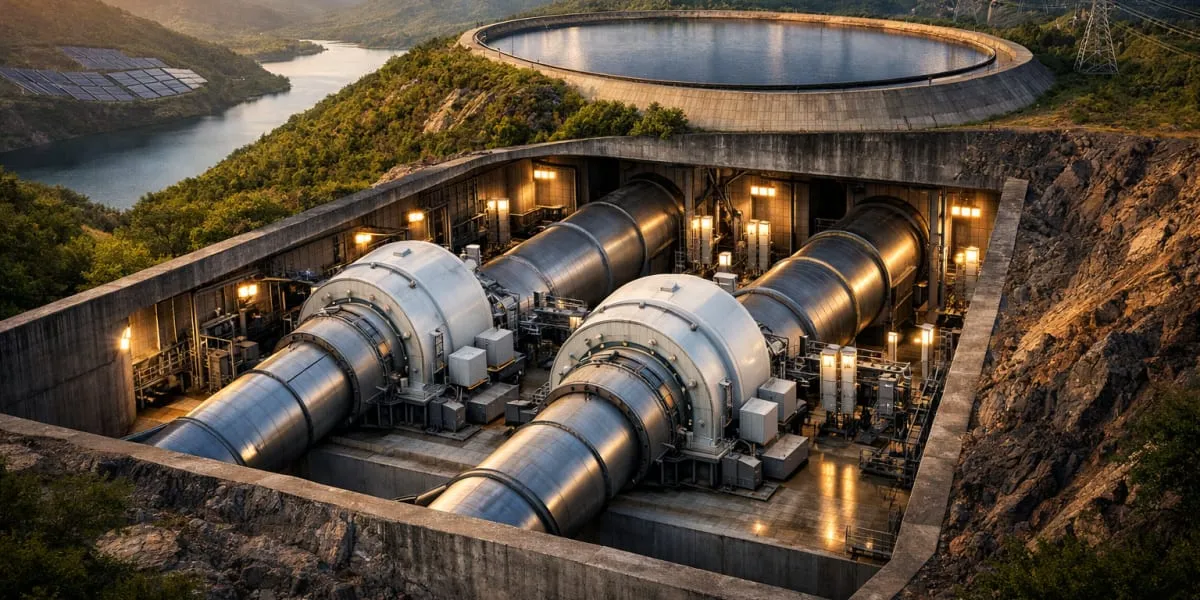
GE Vernova (GEV) will supply pumped storage units for projects in India, marking a move by the global energy equipment and services firm into the country's long duration storage sector. The announcement said the units are intended to support grid flexibility as India increases variable renewable generation. GEV will provide technology, engineering support and coordination with local partners. The initiative reflects increased interest in long duration solutions among policymakers and investors.

Pumped storage hydro stores energy by moving water between two reservoirs at different elevations, using excess generation during low demand to pump water to the upper reservoir and releasing it at peak times to generate electricity. The units provide inertia, frequency regulation and rapid dispatch, services that are increasingly valuable as renewable output rises. Such systems are known for long duration storage capability and relatively long operational lifetimes. Operators value their durability and low lifecycle costs relative to alternatives.

The company will work with Indian utilities, developers and contractors to integrate the units into existing and planned hydropower schemes, while seeking local supply chain participation and site specific engineering. Manufacturing and installation arrangements will depend on project scale and local regulatory approvals, the company indicated, and operations support will be tailored to grid operator needs. This approach aims to combine global technology with local execution capacity. Local skills development and training will be encouraged.

India is expanding storage options to meet peak demand and renewable targets, and pumped storage is positioned alongside batteries and other technologies as a bulk storage solution. The supply commitment from GEV signals ongoing private sector engagement in national decarbonisation and energy security efforts. Project timelines and definitive contract details were not specified, and the company said it will coordinate with stakeholders as projects progress. Stakeholders will assess site suitability, environmental impacts and grid integration requirements.

GE Vernova (GEV) will supply pumped storage units for projects in India, marking a move by the global energy equipment and services firm into the country's long duration storage sector. The announcement said the units are intended to support grid flexibility as India increases variable renewable generation. GEV will provide technology, engineering support and coordination with local partners. The initiative reflects increased interest in long duration solutions among policymakers and investors. Pumped storage hydro stores energy by moving water between two reservoirs at different elevations, using excess generation during low demand to pump water to the upper reservoir and releasing it at peak times to generate electricity. The units provide inertia, frequency regulation and rapid dispatch, services that are increasingly valuable as renewable output rises. Such systems are known for long duration storage capability and relatively long operational lifetimes. Operators value their durability and low lifecycle costs relative to alternatives. The company will work with Indian utilities, developers and contractors to integrate the units into existing and planned hydropower schemes, while seeking local supply chain participation and site specific engineering. Manufacturing and installation arrangements will depend on project scale and local regulatory approvals, the company indicated, and operations support will be tailored to grid operator needs. This approach aims to combine global technology with local execution capacity. Local skills development and training will be encouraged. India is expanding storage options to meet peak demand and renewable targets, and pumped storage is positioned alongside batteries and other technologies as a bulk storage solution. The supply commitment from GEV signals ongoing private sector engagement in national decarbonisation and energy security efforts. Project timelines and definitive contract details were not specified, and the company said it will coordinate with stakeholders as projects progress. Stakeholders will assess site suitability, environmental impacts and grid integration requirements.

Next Story
Infrastructure Urban

Cabinet Approves Mission For Cotton Productivity

The Union Cabinet has approved Rs 56.59 billion (bn) for the Mission for Cotton Productivity covering the period 2026–27 to 2030–31, with the objective of addressing bottlenecks, reversing declining growth and improving quality in India’s cotton sector. The initiative aligns with the Government of India’s five F vision from farm to foreign and is intended to raise the competitiveness of the textile sector in global markets through coordinated action across ministries and research bodies. The mission will support the development of high-yielding variety (HYV) seeds that are climate resi..

Next Story
Infrastructure Transport

Cabinet Approves Three Rail Multitracking Projects

The Cabinet Committee on Economic Affairs, chaired by the Prime Minister, approved three multitracking projects for the Ministry of Railways at a total cost of Rs 234.37 billion (bn). The projects are Nagda–Mathura third and fourth line, Guntakal–Wadi third and fourth line, and Burhwal–Sitapur third and fourth line. The investment is intended to increase line capacity and improve operational efficiency and service reliability for Indian Railways. The schemes cover 19 districts across Madhya Pradesh, Rajasthan, Uttar Pradesh, Karnataka, Andhra Pradesh and Telangana and will increase the e..

Next Story
Infrastructure Transport

Cabinet Approves Ship Repair Facility At Vadinar

The Cabinet Committee on Economic Affairs has approved the development of a state of the art ship repair facility at Vadinar in Gujarat, to be jointly implemented by Deendayal Port Authority (DPA) and Cochin Shipyard Limited (CSL). The project carries a combined investment of Rs 15.7 billion (Rs 15.7 bn). It is planned as a brownfield facility with a 650 metres jetty, two large floating dry docks, workshops and associated marine infrastructure. Vadinar has a natural deep draft and direct connectivity to major shipping routes and its proximity to ports such as Mundra and Kandla makes it favoura..

Advertisement

Subscribe to Our Newsletter

Get daily newsletters around different themes from Construction world.

STAY CONNECTED

Advertisement

Advertisement

Advertisement