+
Gujarat Notifies 2026 Grid Code for Renewable Integration
POWER & RENEWABLE ENERGY

Gujarat Notifies 2026 Grid Code for Renewable Integration

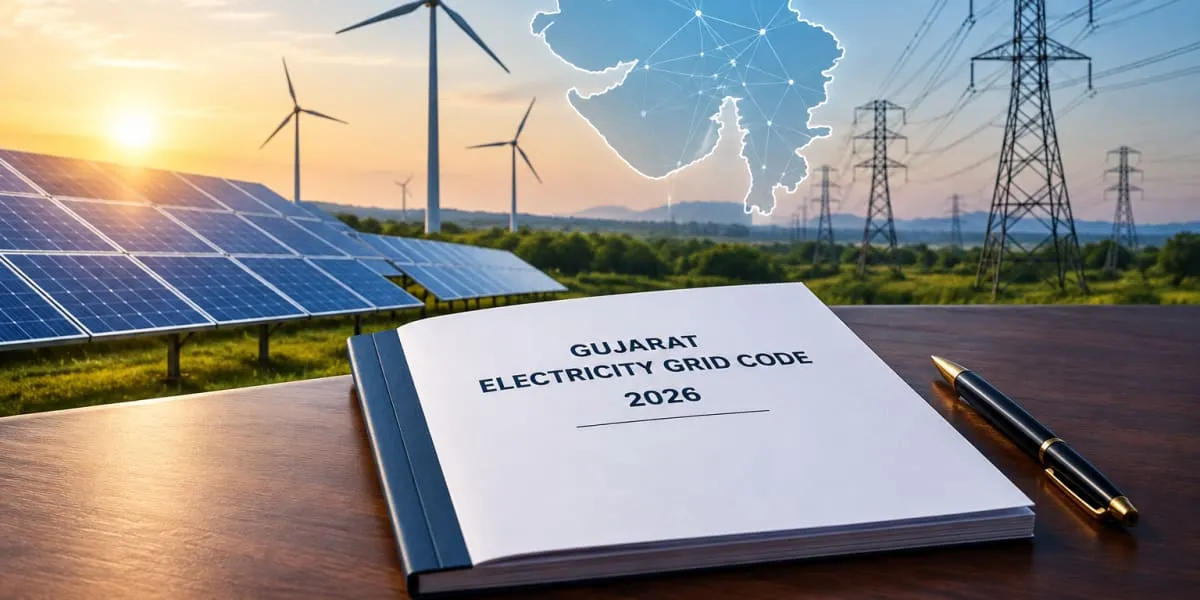
The Gujarat Electricity Regulatory Commission (GERC) has notified the Gujarat Electricity Grid Code, 2026, through Notification No. 09 of 2026. The framework covers the operation, planning, scheduling and development of Gujarat’s intra-state power grid, replacing the code notified on July 16, 2013. It came into force on publication in the Official Gazette.

Issued under the Electricity Act, 2003, and the Gujarat Electricity Industry (Reorganisation and Regulation) Act, 2003, the code applies to entities operating within Gujarat’s intra-state electricity network. Inter-state transmission systems will continue to be governed by the Indian Electricity Grid Code issued by the Central Electricity Regulatory Commission.

Gujarat Energy Transmission Corporation (GETCO) will continue as the State Transmission Utility, responsible for transmission planning, coordination, open access and infrastructure development. The State Load Despatch Centre (SLDC) remains the apex body for real-time monitoring, scheduling, dispatch, system control and energy accounting, with operational authority over connected generating and distribution entities. Regional Sub-SLDCs will support its functions.

The regulations establish the State Operation Coordination Committee for system planning and outage coordination, and the State Level Protection Co-ordination Committee for protection systems and related operational requirements. A Resource Planning Code requires 10-year rolling plans for transmission development, integrated resource planning and demand forecasting across multiple time horizons.

The Connection Code sets technical requirements for network interfaces, telemetry, communications, protection equipment and cybersecurity. Separate provisions cover solar, wind, wind-solar hybrid, standalone Energy Storage Systems (ESS) and Pumped Storage Plants (PSPs), including testing, trial runs and Commercial Operation Date requirements.

To improve flexibility, thermal power plants must operate at minimum turndown levels of up to 55 per cent of Maximum Continuous Rating, with compensation for part-load operation. Scheduling and dispatch will use 15-minute blocks for long-term, medium-term, short-term and real-time transactions. Frequency must remain between 49.900 Hz and 50.050 Hz, supported by primary, secondary and tertiary reserves. Deviations and reactive power exchanges will be settled through state pool accounts, while persistent non-compliance could lead to disconnection and legal penalties.

The Gujarat Electricity Regulatory Commission (GERC) has notified the Gujarat Electricity Grid Code, 2026, through Notification No. 09 of 2026. The framework covers the operation, planning, scheduling and development of Gujarat’s intra-state power grid, replacing the code notified on July 16, 2013. It came into force on publication in the Official Gazette. Issued under the Electricity Act, 2003, and the Gujarat Electricity Industry (Reorganisation and Regulation) Act, 2003, the code applies to entities operating within Gujarat’s intra-state electricity network. Inter-state transmission systems will continue to be governed by the Indian Electricity Grid Code issued by the Central Electricity Regulatory Commission. Gujarat Energy Transmission Corporation (GETCO) will continue as the State Transmission Utility, responsible for transmission planning, coordination, open access and infrastructure development. The State Load Despatch Centre (SLDC) remains the apex body for real-time monitoring, scheduling, dispatch, system control and energy accounting, with operational authority over connected generating and distribution entities. Regional Sub-SLDCs will support its functions. The regulations establish the State Operation Coordination Committee for system planning and outage coordination, and the State Level Protection Co-ordination Committee for protection systems and related operational requirements. A Resource Planning Code requires 10-year rolling plans for transmission development, integrated resource planning and demand forecasting across multiple time horizons. The Connection Code sets technical requirements for network interfaces, telemetry, communications, protection equipment and cybersecurity. Separate provisions cover solar, wind, wind-solar hybrid, standalone Energy Storage Systems (ESS) and Pumped Storage Plants (PSPs), including testing, trial runs and Commercial Operation Date requirements. To improve flexibility, thermal power plants must operate at minimum turndown levels of up to 55 per cent of Maximum Continuous Rating, with compensation for part-load operation. Scheduling and dispatch will use 15-minute blocks for long-term, medium-term, short-term and real-time transactions. Frequency must remain between 49.900 Hz and 50.050 Hz, supported by primary, secondary and tertiary reserves. Deviations and reactive power exchanges will be settled through state pool accounts, while persistent non-compliance could lead to disconnection and legal penalties.

Related Stories

Gold Stories

Next Story
Infrastructure Energy

KPIL announces new business wins worth Rs 22.25 bn

Kalpataru Projects International (KPIL) has secured new orders and a letter of comfort worth approximately Rs 20.31 billion in its power transmission and distribution (T&D) business across India and international markets. Additionally, its Swedish subsidiary, Linjemontage i Grästorp AB, has received an order worth approximately Rs 1.94 billion (SEK 200 million), taking the combined order value to Rs 22.25 billion.Commenting on the order wins, Manish Mohnot, Managing Director and CEO, KPIL, said the new orders reflect customer confidence in the company's execution capabilities and technical ex..

Next Story
Infrastructure Transport

Tiruchi Airport Handles over 20 t of Domestic Cargo in a Month

Tiruchi International Airport has handled more than 20 t of inbound and outbound domestic cargo since the facility was launched in late August. Outbound shipments have exceeded inbound volumes, with private carriers transporting goods to Chennai, Delhi, Bengaluru and Mumbai. The domestic cargo service began after the Bureau of Civil Aviation Security (BCAS), an independent department under the Ministry of Civil Aviation, granted clearance. The facility was introduced to give local businesses a faster route for sending goods to major domestic hubs, reducing their reliance on cargo routed throug..

Next Story
Infrastructure Urban

Gabriel India Forms Joint Venture with Forvia for Advanced Seating

Gabriel India, part of the US$2.6 bn Anand Group, has formed a joint venture with France-based Forvia to bring advanced seating systems and technologies to the Indian automotive market. The partnership expands Gabriel India’s participation in vehicle systems as automotive architectures become more sophisticated and customer requirements evolve. The joint venture, named Faurecia Anand Seating India, combines Forvia’s global seating technology expertise with Gabriel India’s manufacturing capabilities, customer relationships and understanding of the Indian automotive market. Forvia will hol..

Advertisement

Subscribe to Our Newsletter

Get daily newsletters around different themes from Construction world.

STAY CONNECTED

Advertisement

SPECIAL OFFER
QR Code