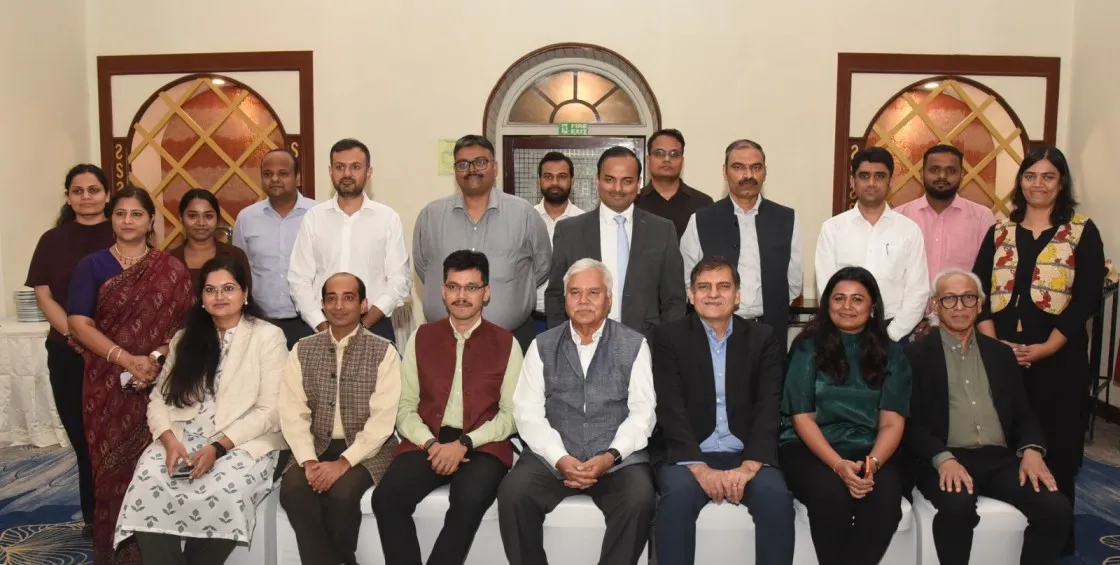
India Energy Stack Taskforce reviews roadmap for national rollout
POWER & RENEWABLE ENERGY

India Energy Stack Taskforce reviews roadmap for national rollout

The India Energy Stack (IES) Taskforce has reviewed its Final Report, outlining the strategy, architecture, governance framework and roadmap for scaling the initiative as a digital public infrastructure for India's power sector. The report consolidates design, development and pilot implementation undertaken since the Ministry of Power constituted the Taskforce in June 2025.

The meeting was chaired by Dr Ram Sewak Sharma, Chairperson, IES Taskforce. The report was presented by Prince Dhawan, Executive Director, REC Limited, and Swetha Ravi Kumar, Executive Director, FSR Global. Jitendra Srivastava, CMD, REC Limited, delivered the welcome address, while Shashank Misra, Joint Secretary, Ministry of Power, concluded the meeting.

IES is designed as a common framework of open standards and protocols that enables utilities, system operators, regulators, market participants, technology providers and consumers to securely exchange data and interact through shared digital infrastructure, while allowing existing systems to continue operating.

Its framework is based on three functions: Register, Discover and Exchange. Register provides participants with verifiable digital identities and lists them in a shared directory. Discover enables systems to identify and verify one another and establish the information or services to be exchanged. Exchange facilitates data transfers using common schemas and taxonomies, with verifiable digital credentials used for authentication where required.

Pilots and priority applications

IES has been implemented and tested through pilots across six utilities in five states: Tata Power Mumbai, APEPDCL, DGVCL, PVVNL, BRPL and TPDDL. Consumers have begun accessing digital energy credentials, including the Consumer Energy Passport and Consumer Meter Digest, through DigiLocker in partnership with the National e-Governance Division (NeGD). Peer-to-peer energy transactions have also been demonstrated with participating utilities.

The IES specifications and schemas have been published as an open public resource, allowing utilities, regulators, market participants and technology providers to adopt the standards and contribute additional schemas. Stakeholders can submit contributions through REC Limited's IES portal.

The next set of priority applications includes generator schedule submissions to State Load Despatch Centres (SLDCs), single-window scheduling of bilateral transactions, verifiable Open Access no-objection certificates, standardised annual revenue requirement (ARR) filings by distribution companies (DISCOMs) to State Electricity Regulatory Commissions (SERCs), data exchange between systems within a DISCOM and verification of generator bills by DISCOMs.

Work is also underway to standardise Central Electricity Authority (CEA) statutory reporting formats and convert them into machine-readable IES schemas.

The Taskforce has recommended that power-sector stakeholders prepare to adopt IES standards. It has also proposed an institutional mechanism to oversee the specifications and conformance certification, supporting consistent implementation across the sector.

REC is the nodal agency for the initiative under the guidance of the Ministry of Power, with FSR Global serving as the knowledge partner.

The India Energy Stack (IES) Taskforce has reviewed its Final Report, outlining the strategy, architecture, governance framework and roadmap for scaling the initiative as a digital public infrastructure for India's power sector. The report consolidates design, development and pilot implementation undertaken since the Ministry of Power constituted the Taskforce in June 2025.The meeting was chaired by Dr Ram Sewak Sharma, Chairperson, IES Taskforce. The report was presented by Prince Dhawan, Executive Director, REC Limited, and Swetha Ravi Kumar, Executive Director, FSR Global. Jitendra Srivastava, CMD, REC Limited, delivered the welcome address, while Shashank Misra, Joint Secretary, Ministry of Power, concluded the meeting.IES is designed as a common framework of open standards and protocols that enables utilities, system operators, regulators, market participants, technology providers and consumers to securely exchange data and interact through shared digital infrastructure, while allowing existing systems to continue operating.Its framework is based on three functions: Register, Discover and Exchange. Register provides participants with verifiable digital identities and lists them in a shared directory. Discover enables systems to identify and verify one another and establish the information or services to be exchanged. Exchange facilitates data transfers using common schemas and taxonomies, with verifiable digital credentials used for authentication where required.Pilots and priority applicationsIES has been implemented and tested through pilots across six utilities in five states: Tata Power Mumbai, APEPDCL, DGVCL, PVVNL, BRPL and TPDDL. Consumers have begun accessing digital energy credentials, including the Consumer Energy Passport and Consumer Meter Digest, through DigiLocker in partnership with the National e-Governance Division (NeGD). Peer-to-peer energy transactions have also been demonstrated with participating utilities.The IES specifications and schemas have been published as an open public resource, allowing utilities, regulators, market participants and technology providers to adopt the standards and contribute additional schemas. Stakeholders can submit contributions through REC Limited's IES portal.The next set of priority applications includes generator schedule submissions to State Load Despatch Centres (SLDCs), single-window scheduling of bilateral transactions, verifiable Open Access no-objection certificates, standardised annual revenue requirement (ARR) filings by distribution companies (DISCOMs) to State Electricity Regulatory Commissions (SERCs), data exchange between systems within a DISCOM and verification of generator bills by DISCOMs.Work is also underway to standardise Central Electricity Authority (CEA) statutory reporting formats and convert them into machine-readable IES schemas.The Taskforce has recommended that power-sector stakeholders prepare to adopt IES standards. It has also proposed an institutional mechanism to oversee the specifications and conformance certification, supporting consistent implementation across the sector.REC is the nodal agency for the initiative under the guidance of the Ministry of Power, with FSR Global serving as the knowledge partner.

Related Stories

Gold Stories

Next Story
Building Material

PureSil Paints Develops Mineral Coatings from Industrial Waste

PureSil Paints, a brand of Relic Coatings LLP, has developed an indigenous mineral-based coating technology aimed at reducing dependence on petrochemical-derived raw materials in the paints and coatings industry. Its proprietary Silicification Technology uses agricultural and industrial by-products to manufacture architectural coatings as an alternative to conventional acrylic paints.Developed in-house by Dr Nikhil Dhote, Founder and Chief Technologist, Relic Coatings LLP, the technology uses silicate binders derived from upcycled rice husk ash and industrial coal fly ash. The formulation is d..
Next Story
Infrastructure Energy

Vedanta Eyes AI to Accelerate Mineral Exploration

Vedanta Group is exploring the use of artificial intelligence (AI) to significantly improve efficiency in mineral exploration, geological analysis and resource modelling. The company aims to reduce exploration processes that traditionally take three to four months to just six to seven days through AI-driven technologies.The proposed approach involves AI-led geological analysis and mineral block modelling to accelerate mineral resource assessment and support faster, more cost-efficient development of domestic mineral reserves. The initiative aligns with India's growing focus on critical mineral..

Next Story
Technology

NXP Launches Unified Robotics Platform for Physical AI

NXP Semiconductors has launched a unified robotics platform designed to accelerate the development and deployment of trusted physical artificial intelligence (AI) systems. Built on the company's neural axis architecture, the platform integrates AI processing, connectivity, motor control, security and energy management within a common hardware and software ecosystem.The platform combines an open-source, modular software development kit (SDK) with pre-validated reference designs, enabling developers to build robotic systems more efficiently. It supports development ranging from individual subsys..

Advertisement

Subscribe to Our Newsletter

Get daily newsletters around different themes from Construction world.

STAY CONNECTED

Advertisement

SPECIAL OFFER
QR Code