India, Ethiopia Elevate Ties During Modi Visit
POWER & RENEWABLE ENERGY

India, Ethiopia Elevate Ties During Modi Visit

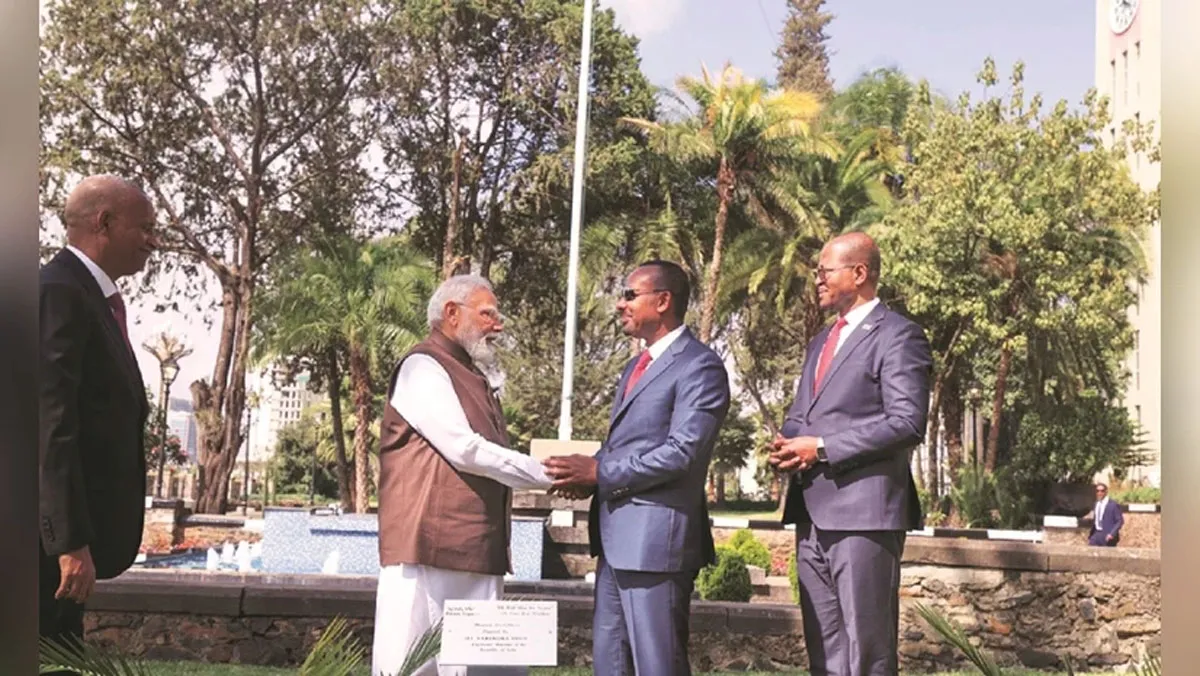
During Prime Minister Narendra Modi’s two-day visit to Ethiopia, which concluded on Wednesday evening, the two countries discussed deepening their economic partnership, particularly in digital public infrastructure, mining, critical minerals and clean energy, as Ethiopia opens up its economy.

Addressing a joint sitting of the Ethiopian Parliament and during talks with Abiy Ahmed, Modi said Indian companies have invested over USD 5 billion in Ethiopia, mainly in manufacturing and pharmaceuticals, creating more than 75,000 local jobs. Over 650 Indian companies are registered with Ethiopia’s investment authorities. Acknowledging Ethiopia’s reform-led development agenda, Modi conveyed that India would work closely with Addis Ababa in line with Ethiopia’s priorities and encourage greater participation by Indian private companies.

In his parliamentary address, Modi drew cultural parallels, noting that both India’s national song Vande Mataram and Ethiopia’s national anthem refer to the land as a mother, reflecting shared values rooted in heritage, culture and respect for the motherland.

During bilateral discussions, Modi reiterated India’s support for Ethiopia’s accession to the World Trade Organisation and its membership of the New Development Bank. Following Ethiopia’s recent entry into BRICS, the two leaders agreed to elevate the relationship to a Strategic Partnership. They also decided to expand cooperation across trade and investment, agriculture, renewable energy, health, education, skills development, defence and artificial intelligence.

At a ceremony held at the Addis International Convention Centre, Modi was conferred Ethiopia’s highest civilian honour, the Great Honour Nishan of Ethiopia. Earlier, Abiy Ahmed personally received Modi at the airport and accompanied him to the National Science Museum and Friendship Park in Addis Ababa.

India also offered support to Ethiopia under the G20 Common Framework on debt, including flexibility on repayments linked to earlier Indian lines of credit. During the visit, agreements were signed on UN peacekeeping training, mutual administrative assistance in customs matters, and the establishment of a data centre at Ethiopia’s Ministry of Foreign Affairs. The two sides also announced additional Indian Council for Cultural Relations scholarships, short AI courses for Ethiopians, and support for maternal and neonatal healthcare.

In a post on X, Modi described the outcomes as “significant steps forward” in a trusted partnership, emphasising cooperation in governance, peacekeeping, digital capacity, education and healthcare, with a strong focus on people-centric development.

Following the Ethiopia leg, Modi arrived in Muscat on Wednesday evening for the final stop of his three-nation tour. India and Oman are set to sign a free trade agreement, aimed at expanding opportunities in textiles, food processing, automobiles, auto components, and gems and jewellery. Commerce and Industry Minister Piyush Goyal has reached Muscat for the signing.

Speaking at the Oman–India Business Forum, Goyal said the agreement would be Oman’s first major trade pact in nearly two decades and highlighted strong potential in sectors such as textiles, footwear, autos, gems and jewellery, agrochemicals and renewable energy. Oman’s Minister of Commerce, Industry and Investment Promotion Qais Al Yousef noted that Indian investments in Oman have more than trebled since 2020 to USD 5 billion, spanning green steel, green ammonia, aluminium manufacturing and logistics.

India already has a similar trade agreement with the Gulf Cooperation Council member United Arab Emirates, which came into force in May 2022.

During Prime Minister Narendra Modi’s two-day visit to Ethiopia, which concluded on Wednesday evening, the two countries discussed deepening their economic partnership, particularly in digital public infrastructure, mining, critical minerals and clean energy, as Ethiopia opens up its economy. Addressing a joint sitting of the Ethiopian Parliament and during talks with Abiy Ahmed, Modi said Indian companies have invested over USD 5 billion in Ethiopia, mainly in manufacturing and pharmaceuticals, creating more than 75,000 local jobs. Over 650 Indian companies are registered with Ethiopia’s investment authorities. Acknowledging Ethiopia’s reform-led development agenda, Modi conveyed that India would work closely with Addis Ababa in line with Ethiopia’s priorities and encourage greater participation by Indian private companies. In his parliamentary address, Modi drew cultural parallels, noting that both India’s national song Vande Mataram and Ethiopia’s national anthem refer to the land as a mother, reflecting shared values rooted in heritage, culture and respect for the motherland. During bilateral discussions, Modi reiterated India’s support for Ethiopia’s accession to the World Trade Organisation and its membership of the New Development Bank. Following Ethiopia’s recent entry into BRICS, the two leaders agreed to elevate the relationship to a Strategic Partnership. They also decided to expand cooperation across trade and investment, agriculture, renewable energy, health, education, skills development, defence and artificial intelligence. At a ceremony held at the Addis International Convention Centre, Modi was conferred Ethiopia’s highest civilian honour, the Great Honour Nishan of Ethiopia. Earlier, Abiy Ahmed personally received Modi at the airport and accompanied him to the National Science Museum and Friendship Park in Addis Ababa. India also offered support to Ethiopia under the G20 Common Framework on debt, including flexibility on repayments linked to earlier Indian lines of credit. During the visit, agreements were signed on UN peacekeeping training, mutual administrative assistance in customs matters, and the establishment of a data centre at Ethiopia’s Ministry of Foreign Affairs. The two sides also announced additional Indian Council for Cultural Relations scholarships, short AI courses for Ethiopians, and support for maternal and neonatal healthcare. In a post on X, Modi described the outcomes as “significant steps forward” in a trusted partnership, emphasising cooperation in governance, peacekeeping, digital capacity, education and healthcare, with a strong focus on people-centric development. Following the Ethiopia leg, Modi arrived in Muscat on Wednesday evening for the final stop of his three-nation tour. India and Oman are set to sign a free trade agreement, aimed at expanding opportunities in textiles, food processing, automobiles, auto components, and gems and jewellery. Commerce and Industry Minister Piyush Goyal has reached Muscat for the signing. Speaking at the Oman–India Business Forum, Goyal said the agreement would be Oman’s first major trade pact in nearly two decades and highlighted strong potential in sectors such as textiles, footwear, autos, gems and jewellery, agrochemicals and renewable energy. Oman’s Minister of Commerce, Industry and Investment Promotion Qais Al Yousef noted that Indian investments in Oman have more than trebled since 2020 to USD 5 billion, spanning green steel, green ammonia, aluminium manufacturing and logistics. India already has a similar trade agreement with the Gulf Cooperation Council member United Arab Emirates, which came into force in May 2022.

Next Story
Infrastructure Urban

Study Highlights Freshwater Sponges’ Role in Fighting Metal Pollution

Scientists have identified freshwater sponges and their associated microbial communities as powerful natural allies in tackling toxic metal pollution, offering new hope for sustainable water quality management. A recent study has revealed that these sponges can act both as bioindicators and effective absorbents of harmful metals such as arsenic, lead and cadmium.The findings come from a study published in Microbiology Spectrum by researchers from Bose Institute, an autonomous institute under the Department of Science and Technology, Government of India. The research focused on freshwater spong..

Next Story
Infrastructure Transport

79% of Indian Railways Track now Supports Speeds of 110 Kmph+

Indian Railways has significantly enhanced the speed potential of its track network over the past decade, with 79 per cent of tracks now capable of supporting speeds of 110 kmph and above, compared with just 40 per cent in 2014. The improvement reflects sustained investment in track modernisation and maintenance aimed at faster and safer train operations.According to official data, large-scale upgradation works have been undertaken over the last 11 years to improve track quality and performance. Key measures include the use of heavier 60 kg rails, wider-base concrete sleepers, thick web switch..

Next Story
Infrastructure Transport

Indian Railways Clocks 80% Punctuality Nationwide from Dec 8–14

Indian Railways has reported strong operational performance, achieving an overall punctuality of 80 per cent across the network during the period from December 8 to December 14. The achievement reflects sustained efforts by railway divisions to enhance efficiency and ensure reliable and timely services for passengers and freight users.According to official data, 37 railway divisions recorded punctuality levels exceeding 80 per cent during the review period. Notably, 22 divisions achieved punctuality above 90 per cent, while 10 divisions went a step further by crossing the 95 per cent mark, hig..

Advertisement

Subscribe to Our Newsletter

Get daily newsletters around different themes from Construction world.

STAY CONNECTED

Advertisement

Advertisement

Advertisement

Advertisement

Open In App