+
Jammu and Kashmir Budget Proposes 15 MW Hydro-Solar Parks
POWER & RENEWABLE ENERGY

Jammu and Kashmir Budget Proposes 15 MW Hydro-Solar Parks

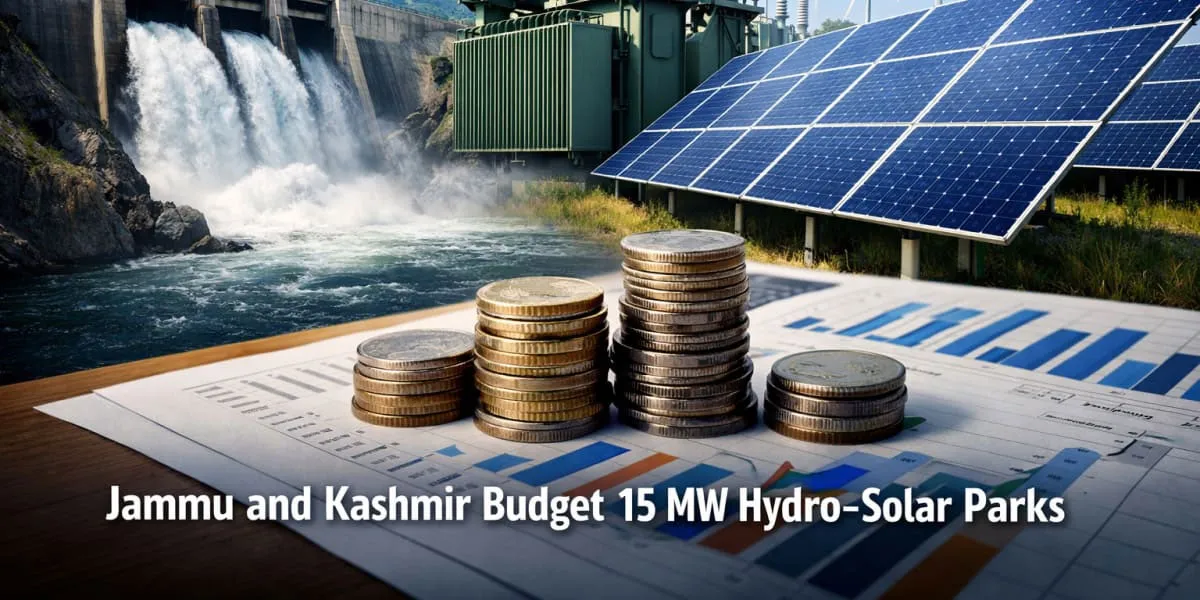
The Jammu and Kashmir government has proposed the development of 15 megawatt (MW) hydro-solar parks as part of its latest budget, with a capital allocation of Rs 1.77 billion (bn) for science and technology. The package aims to strengthen research capabilities and support applied technology projects across the union territory. The proposal is presented as complementary to existing energy and development policies and intended to promote sustainable local industry.

The allocation is intended to finance laboratory upgrades, procurement of specialised equipment and capacity building for researchers and technicians. Officials have outlined plans to integrate renewable energy projects with science initiatives to foster innovation and practical applications. Academic institutions and research centres are identified as potential collaborators for testing and demonstration activities.

The Rs 1.77 billion is equivalent to Rs 1,770 million (mn), reflecting the conversion from the originally stated figure in crores. The budget document frames the funding as capital expenditure to be released over the coming fiscal periods subject to legislative approval and administrative processes. Implementation is expected to involve phased disbursements, monitoring of outcomes and routine financial oversight.

The proposed hydro-solar parks are presented as measures to augment local renewable energy capacity, reduce dependence on fossil sources and provide opportunities for skill development and local employment. Implementation details, including site selection, timelines and private sector participation, are expected to be clarified as the budget moves through approval stages. Environmental assessments and community engagement are cited as components of project planning.

Stakeholders are expected to include local industry, academic partners and community representatives in project design to maximise socio-economic benefits. The initiative is projected to support skill training programmes, technology transfer and small enterprise participation linked to project supply chains. Progress and impact are likely to be subject to routine evaluation and public reporting during implementation.

The Jammu and Kashmir government has proposed the development of 15 megawatt (MW) hydro-solar parks as part of its latest budget, with a capital allocation of Rs 1.77 billion (bn) for science and technology. The package aims to strengthen research capabilities and support applied technology projects across the union territory. The proposal is presented as complementary to existing energy and development policies and intended to promote sustainable local industry. The allocation is intended to finance laboratory upgrades, procurement of specialised equipment and capacity building for researchers and technicians. Officials have outlined plans to integrate renewable energy projects with science initiatives to foster innovation and practical applications. Academic institutions and research centres are identified as potential collaborators for testing and demonstration activities. The Rs 1.77 billion is equivalent to Rs 1,770 million (mn), reflecting the conversion from the originally stated figure in crores. The budget document frames the funding as capital expenditure to be released over the coming fiscal periods subject to legislative approval and administrative processes. Implementation is expected to involve phased disbursements, monitoring of outcomes and routine financial oversight. The proposed hydro-solar parks are presented as measures to augment local renewable energy capacity, reduce dependence on fossil sources and provide opportunities for skill development and local employment. Implementation details, including site selection, timelines and private sector participation, are expected to be clarified as the budget moves through approval stages. Environmental assessments and community engagement are cited as components of project planning. Stakeholders are expected to include local industry, academic partners and community representatives in project design to maximise socio-economic benefits. The initiative is projected to support skill training programmes, technology transfer and small enterprise participation linked to project supply chains. Progress and impact are likely to be subject to routine evaluation and public reporting during implementation.

Next Story
Infrastructure Transport

NHAI Awards Contracts For Bhubaneswar Ring Road

The National Highways Authority of India (NHAI) has issued Letters of Award for the construction of the six-lane access-controlled Capital Region Ring Road (Bhubaneswar Bypass) project in Odisha. The 111 km greenfield corridor from Rameshwar to Tangi will be developed in three packages under the Hybrid Annuity Model (HAM) and is expected to be completed in about 30 months. Package I has been awarded to Patel Infrastructure Limited for the 40 km stretch from Rameshwar to Bilipada. The scope includes service roads, two interchanges, one railway overbridge, 10 minor bridges, 142 culverts, one wa..

Next Story
Real Estate

Hafele Begins Local Production In Maharashtra

Hafele has commenced operations at a new local production facility in Maharashtra, marking a step in the company’s localisation strategy and its commitment to the Government of India’s ‘Make in India’ initiative. The facility is designed to support local value creation and serve as a foundation for scalable manufacturing operations in the country. In the first phase, the company has started production of its MatrixBox Premium+ drawer systems, designed for modern kitchens and engineered for soft-close and noiseless performance. The system supports heavy-duty usage and offers multiple f..

Next Story
Resources

DP World Installs Container Pavilion In Lucknow

DP World has expanded its Beyond Boundaries Initiative with the installation of a repurposed shipping container pavilion and the distribution of 250 cricket kits in Lucknow, aimed at strengthening grassroots access to cricket in Uttar Pradesh. The converted shipping container has been developed into a multi-purpose pavilion for training, preparation and rest. It was unveiled at the Bharat Ratna Shri Atal Bihari Vajpayee Cricket Stadium in the presence of former Indian cricketer Yuvraj Singh and will be permanently housed at Sage Cricket Academy. The initiative has been implemented in partner..

Advertisement

Subscribe to Our Newsletter

Get daily newsletters around different themes from Construction world.

STAY CONNECTED

Advertisement

Advertisement

Advertisement

Open In App