New Method Boosts Catalysts For Clean Hydrogen Production
POWER & RENEWABLE ENERGY

New Method Boosts Catalysts For Clean Hydrogen Production

A new strategy has been developed to enhance the performance of catalysts used in water splitting for hydrogen generation—one of the cleanest known fuels. In water electrolysis, the oxygen evolution reaction (OER) has long posed challenges due to its sluggish kinetics and higher overpotential requirements compared with the hydrogen evolution reaction (HER). Creating efficient, noble-metal-free catalysts for OER remains a key research priority.

Coordination polymers (COPs), formed through the combination of metal ions and organic molecules, are widely explored for water electrolysis. However, their full coordination by solvent and water molecules leaves very few active sites for electrocatalysis, limiting their direct applicability.

Researchers at the Centre for Nano and Soft Matter Sciences (CeNS), Bengaluru—an autonomous institute under the Department of Science and Technology—have now devised a novel approach to significantly enhance the catalytic activity of COPs while preserving their structural framework.

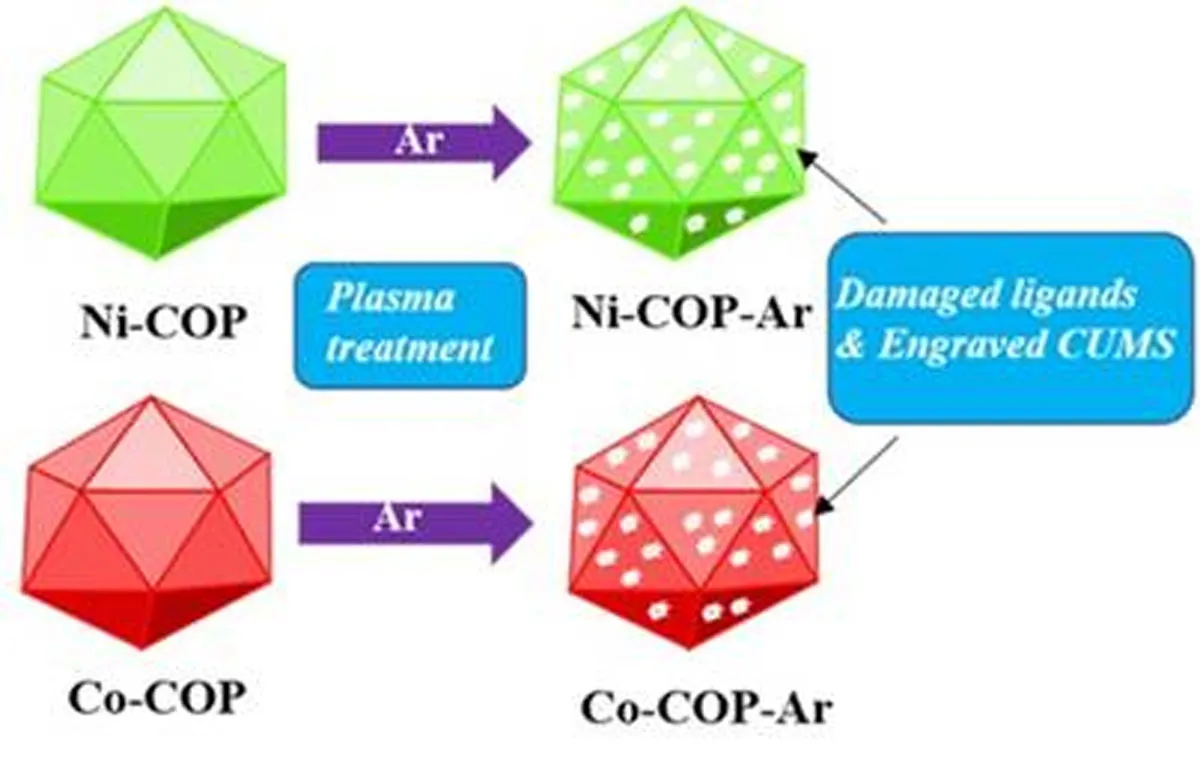
Their method uses argon plasma treatment to activate the polymer by generating coordinatively unsaturated metal sites (CUMSs). These newly created active sites greatly improve catalytic performance without compromising the bulk structure.

Detailed structural investigations confirmed that the Ni- and Co-based COPs retained their integrity across single-crystal and bulk powder X-ray diffraction analyses. While the untreated materials showed high onset potentials and limited OER activity in alkaline media, their performance improved substantially after plasma activation. Powder XRD, TEM imaging, XPS analysis and contact-angle studies verified that the bulk structure remained unchanged despite the formation of CUMSs.

The plasma-activated Ni- and Co-COPs displayed marked enhancements in electrocatalytic activity, demonstrating an effective approach to elevate the intrinsic efficiency of coordination-polymer-based catalysts.

Published in ACS Applied Nano Materials, this work opens new avenues for designing cost-effective, high-performance catalysts for water splitting, supporting broader efforts to advance clean and sustainable hydrogen energy.

A new strategy has been developed to enhance the performance of catalysts used in water splitting for hydrogen generation—one of the cleanest known fuels. In water electrolysis, the oxygen evolution reaction (OER) has long posed challenges due to its sluggish kinetics and higher overpotential requirements compared with the hydrogen evolution reaction (HER). Creating efficient, noble-metal-free catalysts for OER remains a key research priority. Coordination polymers (COPs), formed through the combination of metal ions and organic molecules, are widely explored for water electrolysis. However, their full coordination by solvent and water molecules leaves very few active sites for electrocatalysis, limiting their direct applicability. Researchers at the Centre for Nano and Soft Matter Sciences (CeNS), Bengaluru—an autonomous institute under the Department of Science and Technology—have now devised a novel approach to significantly enhance the catalytic activity of COPs while preserving their structural framework. Their method uses argon plasma treatment to activate the polymer by generating coordinatively unsaturated metal sites (CUMSs). These newly created active sites greatly improve catalytic performance without compromising the bulk structure. Detailed structural investigations confirmed that the Ni- and Co-based COPs retained their integrity across single-crystal and bulk powder X-ray diffraction analyses. While the untreated materials showed high onset potentials and limited OER activity in alkaline media, their performance improved substantially after plasma activation. Powder XRD, TEM imaging, XPS analysis and contact-angle studies verified that the bulk structure remained unchanged despite the formation of CUMSs. The plasma-activated Ni- and Co-COPs displayed marked enhancements in electrocatalytic activity, demonstrating an effective approach to elevate the intrinsic efficiency of coordination-polymer-based catalysts. Published in ACS Applied Nano Materials, this work opens new avenues for designing cost-effective, high-performance catalysts for water splitting, supporting broader efforts to advance clean and sustainable hydrogen energy.

Next Story
Real Estate

Modon, Related, Panepinto form JV for Harborside 4 in Jersey City

Abu Dhabi-based Modon Holding PSC has formed a joint venture with US real estate major Related Companies and Jersey City-based Panepinto Properties to develop Harborside 4, a 54-storey luxury residential tower on a prime waterfront site in downtown Jersey City, New Jersey.Under the partnership, Modon will hold a majority equity stake alongside Related and Panepinto, marking another step in the group’s strategy to scale and diversify its global real estate portfolio. The project will be developed on one of the last remaining premium waterfront parcels in the city.Designed by Handel Architects..

Next Story
Infrastructure Urban

P+Ex and Post-Tensioning Institute partner to drive sustainability

P+Ex, the Center of Excellence for Concrete Preservation and Service Life Extension, has announced a strategic partnership with the Post-Tensioning Institute (PTI) aimed at advancing sustainability, durability, and resilience in the built environment.The collaboration brings together P+Ex’s expertise in concrete preservation, repair, and service life extension with PTI’s global leadership in post-tensioning technology. Through this alliance, the two organisations will work to advance best practices in durability-focused design for new structures, while also promoting effective repair, reha..

Next Story
Infrastructure Energy

India’s Largest 2,000 MW Subansiri Hydro Project Turns Operational

India’s largest hydropower project, the 2,000 MW Subansiri Lower Hydroelectric Project, has finally become operational with the commissioning of its first unit, marking a major milestone after nearly 20 years of development marked by delays, protests and cost escalation.The 250 MW Unit-2 of the project, located on the Subansiri River at Gerukamukh on the Assam–Arunachal Pradesh border, was virtually inaugurated from New Delhi by Union Minister of Power Manohar Lal Khattar. The event was attended by Pankaj Agarwal, Secretary (Power), and Bhupender Gupta, Chairman and Managing Director, Nati..

Advertisement

Subscribe to Our Newsletter

Get daily newsletters around different themes from Construction world.

STAY CONNECTED

Advertisement

Advertisement

Advertisement

Advertisement

Open In App