New Technique Maps Sun’s Magnetic Activity By Latitude
POWER & RENEWABLE ENERGY

New Technique Maps Sun’s Magnetic Activity By Latitude

Astronomers have developed a new technique to track how the Sun’s magnetic activity varies with latitude, offering fresh insights into the operation of the solar magnetic dynamo and its influence on space weather and Earth’s climate.

The Sun, a dynamic and magnetically active star, undergoes an 11-year cycle marked by changing patterns of sunspots and magnetic features. Understanding these variations is crucial, as solar activity affects satellite communications, navigation systems and even power grids on Earth.

A team led by researchers at the Indian Institute of Astrophysics (IIA), an autonomous institute under the Department of Science and Technology, analysed 11 years (2015–2025) of calcium K line spectroscopic data from the Kodaikanal Solar Observatory, which recently marked its 125th anniversary. The Ca-K line at 393.4 nm, originating from the Sun’s chromosphere, is a key diagnostic for magnetic fields.

Using a method devised by Jagdev Singh of IIA, the researchers captured light from entire latitude bands—effectively slicing the Sun from pole to pole—to reveal large-scale magnetic patterns that are not visible when examining individual sunspots. They analysed multiple Ca-K spectral features, including line widths and intensity ratios, which act as proxies for magnetic activity, and tracked their changes over an entire solar cycle.

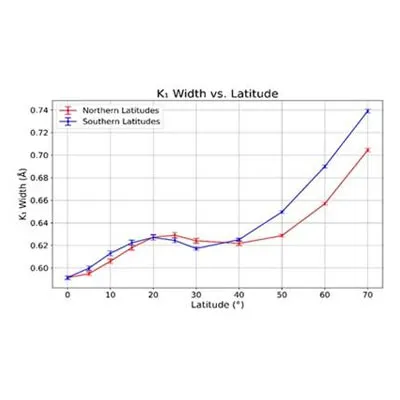
The study shows that most solar magnetic activity is concentrated between 40° north and south, with the strongest signals appearing around 15–20° in both hemispheres—the same latitudes where sunspot activity peaks. These spectral findings correlate strongly with magnetic feature coverage identified using NASA’s Solar Dynamics Observatory data.

The researchers also observed clear hemispheric differences. The southern hemisphere showed steeper increases in activity at higher latitudes and stronger correlations with magnetic indicators. By calculating how the Ca-K line responds to changes in magnetic filling factor, the team produced “spectral response profiles” that peak near the Ca-K core and display systematic north–south asymmetries, offering clues to the deeper processes driving the solar dynamo.

The findings confirm that solar activity follows predictable latitude-dependent patterns aligned with the 11-year solar cycle. The variations reflect changes in temperature and magnetic strength in the chromosphere, improving understanding of how the Sun’s magnetic engine functions.

The study, published in Monthly Notices of the Royal Astronomical Society, was authored by scientists from IIA, IIT BHU and Amrita Vishwa Vidyapeetham, including Apoorva Srinivasa, Anu Sreedevi, Narayanankutty Karuppath, P. Devendran, T. Ramesh Kumar and P. Kumaravel.

Astronomers have developed a new technique to track how the Sun’s magnetic activity varies with latitude, offering fresh insights into the operation of the solar magnetic dynamo and its influence on space weather and Earth’s climate. The Sun, a dynamic and magnetically active star, undergoes an 11-year cycle marked by changing patterns of sunspots and magnetic features. Understanding these variations is crucial, as solar activity affects satellite communications, navigation systems and even power grids on Earth. A team led by researchers at the Indian Institute of Astrophysics (IIA), an autonomous institute under the Department of Science and Technology, analysed 11 years (2015–2025) of calcium K line spectroscopic data from the Kodaikanal Solar Observatory, which recently marked its 125th anniversary. The Ca-K line at 393.4 nm, originating from the Sun’s chromosphere, is a key diagnostic for magnetic fields. Using a method devised by Jagdev Singh of IIA, the researchers captured light from entire latitude bands—effectively slicing the Sun from pole to pole—to reveal large-scale magnetic patterns that are not visible when examining individual sunspots. They analysed multiple Ca-K spectral features, including line widths and intensity ratios, which act as proxies for magnetic activity, and tracked their changes over an entire solar cycle. The study shows that most solar magnetic activity is concentrated between 40° north and south, with the strongest signals appearing around 15–20° in both hemispheres—the same latitudes where sunspot activity peaks. These spectral findings correlate strongly with magnetic feature coverage identified using NASA’s Solar Dynamics Observatory data. The researchers also observed clear hemispheric differences. The southern hemisphere showed steeper increases in activity at higher latitudes and stronger correlations with magnetic indicators. By calculating how the Ca-K line responds to changes in magnetic filling factor, the team produced “spectral response profiles” that peak near the Ca-K core and display systematic north–south asymmetries, offering clues to the deeper processes driving the solar dynamo. The findings confirm that solar activity follows predictable latitude-dependent patterns aligned with the 11-year solar cycle. The variations reflect changes in temperature and magnetic strength in the chromosphere, improving understanding of how the Sun’s magnetic engine functions. The study, published in Monthly Notices of the Royal Astronomical Society, was authored by scientists from IIA, IIT BHU and Amrita Vishwa Vidyapeetham, including Apoorva Srinivasa, Anu Sreedevi, Narayanankutty Karuppath, P. Devendran, T. Ramesh Kumar and P. Kumaravel.

Next Story
Products

Kuche7 Launches Ruby Vanity for Sculpted, High-Performance Bathrooms

Kuche7, India’s leading maker of premium stainless-steel kitchens, has unveiled the Ruby Vanity, a bathroom system engineered for long-term performance with a warm, sculpted aesthetic. Built on a 304-grade stainless-steel framework, the vanity offers corrosion resistance, structural strength and high durability suited to humid environments.Precision metal-forming enables the seamless curved façade, finished in a matte beige PU coat and paired with a marble countertop for depth and texture. Stainless-steel internal carcasses ensure efficient, moisture-resistant storage for everyday use. The ..

Next Story
Resources

Knauf India Doubles Capacity with New Metal Line at Khushkhera Plant

Knauf India, the world’s leading drywall and ceiling solutions company, has inaugurated a new Metal Line at its Khushkhera plant, doubling the facility’s overall production capacity. The expansion strengthens Knauf’s local manufacturing footprint and supports the growing domestic demand for advanced building materials.The launch was held during Knauf’s Dealer Engagement Day, which brought together dealers, partners and team members from across the country for a full-day programme combining technical demonstrations and engagement activities. The event began with a guided plant tour show..

Next Story
Products

Valueline Launches Tiberio by Ceramica Cielo in India

Valueline, a premium home solutions brand established in 2002, has announced the launch of Tiberio by Ceramica Cielo, an Italian bathroom collection that pairs traditional ceramic craftsmanship with contemporary design. The series is positioned to bring refined elegance and architectural depth to modern interiors.Designed by Andrea Parisio and Giuseppe Pezzano, Tiberio emphasises balanced proportions and a harmonious integration of ceramic and wood. The collection offers both modular and freestanding formats, enabling application across varied settings including high-end residences, boutique h..

Advertisement

Subscribe to Our Newsletter

Get daily newsletters around different themes from Construction world.

STAY CONNECTED

Advertisement

Advertisement

Advertisement

Advertisement

Get CW App