Tamil Nadu Power Demand Likely To Nearly Double By 2035
POWER & RENEWABLE ENERGY

Tamil Nadu Power Demand Likely To Nearly Double By 2035

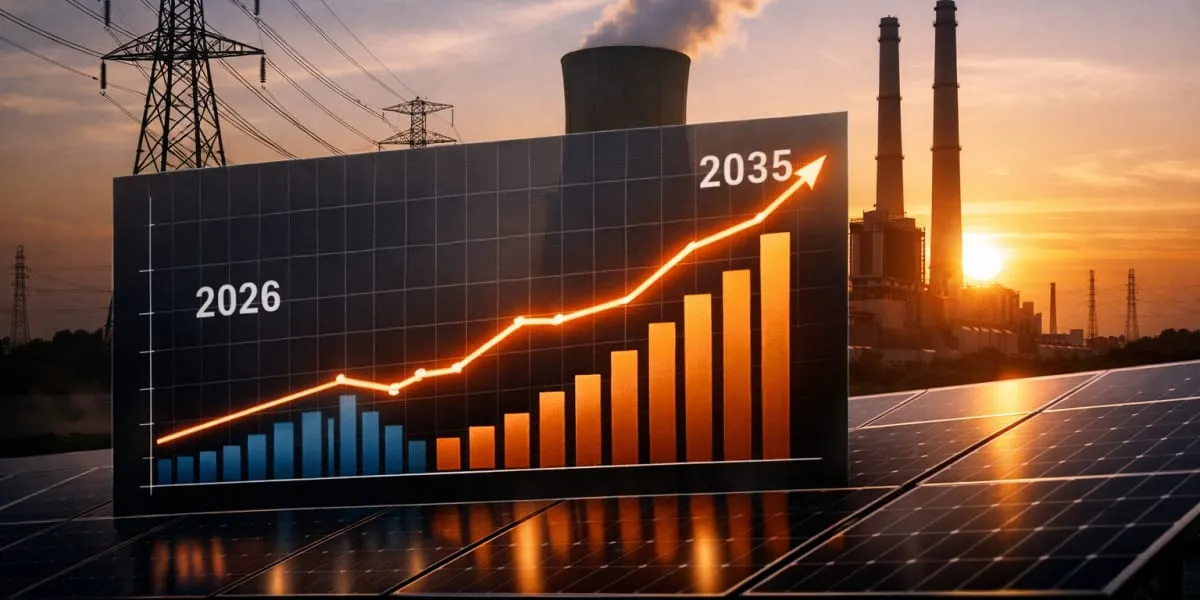
The Central Electricity Authority's National Generation Adequacy Plan for 2026-27 to 2035-36 projects Tamil Nadu's energy requirement to rise by about 89 per cent over the next ten years. The state demand is projected at 148,219 million units (mn units) in 2026-27 and is likely to reach 280,398 mn units by 2035-36. Tamil Nadu is expected to be second among southern states while Andhra Pradesh is projected to top the list with 293,798 mn units in 2035-36. Gujarat's requirement is forecast at 365,811 mn units by 2035-36.

The Tamil Nadu Power Distribution Corporation Limited's sixteenth annual report for 2024-25 showed power purchase spending that consumed most of its revenue. Converted from crore figures the utility's power procurement totalled Rs 759,603.2 million (mn) while total income converted to million was Rs 1,004,171.3 mn, indicating nearly 75 per cent of income went to buying power. The report warned that sustained reliance on costly private procurement is not sustainable for the utility's finances. It recommended greater emphasis on expanding state owned generation capacity to manage rising demand.

A senior TNPDCL official said no major state owned plants had come into full commercial operation since North Chennai Stage II, with two units of 600 megawatt (MW), was commissioned in May 2014. North Chennai Stage III with 800 MW had recently commenced commercial operations but the plant load factor stood at around 40 per cent while some technical works remained to be completed. The official named pipeline projects including Udangudi with two units of 660 MW, Ennore SEZ with two units of 660 MW, Uppur with two units of 800 MW and an ETPS expansion with one unit of 660 MW.

The official said the first unit of the Udangudi project was nearing completion and expected to begin commercial operations soon and that after the Assembly elections the new government should concentrate on completing these projects to boost state owned generation. Increased generation was presented as a path to reduce dependence on private procurement and to address the utility's debt, which was stated at around Rs 1,760 billion (bn).

The Central Electricity Authority's National Generation Adequacy Plan for 2026-27 to 2035-36 projects Tamil Nadu's energy requirement to rise by about 89 per cent over the next ten years. The state demand is projected at 148,219 million units (mn units) in 2026-27 and is likely to reach 280,398 mn units by 2035-36. Tamil Nadu is expected to be second among southern states while Andhra Pradesh is projected to top the list with 293,798 mn units in 2035-36. Gujarat's requirement is forecast at 365,811 mn units by 2035-36. The Tamil Nadu Power Distribution Corporation Limited's sixteenth annual report for 2024-25 showed power purchase spending that consumed most of its revenue. Converted from crore figures the utility's power procurement totalled Rs 759,603.2 million (mn) while total income converted to million was Rs 1,004,171.3 mn, indicating nearly 75 per cent of income went to buying power. The report warned that sustained reliance on costly private procurement is not sustainable for the utility's finances. It recommended greater emphasis on expanding state owned generation capacity to manage rising demand. A senior TNPDCL official said no major state owned plants had come into full commercial operation since North Chennai Stage II, with two units of 600 megawatt (MW), was commissioned in May 2014. North Chennai Stage III with 800 MW had recently commenced commercial operations but the plant load factor stood at around 40 per cent while some technical works remained to be completed. The official named pipeline projects including Udangudi with two units of 660 MW, Ennore SEZ with two units of 660 MW, Uppur with two units of 800 MW and an ETPS expansion with one unit of 660 MW. The official said the first unit of the Udangudi project was nearing completion and expected to begin commercial operations soon and that after the Assembly elections the new government should concentrate on completing these projects to boost state owned generation. Increased generation was presented as a path to reduce dependence on private procurement and to address the utility's debt, which was stated at around Rs 1,760 billion (bn).

Next Story
Infrastructure Energy

Power Mech Enters Urban Mobility With Rs 2.96 bn Mumbai Monorail Contract

Power Mech said it has secured a contract worth Rs 2.96 billion (Rs 2.96 bn) to deliver work on the Mumbai Monorail, marking the company's formal entry into urban mobility. The award was described as a significant contract for the firm and follows its focus on infrastructure projects. Shares of the company rose on the announcement as investors reacted to the new order. The contract will expand Power Mech's engineering and construction portfolio into urban transit systems and provides the company with exposure to the fast growing urban mobility segment in metropolitan areas. The work is expecte..

Next Story
Infrastructure Urban

Yogi Orders Expert Panel On Smart Meter Overbilling

The Uttar Pradesh chief minister ordered the formation of an expert panel to investigate widespread complaints of overbilling linked to newly installed smart meters. The panel was instructed to review meter data, examine installation practices and identify technical or procedural causes behind discrepancies in consumer bills. The state energy department was asked to prioritise the inquiry and to coordinate with distribution companies to ensure rapid access to required records and equipment. The committee was directed to conduct technical audits of meters and to establish whether faults, calibr..

Next Story
Infrastructure Energy

Power Firms Seek Relaxation Of HERC Fuel Surcharge Rules

Uttar Haryana Bijli Vitran Nigam (UHBVN) and Dakshin Haryana Bijli Vitran Nigam (DHBVN) have approached the Haryana Electricity Regulatory Commission (HERC) seeking relaxation of rules that govern recovery of fuel and power purchase costs. The distribution companies have filed petitions proposing amendments to Regulation sixty eight of the Multi-Year Tariff (MYT) Regulations, 2024 for financial year 2025-26, and have asked the regulator to consider alternative recovery mechanisms to the current monthly arrangement. Under the existing framework, additional costs arising from fuel and power purc..

Advertisement

Subscribe to Our Newsletter

Get daily newsletters around different themes from Construction world.

STAY CONNECTED

Advertisement

Advertisement

Advertisement