




+
US India Trade Deal Lowers Solar Tariffs
POWER & RENEWABLE ENERGY

US India Trade Deal Lowers Solar Tariffs

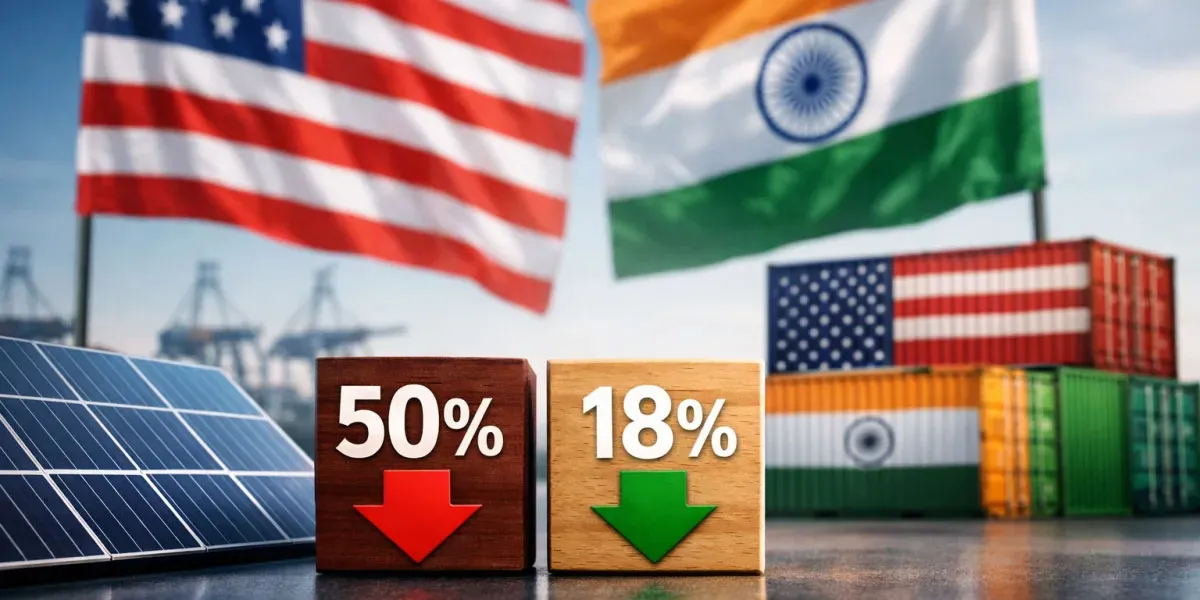
The United States (US) and India reached a trade deal on three February 2026 that reduces reciprocal tariffs on Indian goods, including solar modules, and energy storage components, from 25 per cent to 18 per cent. The agreement also rescinds a previously imposed 25 per cent penalty tariff that had applied because of India's trade with Russia, reducing the total tariff burden on Indian solar exports to the US from roughly 50 per cent to 18 per cent. The White House said the deal is contingent on India committing to purchase 500 billion dollars in American energy and technology over five years and on a reorientation of certain energy imports away from Russia toward US and Venezuelan sources.

Data from JMK Research and Mercom Capital show India exported 10.4 gigawatt (GW) of solar modules to the US in the first nine months of 2025, with roughly 97 per cent of the country's total module exports destined for the US last year. PL Capital reported India's share of the total US solar import market rose to about 11 per cent in 2024–2025, up from roughly three per cent in 2022. Analysts say the growth reflects a rapid market shift that has diversified supply chains amid tighter trade conditions.

Indian manufacturers including Vikram Solar and Waaree Energies are positioned to gain ground in utility scale and commercial and industrial markets as tariff clarity improves. Industry executives indicated that the removal of penalties and clearer reciprocal duties provide demand visibility for capacity planning and investment. Market observers suggest the change may encourage expansion in module production and energy storage supply chains as alternatives to Chinese linked facilities.

Stakeholders cautioned that implementation details will determine the practical effects on project economics and sourcing choices. Market participants will focus on contractual terms, certification requirements and logistics arrangements that could affect shipment timelines and costs. The coming quarters are likely to show how swiftly Indian exporters translate improved access into increased deliveries and whether import commitments lead to lasting procurement shifts.

The United States (US) and India reached a trade deal on three February 2026 that reduces reciprocal tariffs on Indian goods, including solar modules, and energy storage components, from 25 per cent to 18 per cent. The agreement also rescinds a previously imposed 25 per cent penalty tariff that had applied because of India's trade with Russia, reducing the total tariff burden on Indian solar exports to the US from roughly 50 per cent to 18 per cent. The White House said the deal is contingent on India committing to purchase 500 billion dollars in American energy and technology over five years and on a reorientation of certain energy imports away from Russia toward US and Venezuelan sources. Data from JMK Research and Mercom Capital show India exported 10.4 gigawatt (GW) of solar modules to the US in the first nine months of 2025, with roughly 97 per cent of the country's total module exports destined for the US last year. PL Capital reported India's share of the total US solar import market rose to about 11 per cent in 2024–2025, up from roughly three per cent in 2022. Analysts say the growth reflects a rapid market shift that has diversified supply chains amid tighter trade conditions. Indian manufacturers including Vikram Solar and Waaree Energies are positioned to gain ground in utility scale and commercial and industrial markets as tariff clarity improves. Industry executives indicated that the removal of penalties and clearer reciprocal duties provide demand visibility for capacity planning and investment. Market observers suggest the change may encourage expansion in module production and energy storage supply chains as alternatives to Chinese linked facilities. Stakeholders cautioned that implementation details will determine the practical effects on project economics and sourcing choices. Market participants will focus on contractual terms, certification requirements and logistics arrangements that could affect shipment timelines and costs. The coming quarters are likely to show how swiftly Indian exporters translate improved access into increased deliveries and whether import commitments lead to lasting procurement shifts.

Next Story
Resources

Hisense Opens First India Manufacturing Plant at Sri City

Hisense has inaugurated its first manufacturing facility in India at Sri City, Andhra Pradesh, through a joint venture with Epack Manufacturing Technologies Private Limited, a wholly owned subsidiary of Epack Durable Limited.The 10-acre facility, developed with an investment exceeding USD 30 million, is located within Epack Durable’s industrial park at Sri City and will commence commercial production from February 2026. Once fully operational, the plant will manufacture Room Air Conditioners (RACs) exclusively for Hisense India, accounting for 100 per cent of the brand’s domestic RAC outpu..

Next Story
Real Estate

Superb Realty Launches Altura, Focuses on IAQ-Led Office Design

Superb Realty has launched Superb Altura, a mixed-use Grade A commercial development at Amar Mahal junction in the Chembur–Ghatkopar corridor, positioning indoor air quality and intelligent building systems at the centre of its design strategy amid rising pollution levels in Mumbai.The development reflects a shift in office real estate priorities, where occupiers increasingly evaluate how buildings manage health, energy efficiency and operational resilience in high-pollution urban environments. Altura integrates advanced systems that continuously monitor and optimise indoor environments, cov..

Next Story
Infrastructure Transport

CPCL Tops NHAI’s First DPR Consultant Ranking

Chaitanya Projects Consultancy (CPCL) has secured the top position in the National Highways Authority of India’s first-ever provisional DPR consultants rating, achieving a score of 80.75 out of 100. The ranking places CPCL ahead of 55 peer firms, including Pentacle Consultants (78), L&T Infrastructure Engineering (76), MSV International Technology (74), and Transys Consulting (72).The rankings, released in the fourth week of January 2026, mark NHAI’s first structured and transparent evaluation of DPR consultants to improve quality standards under Bharatmala and other national highway p..

Advertisement

Subscribe to Our Newsletter

Get daily newsletters around different themes from Construction world.

STAY CONNECTED

Advertisement

Advertisement

Advertisement

Open In App















