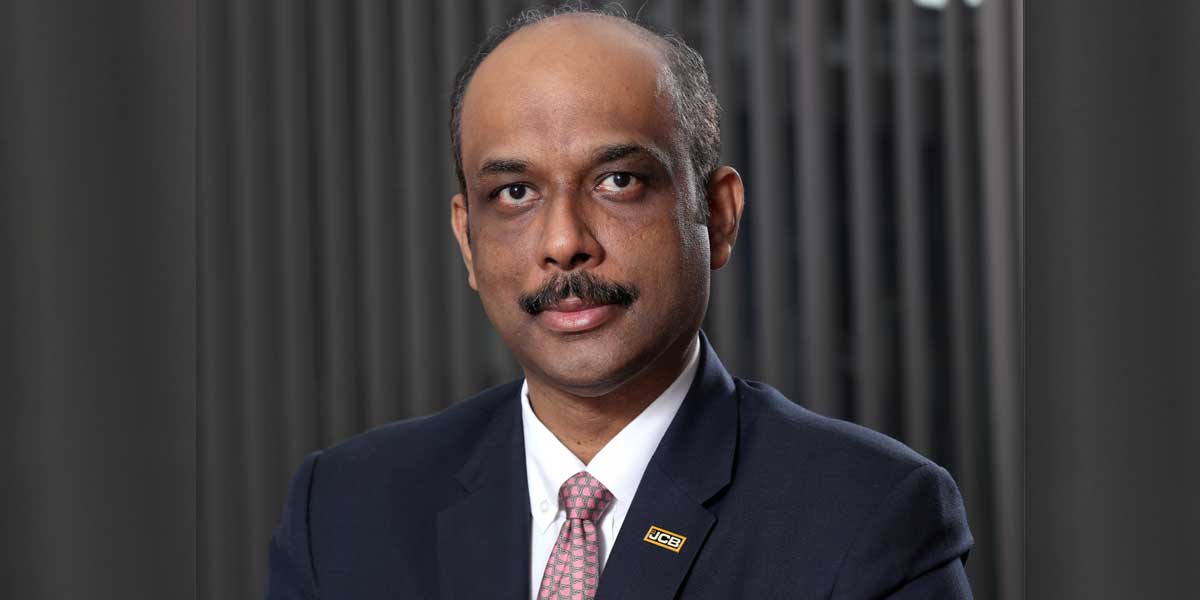
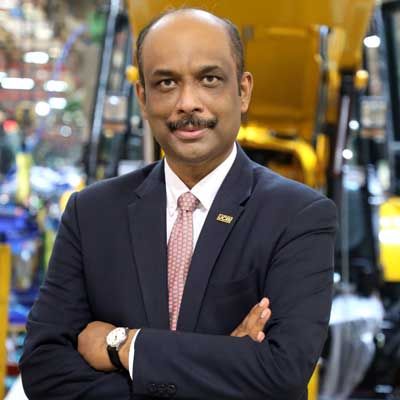
Deepak Shetty, Deputy CEO and MD of JCB India, shares the key growth drivers for earthmoving equipment in 2021, and challenges in supply chain areas.How has the year 2020 been for the earthmoving equipment market?
Construction equipment is an important part of the Infrastructure growth story of India. These
machines are used in infrastructure projects and at almost every construction site. Covid-19 has had an
unprecedented effect on several industries. All infrastructure development projects had temporarily
come to a standstill in the months of April and May due to the unforeseen pandemic. It had a deep
impact on the construction equipment market and its demand during the time.
However, the months of June to December have seen Green Shoots and all indicators are pointing
towards a V-Shaped recovery in the coming months. Resultantly, the demand for construction
equipment has also improved. These construction equipment machines are now being used in the
Infrastructure development in Rural and Urban India in different applications.
New projects are being announced by the government despite the pandemic. It is a welcome step and
this will certainly help in further improving the sentiment for the industry. We are hopeful of closing the
year on a healthy number.
After the slowdown this year, what will be the key growth drivers for earthmoving equipment in
2021?
Infrastructure projects have now restarted, which is leading to green shoots in the construction
equipment industry. A strong focus, along with a sustained spend on infrastructure development would
result in multiple long-term benefits.
Roads and highways will continue to play a key role in bringing forth recovery in the construction
industry. The Government reforms in the sector are a step in the right direction as it is expected to give a
strong push to highway construction. The Government has a plan for Rs 111 lakh crore in the National
Infrastructure Pipeline. This proposed plan must continue as the growth of the infrastructure sector will
create demand with a multiplier effect and will also contribute to the spike in urban demand.
At a national level, railways, irrigation and large projects like Sagarmala and Bharatmala should also be
given the impetus. This will strengthen logistics and develop requisite infrastructure enhancing capacity
at ports, improving operational efficiency and connectivity. All of this would require the use of smart
construction equipment.
Going further, two key sectors are set to emerge in the coming years – first being Infrastructure
development in Rural India and the other will be the creation of world-class healthcare infrastructure
across the country.
Rural India, is set to emerge as a strong growth driver, especially with the recent push by the
Government through programmes such as PMGSY. Schools, colleges, industries will need to be created
and segments like municipal waste, village roads, rural infra are set to grow.
From a healthcare infrastructure perspective, we need to revolutionise the sector with world-class on
ground healthcare facilities built across the country. Hospitals, Institutes, research facilities, etc. will
need to be scaled up, all of which would again require the use of smart construction equipment.
Thus, with the revival of consumer sentiment in urban areas and the increasing demand from rural
regions, we are hopeful of a brighter future. Additionally, the focus on creating 100 new airports, Smart
cities and Metro projects will certainly open up newer opportunities. Infrastructure creation also opens
up opportunities for allied industries like raw material, quarrying, equipment manufacturing, etc.
thereby creating jobs and livelihoods.
What is your view on the following factors in earthmoving equipment industry and how are you
working around each of these?
Production, demand and sales: Due to Covid-19, we had to calibrate our production to match the lower
demand during the period of the lockdown. However, as the markets gradually reopened, we have
resumed operations at all our manufacturing facilities in India.
The construction equipment Industry has been witnessing green shoots June/July onwards. We are
encouraged by this gradual revival and are hopeful that as more infrastructure projects start and
resume work, we could see more growth and recovery. With sustained focus and investments in the
sector, the next year looks positive.
The quarter ending December 2020 has been encouraging for us and the Industry. We feel that all
indicators are currently pointing towards a V-shaped recovery. However, we must note that we are not
out of the pandemic as of yet. Any disruption to the business by way of a lockdown can be detrimental.
At JCB, we are adapting to the new normal and are encouraged by this phase of revival, During the last
quarter of the year 2020, we launched the industry’s first dual-fuel CNG backhoe loader in India. It was
launched by the Honourable Minister for Road Transport & Highways and Micro, Small and Medium
Enterprises, Nitin Gadkari.
We also remained committed to the India growth story and inaugurated our largest Parts Centre in
Bhaproda, Haryana. This facility will cater to the parts requirement of our dealers and customers in
Northern India and also for exports.
We believe, the Government’s impetus on the construction of roads and highways has always played a
pivotal role in the growth of the sector and that must continue. Infrastructure creation opens up
opportunities for allied industries like raw material, quarrying, equipment manufacturing etc. while also
creating jobs and livelihoods.
Make in India and exports: The ‘Make in India’ programme was launched six years ago with a focus on
making India a ‘Manufacturing Hub for the World’. Today, it has dovetailed into ‘Vocal for Local’ and the
ambition to become ‘Atma Nirbhar’, or Self Reliant. India will need to be competitive and strong-willed
to be able to compete with global players in all aspects of the value chain including demand and supply.
The shift to local manufacturing has already begun.
To cater to the vision of making India ‘Atma Nirbhar’ (self-reliant) and to compete with global standards,
the industry has realised the criticality of investing in building world-class infrastructure in the country.
Industry is focusing on greater adoption of technologies like Telematics, IoT, Big data, VR and data
analytics along with machine learning.
JCB is an embodiment the Prime Ministers vision of ‘Make in India’ and Atmanirbhar Bharat. Our
machines have been contributing to the building of world-class infrastructure in the country for over 40
years.
We today have five state-of-the-art factories in Delhi-NCR, Pune and Jaipur – all of which operate on the
principle of ‘One Global Quality’. Our Jaipur factory is also a significantly gender diverse facility, with
over 30% of the workforce on the shop floor being women. Our sixth factory at Vadodara, which will
focus on exports is currently underway.
Innovation has been the corner stone of JCB’s operations around the world. In India we have a full
design and innovation centre at Pune which is our largest outside of the UK. This facility develops
exciting and new technologies of the future for Global and Domestic projects. We thus, Innovate, Design,
Manufacture, Sell and Export from India. We have exported our ‘Made in India’ products to over 110
countries from India.
JCB has always believed in localisation. Our flagship product, the JCB backhoe loader is indigenised to
almost 97% (by value). This has been possible due to sustained efforts over the years. The same ‘Made
in India’ machine is exported to countries around the world. And we are further committed to increasing
the localisation levels across all our product lines and are working relentlessly to reduce imports.
Product price and support: Customers all over the world look for a value proposition. Especially in
products such as earthmoving and construction equipment where customers will retain the product for
a fairly large amount of time. While the price is certainly an important parameter but it is often not the
only decision making factor when it comes to finalising a product. We need to look at the entire life cycle
of the machine and the support required during that period.
Product support is where JCB has invested a significantly so that our customers can ensure equipment
uptime and should have the convenience and peace of mind of ensuring that their machines are well
looked after.
This leads to higher productivity and greater returns on their investment. Machine downtime can
severely hamper the profitability of a site and also of the equipment involved. Thus, with over 700 parts
outlets and 60 plus dealers, we have ensured that there is a tremendous focus that customers get world-
class product support at their work sites.
Profitability at the worksite can only be achieved if the equipment performs at optimal levels at all
times. To achieve this there is a combination of the product, its design and the support. At JCB we have
tried to align all these three important parameters in favour of the customer. Our Machines are built to
One Global Quality and are exported to over 110 countries.
Complying with new emission norms: JCB India is committed to carrying out socially and
environmentally responsible operations across the country. Sustainability is at the core of our business.
We are in full support of the upcoming fuel emission norms and are well-prepared to welcome this
change, which will lead to better technology and sustainability in the long run.
We believe the new standards will enable the percolation of world-class technology and advancement in
the products/component thus, getting us at par with other advanced markets such as USA and Europe. It
will also contribute in the enhancement of the overall value chain of the product in terms of
development, research and upgraded technology in the supply chain.
To ensure seamless transition from BS (CEV) III to BS (CEV) 1V emission standards for wheeled
construction equipment, JCB has investing in technology, service support network, skilling and training
of people.
Projects where equipment were used: Rural India is fast becoming a strong growth driver for us. Our
advanced Telematics technology, Livelink has been very helpful in ascertaining the activity areas
nationally, JCB machines have already been deployed in projects on Railways, Irrigation and large
projects like Sagarmala and Bharatmala. We have also supplied machines to the Defence forces.
Our equipment continues to find great use at almost every road construction site, in both urban and
rural India. We expect to witness activity soon with the emergence of Infrastructure development in
Rural India and the creation of world-class healthcare infrastructure.
Additionally, the Government’s focus on creating 100 new airports, Smart cities and Metro projects will
certainly open up newer opportunities for our machines.
JCB India manufactures over 60 different products in eight different categories which include backhoe
loaders, excavators, compactors, telehandlers, wheeled loaders, skid steer loader, mini excavators and
generators. Our innovative and intelligent range of machines exhibit a blend of technology and digital
innovation and are designed to cater to the varied infrastructural demands.
Are there still challenges in supply chain areas and getting financing support for buying new
machines?
From a manufacturing standpoint, the supply chains which were disrupted by the national lockdown
and the subsequent intermittent lockdowns, have now re-booted.
Having said that, it is still early to predict anything and everything depends on how the pandemic plays
out. For instance, the situation can get extremely challenging if multiple cities where our suppliers,
dealers and, customers are located go into a lockdown once again, as the movement of our products will
be restricted.
Our supply chain is spread across India and any disruption in one part of the country can affect
operations and have a cascading effect on manufacturing volumes due to which it can affect sales.
Furthermore, there are still some liquidity related challenges that the industry is facing. Transmission of
loans needs to be strengthened further – NBFCs (Non-Banking Financial Corporations) and banks
should not become risk-averse about funding.
Release of payments to major infrastructure companies is a positive move, and will certainly help all
stakeholders. There is also an opportunity for a dedicated Infra Fund which can be useful for funding
infrastructure projects. Rising input costs, particularly steel, off- late needs to be looked at.
What are the digital innovations in your machines?
Customers today want utility and efficiency of the equipment without compromising on safety. Newer
concepts like Telematics, IoT, Big Data Analytics along with Machine Learning can play a major role in
meeting customer demands and increasing the efficiency of the sector.
JCB India has been innovating continuously to create smarter machines that efficiently fulfil this
demand. Our vision is to ensure that our customers get technologically advanced and innovative ‘Made-
in-India’ products, thereby also contributing to making India a global manufacturing hub. Through this
indigenous manufacturing of globally competitive products, we are also ensuring our support to the
Government’s Atma Nirbhar Bharat programme.
Enhanced fuel efficiency and smart machine management can be experienced in these machines through
LiveLink - an advanced telematics technology that benefits operators in better fleet management
through remote monitoring. It helps users increase productivity, control costs and ensure asset safety.
Till date, approximately 1,60,000 LiveLink enabled JCB machines have been sold. These machines can be
monitored for – security, operations and service (SOS) on mobile devices.
Machines can be geo-fenced, time-fenced and can be located anywhere. Customers get to know about the
machine’s health, fuel level, battery conditions, etc. – almost all critical parameters of the machine on
their mobile device. It also gives out service reminders and the history of the machine.
We have pioneered the integration of digital technology in our ‘Intelli’ series of Construction Equipment.
This has improved productivity, reliability and efficiency of our machines to ultimately benefit our
customers with ease of operation and cost profitability. JCB has also pioneered the integration of digital
technology with its digital initiatives for customer support, which are an industry first, in its kind. The
JCB genuine parts application enables customers to order parts of JCB products on their mobile.
Further, an internal tool – Smart Serve has been developed to help dealerships support engineers to
improve efficiency and productivity, thereby improving profitability.
JCB India also provides the widest after-sales service to its customers through 700 outlets and over 60
dealers. Since these machines work in far-flung areas, well-connected product support must be offered
to customers to minimise the downtime and maximise productivity.
What is your future outlook for the earthmoving equipment industry?
Despite pandemic, we remain positive and hopeful for the future. As the thrust on infrastructure
creation continues to be a priority for the government, we are optimistic of a strong recovery. Rural
India, where we have a significant presence, is also set to emerge as the new growth driver for us in the
coming days. With over 700 outlets in India, JCB India is staying as close to our customers as possible.
In the new normal world, there is going to be a significant scope of digitisation and automation.
Technology and innovation will become the key drivers of growth. Greater focus on adoption of
technologies will be given as these can increase the efficiency of the machines.
Hence, as we go ahead, a strong focus will be laid on manufacturing innovative products which exhibit a
seamless blend of technology and digital innovation in terms of design, performance, efficiency and
safety. The utilisation of smart technologies and their unmatched benefits like enhanced productivity,
safety, security and versatility to customers and end-users, will play an important role.
JCB India has already been adopting significant integration of digital technologies in products, processes,
factories, etc. in the form of Telematics, IoT, Big Data and Machine Learning. We use technology to
connect with our teams, our dealer engineers and over 1,60,000 JCB machines across the country
through our advanced Telematics technology-JCB LiveLink.
We will ensure that our customers get technologically advanced and innovative ‘Made-in-India’
products, thereby contributing to making India a global manufacturing hub. JCB’s made in India
machines are exported to over 110 countries. Through this indigenous manufacturing of globally
competitive products, we are also ensuring our support to the Prime Minister’s vision for becoming
‘Atma Nirbhar’. Our pioneering efforts in integrating our businesses with digital technology, both in
Products and Product Support, gives our customers better value.