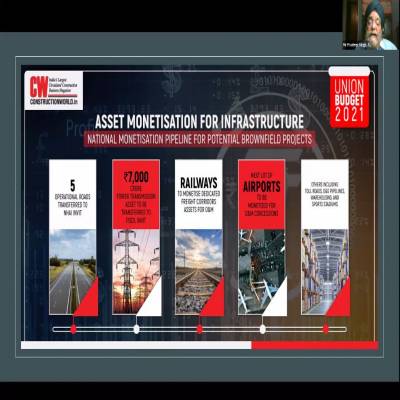
Real estate, cement, steel, and construction equipment industries have been in the news lately—mostly because their movements have indicated to us how the post-pandemic recovery is likely to be. In a webinar hosted by Construction World and FIRST Construction Council yesterday, experts churned the Union Budget 2021-22 to decode what it means for those industries.
_________
Construction World and FIRST Construction Council organised a webinar with prominent analysts and industry captains on February 2, the day after Finance Minister Nirmala Sitharaman’s Union Budget 2021-22 speech.
The speakers were:
Deepto Roy, Partner, Shardul Amarchand Mangaldas & CoDip Kishore Sen, Director, L&THemal Mehta, Partner, Deloitte IndiaPradeep Singh, former Vice Chairman & MD, IDFC ProjectsSandeep Singh, MD, Tata HitachiSumit Banerjee, former MD & CEO, ACC Ltd
The 90-minute session was moderated by Construction World’s Editor-in-Chief Pratap Padode.
The pandemic wreaked havoc on every sector of the economy, leading to two consecutive quarters of contraction in GDP by -23.9% and -7.5%. The industry was looking for path-breaking announcements from the Union Budget 2021-22. For a while now, the industry has aspired for the government’s nurturing hand on both industry and consumer, by both spending and enabling.
Were these aspirations fulfilled? What were some of the hits and more importantly, some misses? What are some loopholes and potential pitfalls? The webinar touched upon some of the sectors and industries that are especially focus, either as bellwethers of the economy or as projectors of what impacts the Budget will have on them.
Did real estate miss out?
Even before the Budget, state governments had announced a slew of relaxations to boost the real estate sector. In addition to these interventions, the real estate sector was in dire need of more concessions for revival and accelerated growth. Certain measures like extending tax holiday benefit to affordable housing for one more year, allowing the raising of debt financing by REIT/InvIT from FPI, and expansion of the safe harbour from 10% to 20% in case of transfer of a residential unit during 12 November 2020 to 30 June 2021 by way of the first-time allotment to any person for consideration not exceeding Rs 20 million have been welcomed by the industry.
But did the Budget itself provide solace to the industry? Did it help accelerate consumption by incentivising the buyer? Surprisingly, notwithstanding its emphasis on affordable housing, the Budget’s treatment of real estate seems to have left some gaps between expectations and announcements.
Hemal Mehta, Partner, Deloitte India, pointed out in the webinar that the FM missed out on the issue of taxing of unsold inventory. Another demand that was missed out, Mehta said, was a capital gain exemption for a REIT.
Mehta said that while the government has shown clear commitment to invest money in infrastructure and there is a lot of ease to actually access the debt-finance for infrastructure and real estate, it remains to be seen how various guidelines will be introduced for debt funding.
Of steely grit and cementing gains
The recent—and steep, as the Roads Minister Nitin Gadkari has repeatedly reminded us—increase in material prices has been a cause of concern for user industries. In particular focus was a dip in supply. But internationally, supply is fast catching up with post-pandemic demand flood. In India, though, analysts seem to agree that prices are unlikely to fall anytime soon. The Union Budget comes in an environment where the government could have either augured a cooling-off or a continuance.
Will the impetus was given to affordable housing by the government and the expansion of NIP be good enough as a signal for cement and steel—especially, can it help the materials industries start expanding their capacities?
A respected voice in the industry, Sumit Banerjee, former MD & CEO, ACC Ltd, points out that the cement sector has never worried about the budget to set up their capacities. Even before the budget, companies like JSW Cements, Ramco Cement, and Dalmia Cement had announced the creation of new capacity investments in new capacity despite pandemic.
On whether the Union Budget 2021-22 does enough for steel and cement, Banerjee said the answer is a “yes and no.”
“Steel and cement have been quite contrarian in their decisions to set up capacities, in my experience,” Banerjee said. “When the financial year started with the Covid-19 pandemic, people were really spelling doom for steel and cement industry. The cement industry was forecast to decline 30% in the first couple of months of the financial year. From there on to today, we have cumulatively had a drop of only about 11%. The steel industry is doing even better, because the steel industry also has the possibility of exports, and which cement doesn't have.”
According to Banerjee, the infrastructure development provisioned in the budget will spur the demand for the two major building materials. But real estate—not so much.
“Whether the Budget will further spur it is a good question,” Banerjee said. “The demand is largely—about 70%—retail, and less from infrastructure. So, even if there is a lot of infrastructure activity, it will have a lesser impact on cement than if rural and residential activity were emphasised. The Budget has not done much in that direction. It has not been a demand-driven budget, but more a Keynesian budget.
Construction equipment—towards better efficiency?
The construction equipment (CE) industry was given some time to comply with the emission norms and they come into effect from first April 21. Is the construction equipment sector ready and how does it react to the blueprint of infra growth in terms of what lies ahead?
The demand that will emerge from the development of the road sector is expected to put pressure on the manufacturers to bring in advanced technology and improve efficiency, Sandeep Singh, MD, Tata Hitachi, said. “We are also looking controlling the cost of our manufacturing because that is becoming another challenge.”
Singh added, “The budget is very good. It will bring in a huge amount of energy for construction equipment sector. We need to work very closely with the government and other stakeholders to ensure that we are able to put all the resources in place to develop infrastructure, bringing in a customised solution, bringing in more attachments, and meeting customer requirements in terms of efficiency cost.”