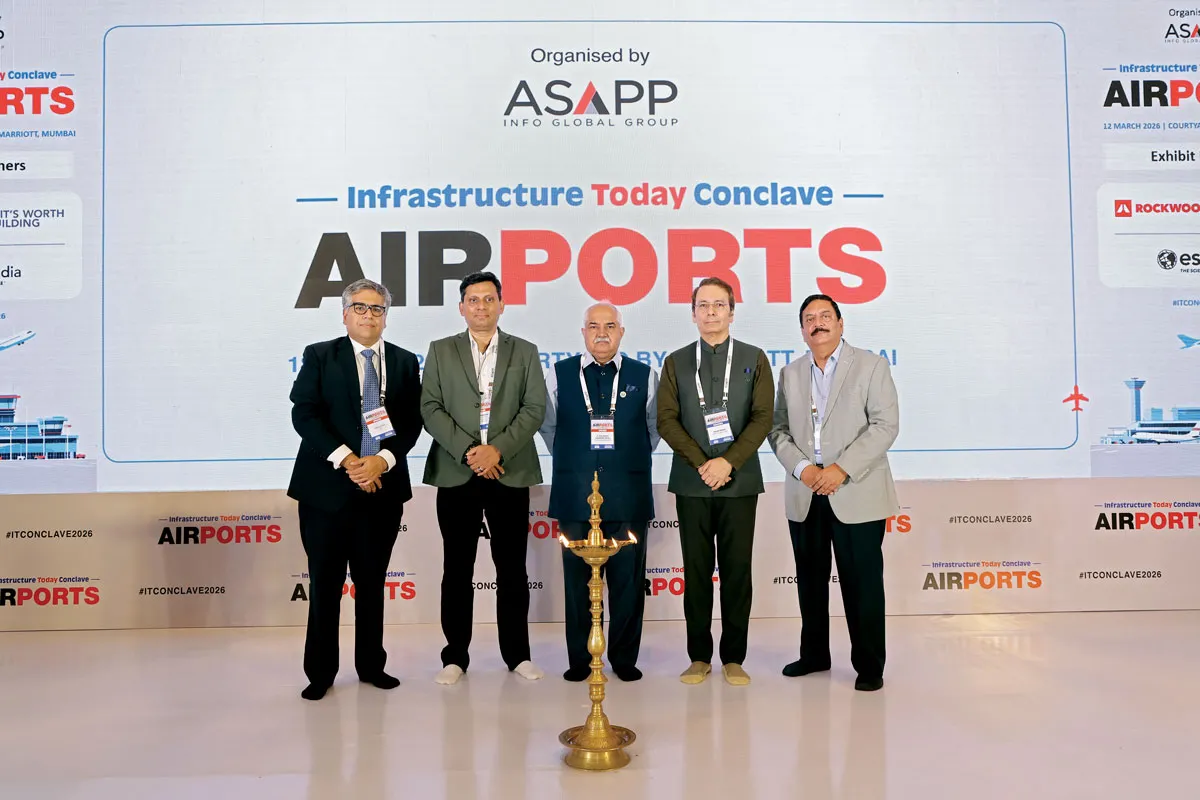
India’s aviation sector is entering a decisive phase – one where ambition is no longer defined by the number of airports being announced but by the system’s ability to deliver, sustain and monetise them.At the Infrastructure Today Airports Conclave held on March 12, 2026, at Courtyard by Marriott in Mumbai, a clear shift emerged: from building airports to building a viable aviation ecosystem. The event was supported by Silver Partner Pidilite, Innovation Partner Piramal Nextgen, Exhibit Partners Rockwool and esri India, and Business Intelligence Partner IMPACCT.Opening the discussion, Pratap Padode, Editor-in-Chief, Infrastructure Today, positioned aviation as a structural shift in India’s mobility landscape, driven by rising affordability and policy interventions like UDAN. Now the world’s third-largest aviation market, India is expected to see over 170 airports by 2029, with a long-term vision of nearly 400. However, this rapid expansion is already colliding with capacity constraints and operational pressure, raising a fundamental question: Can execution keep pace with ambition?A strong pipeline, with structural complexitiesThe scale of opportunity is undeniable. As highlighted by Tanveer Padode, CEO, IMPACCT, India currently has over 240 airport projects across various stages, from feasibility to execution. But unlike linear infrastructure such as roads, airport development is inherently complex, requiring detailed feasibility, long gestation periods and multilayered stakeholder coordination. The pace of expansion, therefore, is not just a function of intent, but of planning depth and execution capability. Equally critical is the question of accessibility. As aviation expands into smaller cities, affordability remains a constraint, indicating that infrastructure growth must align with demand maturity, not just supply creation.Execution – Where India wins, and where it slows downIf the pipeline reflects ambition, execution reveals capability. Drawing from military infrastructure, Lt Gen Rajeev Chaudhury, Former Director General, Border Roads Organisation, demonstrated how extreme constraints can accelerate delivery. In high-altitude regions where oxygen levels drop drastically and working windows are limited, projects are driven by survival conditions rather than conventional project parameters. Yet, despite these constraints, outcomes have been delivered at unprecedented speed – through tight logistics planning, simplified design and a mission-driven approach.The contrast with civil infrastructure is telling. While technical capability exists, delays are often systemic, driven by fragmented accountability, slow decision-making and procedural inefficiencies. The implication is clear: India’s challenge is not engineering – it is governance and coordination.Capital is available, but selectiveThe financing landscape has evolved alongside the sector. Airports are no longer viewed as standalone infrastructure assets but as integrated ecosystems with multiple revenue streams, ranging from aeronautical income to retail, real estate and services. This evolution has improved investor confidence, with mature assets achieving high credit ratings and demonstrating resilience even during disruptions like COVID. However, the next phase introduces new risks. With most metro airports already developed, the focus is shifting to Tier-2 and Tier-3 markets, where traffic visibility, revenue potential and operating economics remain uncertain. As a result, capital is becoming more selective. Investors are increasingly evaluating regulatory stability, traffic predictability and non-aero revenue potential before committing funds.Building while operating: The new normalAirport construction in India is no longer a greenfield exercise; it is increasingly a brownfield challenge. Expansions are being executed within live environments, where runways, terminals and passenger flows must remain uninterrupted. This leaves extremely limited construction windows and demands precise phasing, contingency planning and regulatory alignment. A recurring insight across stakeholders was that many delays originate not onsite but at the design stage, where constructability, material standardisation and execution constraints are often overlooked.At the same time, the definition of sustainability is evolving. The focus is shifting from operational efficiency to material choices, lifecycle durability and local sourcing, indicating a broader shift in how airport infrastructure is being conceptualised.The Tier-2 question: Connectivity vs. viabilityIndia’s next phase of aviation growth will be driven by regional airports but their long-term viability remains unresolved. While connectivity has improved significantly under UDAN, many Tier-2 and Tier-3 airports struggle with low demand, high operating costs and limited revenue streams. The discussions pointed to a fundamental gap: Regional airports are often developed using the same frameworks as metro hubs, without accounting for differences in scale, economics and demand patterns.Sustainability, therefore, depends on integration with local economies, whether through tourism, manufacturing, logistics or agriculture. Without this alignment, airports risk becoming underutilised assets rather than growth enablers.Operations under pressureEven as new airports are planned, existing ones are operating at or beyond capacity. Major hubs like Mumbai are handling traffic far exceeding their designed limits, forcing operators to optimise rather than expand. This has led to a shift towards data-driven operations, where AI, digital platforms and real-time analytics are used to improve throughput, reduce delays and enhance passenger experience.At the same time, airports are evolving into experience-led environments, where retail, hospitality and service delivery play a critical role in revenue generation. Operationally, a hybrid model is emerging – balancing inhouse control with outsourced expertise – to address talent shortages and increasing complexity.Cargo: The underleveraged opportunityOne of the most critical gaps identified was in cargo. Despite contributing disproportionately to global trade value, air cargo in India remains underdeveloped and fragmented. While major airports have basic infrastructure, the lack of end-to-end integration – particularly in cold-chain logistics – limits efficiency and scalability. For sectors such as pharmaceuticals and agriculture, this is a significant bottleneck. Temperature-sensitive supply chains, in particular, suffer from inconsistencies across handling points, reducing reliability.The opportunity, however, is substantial. With the right ecosystem – integrated logistics, dedicated freighters and policy support – cargo can emerge as a major revenue driver for airports.From infrastructure to ecosystemAcross sessions, a consistent theme emerged: airports are no longer isolated infrastructure projects. They are economic ecosystems, integrating transport, logistics, commerce, data and urban development. This shift requires a corresponding change in approach, moving from project-led execution to system-led planning.India’s aviation sector has already demonstrated its ability to scale. The next challenge is more complex: To deliver infrastructure that is financially viable, operationally efficient and aligned with long-term economic growth.The opportunity is clear. So is the gap. Bridging it will define the next decade of India’s aviation story.CW Lens: Key takeawaysExpansion shifting to execution focusPipeline strong, delivery unevenFinancing becoming risk-sensitiveTier-2 viability remains uncertainCargo underdeveloped, high potentialPlanning gaps driving delaysBrownfield complexity increasingAI enabling capacity optimisationAirports evolving into ecosystemsGovernance key to faster deliveryQuotes (All Speakers & Moderators)Pratap Padode: “Aviation is finally set for take-off – and this time, the momentum is structural.”Tanveer Padode: “We are currently tracking 241 airport projects across India.”Lt. Gen. Rajeev Chaudhury: “At these altitudes, the challenge is survival first.”Session 1Dr. Vasudevan: “Airports are no longer transport assets; they are complex ecosystems.”Aditya Taneja: “Traffic risk cannot be eliminated; it can only be managed.”Nitesh Jain: “The sector has come full circle, from uncertainty to AAA-rated assets.”Ashish Dongre: “The next challenge is the viability of the next set of airports.”Session 2Nilabha Dey: “Airports today are critical urban infrastructure.”Manoj Tipnis: “Building a brownfield airport is like open-heart surgery.”Cdr. Pradeep Dixit: “Safety cannot be an afterthought – it must be designed in.”Rajesh Jethwani: “99 per cent construction means nothing without compliance.”Biswajit Sarma: “Constructability must drive design, not the other way around.”Krunal Negandhi: “Sustainability must move from operations to materials.”Shashidhar Suvarna: “Durability and lifecycle thinking define sustainability.”Ramesh Ogale: “What is not planned on paper cannot be fixed on site.”Session 3Jehan Sabavala: “The question is no longer connectivity; it is sustainability.”Rahul Khanna: “Non-aero revenues must be planned from Day 1.”Sundar Chandramouli: “Tier-2 airports must work in synergy, not competition.”Mehnaz Ansari: “Regional airports need a different rulebook.”Amol Khair: “Without an ecosystem, airports become stranded assets.”Session 4Milan Zatakia: “Airports today are mini smart cities.”Hitharth Mankodi: “Hybrid models are not a choice – they are a necessity.”Diloo Parikh: “Passenger experience is as important as operations.”Session 5Ankit Kedia: “Air cargo drives disproportionate value in global trade.”Chaitaly Mehta: “Cargo was treated as a stepchild – until the pandemic.”Preeti Saluja: “Cold-chain breaks compromise lives.”Neeraj Kumar: “From farm to aircraft, the chain is only as strong as its weakest link.”