Pune Smart City Conference
SMART CITIES

Pune Smart City Conference

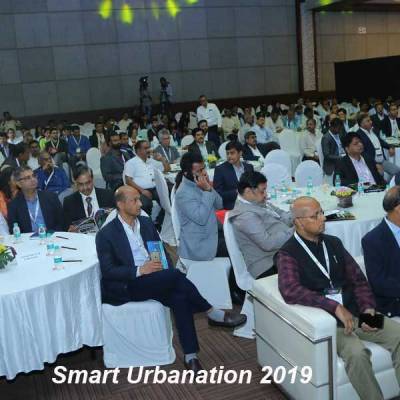
Smart Cities Council India partners were in attendance to discuss aspects that could contribute to making Pune a true smart city in the years to come. Smart Cities Council India (SCCI), in association with Pune Smart City Development Corporation (PSCDCL), organised a Think Table meet on...

Smart Cities Council India partners were in attendance to discuss aspects that could contribute to making Pune a true smart city in the years to come. Smart Cities Council India (SCCI), in association with Pune Smart City Development Corporation (PSCDCL), organised a Think Table meet on December 6, 2018, at Pune.  The event focussed on various standardisation initiatives to be adopted in the smart cities. Smart Cities Think Tables (SCTT) are a series of forum sessions organised by SCCI in different cities of India where the biggest challenges facing the sector are detailed and discussed threadbare. During the conference, the Council’s partners were in attendance to discuss the future smart city requirements of Pune, as well as address the urban challenges faced, and solutions for the same. In his inaugural address, Dr Rajendra Jagtap, CEO, PSCDCL, mentioned that the city aims to use an “integrated approach to provide solutions.” Through a state-of-the-art command and control centre and revolutionary traffic management system, Pune aims to integrate parameters of the Municipal Corporation, Police Department, Fire Department and other utility departments under one centralised control. Through this system, as Dr Jagtap explained, “the city will be in a position to provide to its citizens a faster response time for emergencies, provide real-time traffic and weather data on variable message displays, and manage the public transportation system with the highest level of efficiency.” For Pune Smart City, improving city services through data analysis is a big priority. Using data gathered from the CCTV surveillance and traffic patterns, the city hopes to deduce important information to help with junction redesign, carry limit for streets, areas that require parking spaces, trees and more open spaces, and even urban street art. During the Think Table meet, Dr Jagtap interacted with SCCI members and discussed the progress on the city development plan and defined its needs. Going forward, he emphasised on the need for IT solutions for traffic management, solutions for health, education, governance and mobility, smart lighting, water metering, green transport, safety and surveillance for the city.  Manojit Bose, Chief Knowledge Officer, PSCDCL, interacted with the SCCI members, including TomTom, E&Y, SenRa, Anchor, SAS and VMware, and conveyed expectations from them, particularly with regard to improving liveability standards as the core of the smart city framework and the importance of timely implementation of the projects. For their part, the SCCI partners presented solutions to meet the challenges the city faces and take ahead the development of the smart city in Pune.  According to Bose, Pune Smart City is ensuring the constant promotion and adaptation of new technology and is in the process of procuring 500 e-buses, 150 of which will be on the roads by January 26. That apart, the city is using optic fibre ducts to establish high-speed Internet connectivity.  An e-corridor is being set up to create Wi-Fi connectivity throughout the city, accessible through smartphones. Further, 500 new smart toilets and smart poles will be constructed around Pune. Dr Rajendra Jagtap thanked SCCI for hosting Think Table with Pune Smart City and emphasised that with large-scale ‘smartification’ of 100 cities, Pune could provide useful insights regarding smart city standards and best practices to the rest of the world.  

Next Story
Infrastructure Urban

ISRO’s IMAT Success Boosts Readiness for Maiden Gaganyaan Mission

Union Minister of State for Science and Technology Dr Jitendra Singh informed Parliament that ISRO has achieved a key milestone in its preparations for India’s first human space mission with the successful completion of the Integrated Main Parachute Airdrop Test (IMAT). He said in the Lok Sabha that the test forms a central part of the qualification campaign for the Crew Module’s parachute-based deceleration system, one of the most vital elements in human-rating the mission.According to Dr. Jitendra Singh, the IMAT recreated one of the most demanding descent conditions by intentionally del..

Next Story
Infrastructure Urban

Gyanesh Kumar Takes Charge as Chair of International IDEA Council

Chief Election Commissioner of India Gyanesh Kumar has assumed the Chairship of the Council of Member States of the International Institute for Democracy and Electoral Assistance for 2026. The ceremony in Stockholm was also attended by India’s Ambassador to Sweden, Anurag Bhushan. India, a founding member of International IDEA, has long contributed to the organisation’s governance and global democratic dialogue, and the new Chairship signals broad recognition of the Election Commission of India as a trusted and innovative election management institution.During his visit, Kumar held discuss..

Next Story
Infrastructure Energy

Coal Mines Boost Local Growth and Support India’s Energy Self-reliance

The Magadh and Amrapali coal mines in Jharkhand are playing a pivotal role in strengthening India’s energy security, contributing nearly half of Central Coalfields Limited’s total coal production in 2024–25. Both mines support the broader goal of ensuring steady coal availability for the power sector under the vision of Aatmanirbhar Bharat. Magadh has estimated mineable reserves of 854.91 million tonnes, while Amrapali holds 456.34 million tonne. For FY 2025–26, the two are expected to generate net sales revenues of Rs 28.12 billion and Rs 23.67 billion respectively. Local development ..

Advertisement

Subscribe to Our Newsletter

Get daily newsletters around different themes from Construction world.

STAY CONNECTED

Advertisement

Advertisement

Advertisement

Advertisement

Get CW App