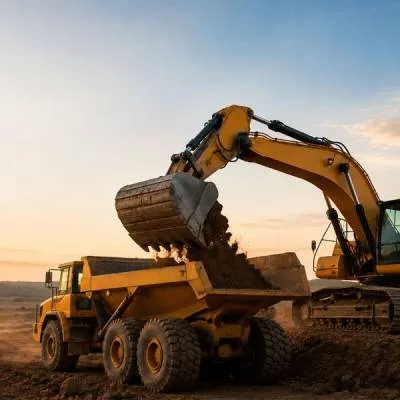
We need to ensure that all the equipment talk to each other
Equipment

We need to ensure that all the equipment talk to each other

Caterpillar has been a key partner in India’s growth since the 1930s, supporting growth in mining, transportation, captive power generation and construction of infrastructure. Vivek Vanmeeganathan, Director, Material Handling & Underground (MH&U) Division, Caterpillar India, shares more…

Market opportunities: Infrastructure will still be the primary segment, within which, roads will be the biggest driver. There have been projects, but the progress has been slow compared to the recent past. But the last two months has been a good indication of where the industry is heading.

Enhancing productivity: The success of a project or its efficiency is largely determined by how the all the equipment are getting well-coordinated and connected. The assets are first connected, and then through an app, you can actually track the machines’ activities at any given point in time. The contractor gets real time visibility, which helps in efficient utilisation of the asset. Also, coordination is important, and hence, we need to ensure that all the equipment talk to each other.

In terms of the overall operating cost, fuel plays a vital role – it can drive more efficiency ensuring minimal time consumption, and that is what our technology typically does. It helps in condition monitoring and predictive maintenance, ensuring that availability of equipment is not an issue. Condition monitoring and site efficiency are two key aspects that can drive productivity and efficiency.

Skilling operators: We have two big channel partners – Gmmco and GCPL – and this is one of our biggest competitive advantages. They have extensive training programmes for the operators. It is the skill of the operator that determines the machine’s efficiency and utilisation.

Product launches: All our machines displayed at Excon 2019 are connected assets. Caterpillar has traditionally enjoyed being the market leader in the motor grade segment. And, at Excon 2019, we launched the next gen motor grader. The next gen motor grader is an upgraded machine with better technology, productivity and efficiency.

Caterpillar has been a key partner in India’s growth since the 1930s, supporting growth in mining, transportation, captive power generation and construction of infrastructure. Vivek Vanmeeganathan, Director, Material Handling & Underground (MH&U) Division, Caterpillar India, shares more… Market opportunities: Infrastructure will still be the primary segment, within which, roads will be the biggest driver. There have been projects, but the progress has been slow compared to the recent past. But the last two months has been a good indication of where the industry is heading. Enhancing productivity: The success of a project or its efficiency is largely determined by how the all the equipment are getting well-coordinated and connected. The assets are first connected, and then through an app, you can actually track the machines’ activities at any given point in time. The contractor gets real time visibility, which helps in efficient utilisation of the asset. Also, coordination is important, and hence, we need to ensure that all the equipment talk to each other. In terms of the overall operating cost, fuel plays a vital role – it can drive more efficiency ensuring minimal time consumption, and that is what our technology typically does. It helps in condition monitoring and predictive maintenance, ensuring that availability of equipment is not an issue. Condition monitoring and site efficiency are two key aspects that can drive productivity and efficiency. Skilling operators: We have two big channel partners – Gmmco and GCPL – and this is one of our biggest competitive advantages. They have extensive training programmes for the operators. It is the skill of the operator that determines the machine’s efficiency and utilisation. Product launches: All our machines displayed at Excon 2019 are connected assets. Caterpillar has traditionally enjoyed being the market leader in the motor grade segment. And, at Excon 2019, we launched the next gen motor grader. The next gen motor grader is an upgraded machine with better technology, productivity and efficiency.

Next Story
Infrastructure Energy

India Adds Record 44.61 GW Solar Capacity in FY2026

India’s solar sector reached a milestone in FY2026, with cumulative installed capacity crossing 150 GW and annual additions hitting a record 44.61 GW, exceeding the government target of 34 GW and nearly doubling FY2025’s 23.83 GW. Distributed Renewable Energy contributed 16.3 GW, while PPA and C&I segments accounted for 34 per cent and 30 per cent, respectively.India has risen from 9th globally in 2015 to 3rd in cumulative solar capacity by 2025 and is set to become the world’s second-largest solar market in annual installations in 2026. Seven states, led by Rajasthan and Gujarat, ac..

Next Story
Real Estate

Abhee Ventures unveils Scottish-themed 45-acre township in Bengaluru

Abhee Ventures, a leading South Indian real estate developer, has announced “Codename New Dimension,” a 45-acre Scottish-themed residential township at Gunjur on Whitefield–Sarjapur Road, Bengaluru. Strategically located between Whitefield and Sarjapur Road, Gunjur benefits from strong connectivity to the Outer Ring Road IT corridor, ITPL, EPIP, the upcoming Dommasandra Metro Station, and the proposed SWIFT City and Peripheral Ring Road.The township, designed in collaboration with London-based UHA London and India’s RSP Architects, offers low-density living with 85 per cent open spaces..

Next Story
Infrastructure Urban

BPE launches world’s thinnest Active Tile for legacy data centres

Best Power Equipments (India) Pvt Ltd (BPE), a leading provider of power solutions, data centre systems, and Battery Energy Storage Systems (BESS), has launched the BPE Active Tile, the world’s thinnest active tile designed for legacy data centres and telecom infrastructure. At just 65 mm thick, the tile requires significantly less space than conventional active tiles, which need nearly 450 mm floor depth.“Most legacy data centres were built decades ago for lower IT loads and traditional airflow patterns,” said A Prabhu, Executive Director – Technical (Global Operations), BPE. “As ra..

Advertisement

Subscribe to Our Newsletter

Get daily newsletters around different themes from Construction world.

STAY CONNECTED

Advertisement

Advertisement

Advertisement