ZF’s high-bay warehouse in Schweinfurt automated by Jungheinrich
Equipment

ZF’s high-bay warehouse in Schweinfurt automated by Jungheinrich

Jungheinrich has automated the high-bay warehouse of global automotive supplier ZF in Schweinfurt, paving the way for an entirely automated material flow from storage to production supply.

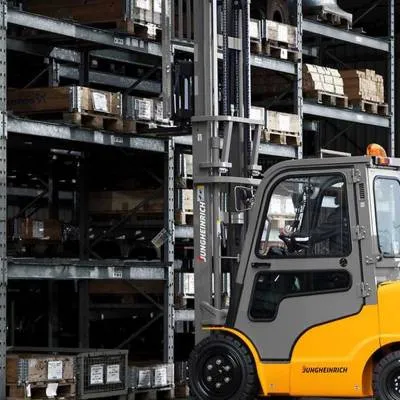
The intralogistics experts from Hamburg provided an integrated solution from a single source, which has now been achieved. The initial position in ZF's high-bay warehouse in Schweinfurt included 985 rack storage areas for large plastic load carriers, pallet cages and Euro pallets. These were distributed over five aisles that were 6.25 m high and 17.7 m long.

Production elements earlier came into the warehouse through a security door system and were deposited there manually.

To automate this process completely, covering narrow-aisle storage, racking and transport from the security door to the warehouse, Jungheinrich delivered the racking system with area access control and the conveyor systems. The boxes and pallets, in the future, would pass via a triple control along with the conveyor system: clearance, weight and contour controls.

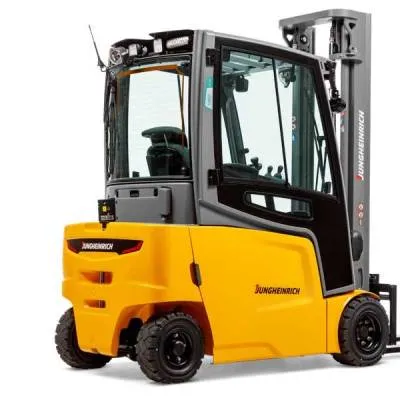
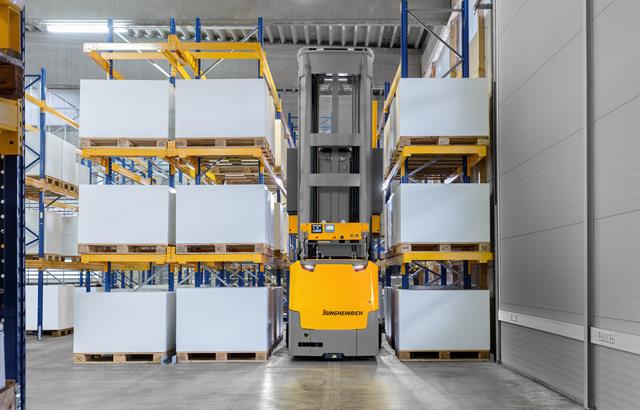
After the barcode is read automatically, they are transported to the high-bay warehouse through roller conveyors on two sides. Jungheinrich's driverless and automated version of the standard EKX narrow-aisle truck, an EKX 516 ka, takes over there.

It delivers the loading units to their exact locations in the ZF warehouse - around the clock. Rails along the racking on the aisles transport the EKX 516ka with electricity. It has an onboard battery charger.

Information about stacking and picking takes place directly and without manual scanning from the forklift to the warehouse management system, which results in even greater productivity. Jungheinrich also provided ZF in Schweinfurt with a Warehouse Control System (WCS) highlighting an integrated material flow calculator.

As per the project lead at ZF, Dominik Hüllmantel, and team lead of intralogistics at ZF, Andre Hofmann, one of the principal reasons they chose Jungheinrich was exactly this all-inclusive package.

The EKX 516ka-operated rack warehouse is an effective solution for them, given the complexity of their methods and the limited space availability.

Image Source


Also read: Sany becomes world’s largest excavator seller in 2020

Also read: Hyundai launches three special attachments with the launch of HX380L

Jungheinrich has automated the high-bay warehouse of global automotive supplier ZF in Schweinfurt, paving the way for an entirely automated material flow from storage to production supply. The intralogistics experts from Hamburg provided an integrated solution from a single source, which has now been achieved. The initial position in ZF's high-bay warehouse in Schweinfurt included 985 rack storage areas for large plastic load carriers, pallet cages and Euro pallets. These were distributed over five aisles that were 6.25 m high and 17.7 m long. Production elements earlier came into the warehouse through a security door system and were deposited there manually. To automate this process completely, covering narrow-aisle storage, racking and transport from the security door to the warehouse, Jungheinrich delivered the racking system with area access control and the conveyor systems. The boxes and pallets, in the future, would pass via a triple control along with the conveyor system: clearance, weight and contour controls. After the barcode is read automatically, they are transported to the high-bay warehouse through roller conveyors on two sides. Jungheinrich's driverless and automated version of the standard EKX narrow-aisle truck, an EKX 516 ka, takes over there. It delivers the loading units to their exact locations in the ZF warehouse - around the clock. Rails along the racking on the aisles transport the EKX 516ka with electricity. It has an onboard battery charger. Information about stacking and picking takes place directly and without manual scanning from the forklift to the warehouse management system, which results in even greater productivity. Jungheinrich also provided ZF in Schweinfurt with a Warehouse Control System (WCS) highlighting an integrated material flow calculator. As per the project lead at ZF, Dominik Hüllmantel, and team lead of intralogistics at ZF, Andre Hofmann, one of the principal reasons they chose Jungheinrich was exactly this all-inclusive package. The EKX 516ka-operated rack warehouse is an effective solution for them, given the complexity of their methods and the limited space availability. Image SourceAlso read: Sany becomes world’s largest excavator seller in 2020 Also read: Hyundai launches three special attachments with the launch of HX380L

Next Story
Infrastructure Urban

Implementation Status of Jal Jeevan Mission

Since August 2019 the Government has implemented Jal Jeevan Mission to provide assured potable water through household tap connections in rural India. At the start of the mission only 32.3 million (mn) rural households, representing 16.7 per cent, were reported to have tap water connections. States and union territories have reported that 125.8 mn additional rural households have since been provided with tap connections. As a result, of about 193.6 mn rural households roughly 158.2 mn, or 81.71 per cent, are reported to have tap water supply at home.\n\nThe State, district and village level st..

Next Story
Infrastructure Urban

Jal Jeevan Mission Reaches Eighty One Per Cent Rural Coverage

The Government reported substantial progress under the Jal Jeevan Mission, launched in August 2019 to provide tap water to every rural household. At launch only 32.3 million (mn) rural households had tap connections and states and Union territories reported provision of 125.8 mn additional households by March 2026. Consequently, out of about 193.6 mn rural households around 158.2 mn, or 81.71 per cent, are reported to have tap water at home. The Finance Minister announced extension of the mission until 2028 in the 2025-26 budget speech. The Swachh Bharat Mission Grameen, launched in October 20..

Next Story
Infrastructure Urban

Empowering Local Governance for Sustainable Rural Water Supply

The Ministry of Jal Shakti has aligned the Jal Jeevan Mission (JJM) with the 73rd Amendment to strengthen village level planning and community ownership of water supply. Gram Panchayats, village water and sanitation committees and Pani Samitis are to plan, implement, manage and maintain piped water systems, with gram sabha processes formalising handover and oversight. Implementation support agencies including non government organisations, community based organisations and self help groups have been empanelled to train local committees and promote women participation. Under JJM, the department ..

Advertisement

Subscribe to Our Newsletter

Get daily newsletters around different themes from Construction world.

STAY CONNECTED

Advertisement

Advertisement

Advertisement