



Delhi Expands TOD Policy to Boost Affordable Housing
Real Estate

Delhi Expands TOD Policy to Boost Affordable Housing

The Government has reinforced Transit Oriented Development (TOD) as envisaged in the Master Plan of Delhi 2021 (MPD?2021) through the Regulations for Transit Oriented Development and Charges, 2026, to promote planned, sustainable and transit linked urban growth. The measures aim to enhance accessibility along metro corridors and to expand affordable housing supply in the National Capital Territory of Delhi (NCT).

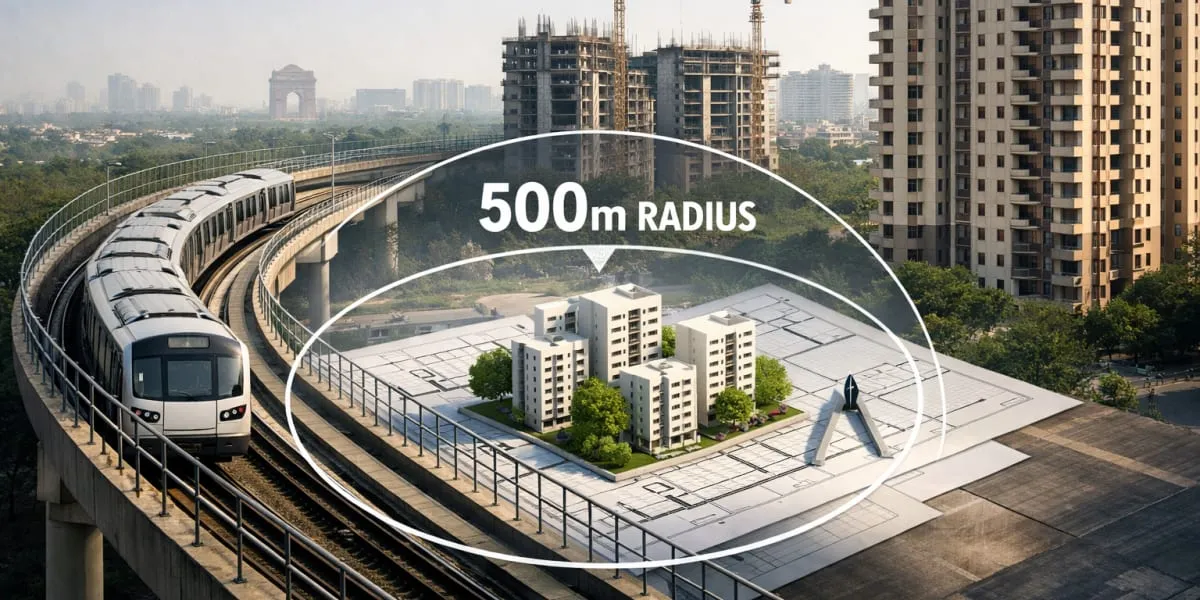
The Regulations designate a 500?metre radius around metro and regional rapid transit system (RRTS) corridors and stations, opening an area of 207 square kilometres for TOD interventions. About 80 square kilometres that were previously excluded, including land under land pooling, low density residential zones and unauthorised colonies, have now been brought within the TOD purview.

The corridor based approach applies to both operational and proposed metro and RRTS lines and allows development to proceed with new transit construction. Plots of 2000 square metres may qualify for TOD benefits where road width criteria are met. Maximum floor area ratio up to 500 is permitted on qualifying plots with an 18 metre road, with 65 per cent earmarked for residential use.

Residential allocation covers dwelling units with a built up area of 100 square metres or less. The remaining 35 per cent of floor area ratio allows mixed uses, with 10 per cent for commercial and amenities and 25 per cent flexible for larger housing, office space or guest accommodation. Provisions also allow underground or elevated pedestrian walkways to link plots with stations.

The Regulations simplify charges into a single TOD charge covering water, sewerage, municipal sanction fees and conversion levies, replacing earlier multiple levies. Ease of doing business measures include a single window approval system and replacement of the node based approach. A TOD committee chaired by the vice chairman of the Delhi Development Authority will coordinate time bound clearances and ensure stakeholder cooperation.

"Join industry leaders at RAHSTA Expo, India's premier platform for roads, highways and traffic infrastructure. Register now to explore innovations, network with experts and shape the future of mobility."

The Government has reinforced Transit Oriented Development (TOD) as envisaged in the Master Plan of Delhi 2021 (MPD?2021) through the Regulations for Transit Oriented Development and Charges, 2026, to promote planned, sustainable and transit linked urban growth. The measures aim to enhance accessibility along metro corridors and to expand affordable housing supply in the National Capital Territory of Delhi (NCT). The Regulations designate a 500?metre radius around metro and regional rapid transit system (RRTS) corridors and stations, opening an area of 207 square kilometres for TOD interventions. About 80 square kilometres that were previously excluded, including land under land pooling, low density residential zones and unauthorised colonies, have now been brought within the TOD purview. The corridor based approach applies to both operational and proposed metro and RRTS lines and allows development to proceed with new transit construction. Plots of 2000 square metres may qualify for TOD benefits where road width criteria are met. Maximum floor area ratio up to 500 is permitted on qualifying plots with an 18 metre road, with 65 per cent earmarked for residential use. Residential allocation covers dwelling units with a built up area of 100 square metres or less. The remaining 35 per cent of floor area ratio allows mixed uses, with 10 per cent for commercial and amenities and 25 per cent flexible for larger housing, office space or guest accommodation. Provisions also allow underground or elevated pedestrian walkways to link plots with stations. The Regulations simplify charges into a single TOD charge covering water, sewerage, municipal sanction fees and conversion levies, replacing earlier multiple levies. Ease of doing business measures include a single window approval system and replacement of the node based approach. A TOD committee chaired by the vice chairman of the Delhi Development Authority will coordinate time bound clearances and ensure stakeholder cooperation.

Next Story
Real Estate

SNN Estates Expands North Bengaluru Housing Project

SNN Estates has announced an expansion of its SNN Estates Felicity residential project in North Bengaluru following strong buyer demand, with 75 per cent of the first-phase inventory sold within three days of launch.The developer will add 76 apartments in the new phase, taking the project's estimated revenue potential to around Rs 1,000 crore upon completion of Phase 2.Spread across 6.5 acres in Rachenahalli, near Manyata Tech Park, the project comprises 604 apartments in 1.5, 2, 2.5, 3 and 4 BHK configurations. The development includes a 50,000-sq-ft clubhouse with amenities such as sports co..

Next Story
Infrastructure Urban

SCG Drives ASEAN Industrial Transformation Strategy

SCG is strengthening its focus on ASEAN as a key growth region by advancing industrial transformation, enhancing competitiveness and building resilient regional value chains. Thammasak Sethaudom, President and Chief Executive Officer, SCG, highlighted the need for industries to continuously develop capabilities, strengthen resilience and deepen regional cooperation to achieve sustainable long-term growth.SCG views ASEAN as an important growth engine alongside China, supported by favourable demographics, trade connectivity and investment flows. With ASEAN’s GDP projected to grow by around 4.7..

Next Story
Products

EUROBOND Expands NABL Accreditation to 51 Testing Parameters

EUROBOND, the flagship brand of Euro Panel Products, has expanded the National Accreditation Board for Testing and Calibration Laboratories (NABL) accreditation of its in-house laboratory from 16 to 51 mechanical and chemical testing parameters, making it the only Indian aluminium composite panel (ACP) manufacturer with accreditation covering such an extensive testing scope.The expanded accreditation enables the company to independently test coils, coatings, cores, aluminium composite panels (ACP) and metal composite panels (MCP) in accordance with international standards, including IS, ASTM, ..

Advertisement

Subscribe to Our Newsletter

Get daily newsletters around different themes from Construction world.

STAY CONNECTED

Advertisement

Advertisement

Advertisement