+
Buildroid AI Raises USD 2 Million to Launch Construction Robots
Technology

Buildroid AI Raises USD 2 Million to Launch Construction Robots

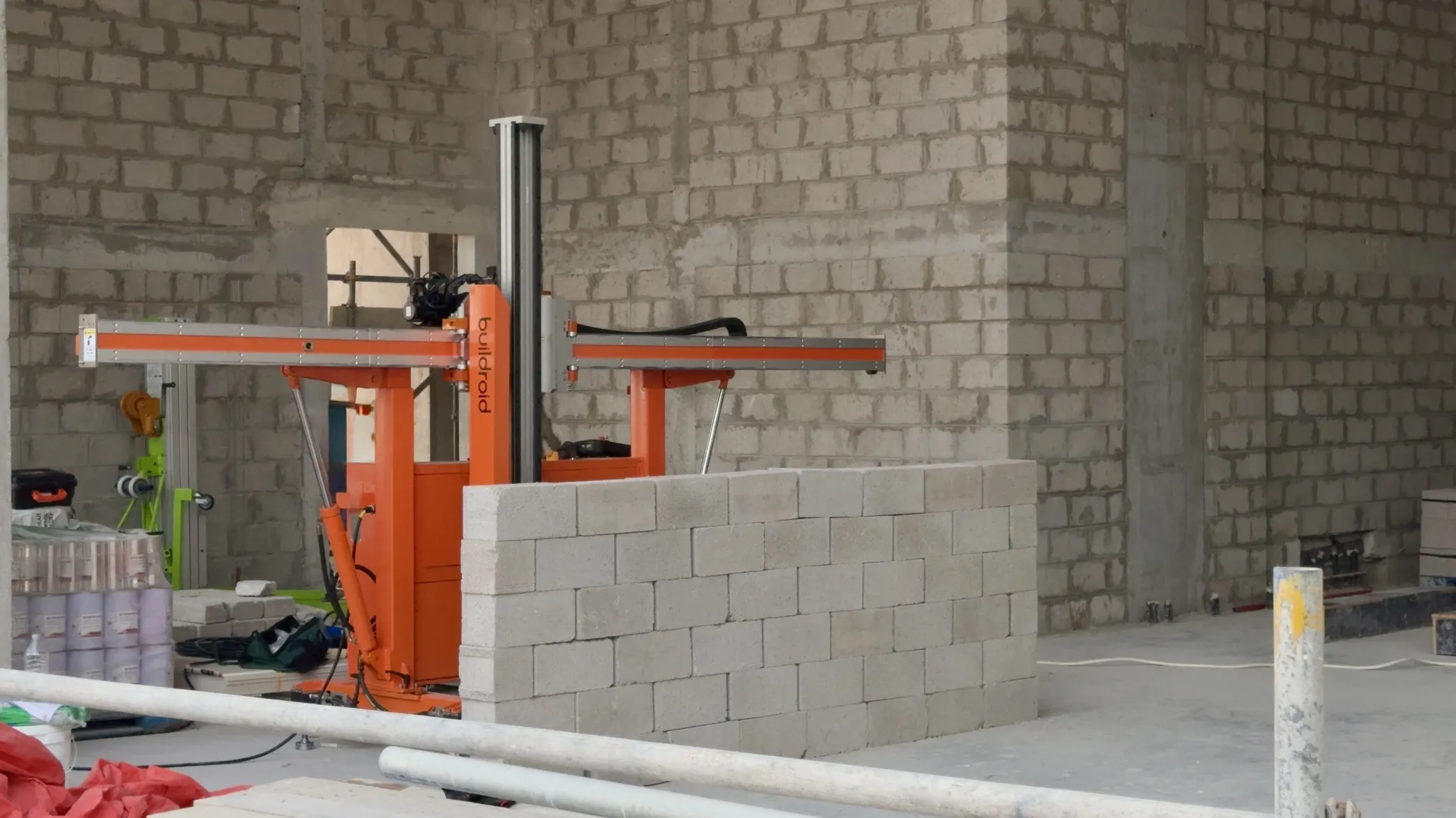
Buildroid AI has emerged from stealth with USD 2 million in pre-seed funding led by Tim Draper, marking the launch of its first AI-driven block-laying robot, unveiled at the Big Five Construction Conference in Dubai. The initiative targets productivity challenges in the UAE construction sector, which is projected to grow 5.2 per cent in 2025 and reach USD 130 billion by 2029.
Founded by Slava Solonitsyn, a YC alumnus and former founder of Mighty Buildings, and Anton Glance, founder of Glance Clock, Buildroid initially aims to transform partition wall-building before scaling to wider applications within the UAE’s USD 42.75 billion construction market.
Slava Solonitsyn, CEO and Co-founder, said: “UAE’s construction growth demands solutions to persistent labour shortages and productivity bottlenecks. Construction robots have been around for over a decade, but have had limited success, primarily because they automate narrow skills and require significant additional labour to support them. With the rapid development of AI, it has become possible to bring general-purpose and industrial robots to construction as well.”
Buildroid integrates Building Information Models with AI-based Digital Twin simulations powered by Nvidia Omniverse to optimise robotic workflows. Its simulated block-laying robot is currently being piloted on UAE construction sites and will be supported by Autonomous Mobile Robots for automated material delivery. The system delivers productivity improvements of up to 10x and cost reductions of up to 4x compared with manual labour.
The startup plans to expand into ERP-style orchestration for robotics, enabling simulation-first workflows and large-scale deployment across contractors. The approach differentiates Buildroid from single-purpose robotic providers in the MENA region, where construction is projected to reach USD 401.2 billion by 2030.
Imad Itani, Head of Innovation, ALEC, said: “In line with our robotics strategy, we are piloting Buildroid’s robotic block-laying system and look forward to leveraging their BIM simulation tools to virtually test solutions and de-risk onsite deployment.”
Lead investor Tim Draper said the platform offers scalable automation supported by skilled operators, combining multiple robotic technologies validated through BIM-based simulations.
The funding will be used to expand pilot programmes, advance simulation and autonomous capabilities, and accelerate commercial rollouts. Buildroid plans to deploy its first commercially available AI-powered robotics teams in Q2 next year through partnerships with major contractors.

Buildroid AI has emerged from stealth with USD 2 million in pre-seed funding led by Tim Draper, marking the launch of its first AI-driven block-laying robot, unveiled at the Big Five Construction Conference in Dubai. The initiative targets productivity challenges in the UAE construction sector, which is projected to grow 5.2 per cent in 2025 and reach USD 130 billion by 2029.Founded by Slava Solonitsyn, a YC alumnus and former founder of Mighty Buildings, and Anton Glance, founder of Glance Clock, Buildroid initially aims to transform partition wall-building before scaling to wider applications within the UAE’s USD 42.75 billion construction market.Slava Solonitsyn, CEO and Co-founder, said: “UAE’s construction growth demands solutions to persistent labour shortages and productivity bottlenecks. Construction robots have been around for over a decade, but have had limited success, primarily because they automate narrow skills and require significant additional labour to support them. With the rapid development of AI, it has become possible to bring general-purpose and industrial robots to construction as well.”Buildroid integrates Building Information Models with AI-based Digital Twin simulations powered by Nvidia Omniverse to optimise robotic workflows. Its simulated block-laying robot is currently being piloted on UAE construction sites and will be supported by Autonomous Mobile Robots for automated material delivery. The system delivers productivity improvements of up to 10x and cost reductions of up to 4x compared with manual labour.The startup plans to expand into ERP-style orchestration for robotics, enabling simulation-first workflows and large-scale deployment across contractors. The approach differentiates Buildroid from single-purpose robotic providers in the MENA region, where construction is projected to reach USD 401.2 billion by 2030.Imad Itani, Head of Innovation, ALEC, said: “In line with our robotics strategy, we are piloting Buildroid’s robotic block-laying system and look forward to leveraging their BIM simulation tools to virtually test solutions and de-risk onsite deployment.”Lead investor Tim Draper said the platform offers scalable automation supported by skilled operators, combining multiple robotic technologies validated through BIM-based simulations.The funding will be used to expand pilot programmes, advance simulation and autonomous capabilities, and accelerate commercial rollouts. Buildroid plans to deploy its first commercially available AI-powered robotics teams in Q2 next year through partnerships with major contractors.

Next Story
Infrastructure Transport

MMRDA Installs 325-Tonne Steel Spans on Mumbai Metro Line 4

The Mumbai Metropolitan Region Development Authority (MMRDA) has achieved a key construction milestone on Metro Line 4 with the successful installation of three large steel spans at Bhandup West during overnight operations.The spans, together weighing 325 metric tonnes, were launched using eight heavy-duty cranes and 12 multi-axle vehicles. The operation required precise engineering and meticulous planning to minimise disruption in the densely populated suburban area.Due to effective inter-agency coordination, the work—originally scheduled across four nights—was completed within just two n..

Next Story
Infrastructure Transport

CMRL Targets March 2027 Opening for Vadapalani–Panagal Park

Chennai Metro Rail Limited (CMRL) is progressing as scheduled to open the Vadapalani–Panagal Park section of Phase II’s Corridor 4 by March 2027. The 3.5 km underground stretch is part of the 26.1 km Corridor 4 connecting Lighthouse with Poonamallee Bypass.Construction activities are advancing steadily, with tunnelling works between Vadapalani and Panagal Park already completed. Track-laying operations are expected to commence shortly. At Panagal Park station, structural works have reached the concourse and platform levels, while excavation continues at the lowest level.CMRL is also consid..

Next Story
Infrastructure Transport

Maha-Metro Invites Pune Metro Civil Maintenance Bids

Maharashtra Metro Rail Corporation Limited (Maha-Metro) has invited bids for the annual civil maintenance contract of the Pune Metro Rail Project. The tender, bearing ID and number P1-O&M-20/2025, is scheduled to close on 23 February 2026, with a pre-bid meeting slated for 10 February 2026. The earnest money deposit (EMD) for the contract is Rs 3,50,500, and the duration of the contract is one year.The scope of work includes annual civil maintenance of 28 elevated and underground stations, 28.079 km of elevated viaduct including steel bridges, 12.15 km of tunnels, and two depots under the ..

Advertisement

Subscribe to Our Newsletter

Get daily newsletters around different themes from Construction world.

STAY CONNECTED

Advertisement

Advertisement

Advertisement

Open In App