+
India’s Data Centre Expansion Accelerates as US Faces Resistance
Technology

India’s Data Centre Expansion Accelerates as US Faces Resistance

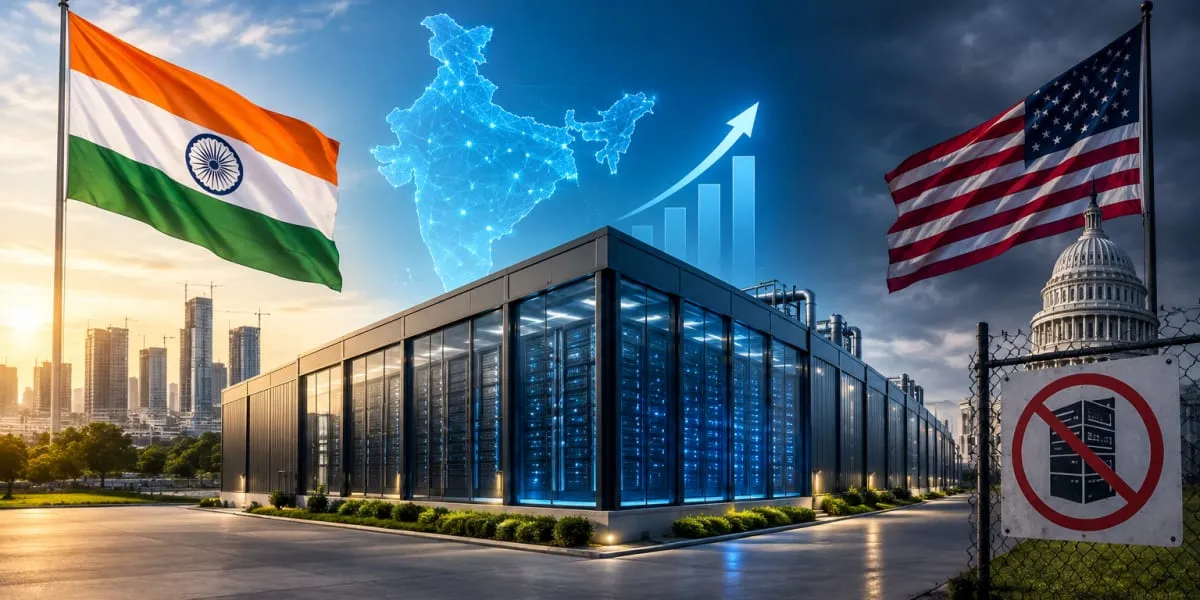
India’s data centre expansion is accelerating as technology companies increase investments in artificial intelligence and cloud infrastructure, while the US confronts growing opposition to new facilities. Amazon, Microsoft and Google have committed nearly $57 bn to India’s AI, cloud and data centre infrastructure in less than a year.

India’s data centre capacity crossed 2.1 GW at the end of the June quarter, according to S&P Global and CBRE. About 200 MW was added during the first six months of the year, with another 500 MW expected to be commissioned through the rest of 2026. India generates nearly 20 per cent of the world’s data but hosts about 3 per cent of global data centre capacity.

Mumbai, including Navi Mumbai, remains the leading market, accounting for about 44 per cent of national capacity. Noida contributes 20 per cent, followed by Chennai at 10 per cent, Hyderabad at 9 per cent, Pune at 8 per cent and Bengaluru at 6 per cent. Mumbai’s subsea cable landing stations and access to international connectivity have helped it attract hyperscalers, although constraints on land, power and expansion are encouraging developers to consider other cities.

Maharashtra and Tamil Nadu have more than 900 MW and 250 MW of built capacity respectively, while interest is increasing in Visakhapatnam, Ahmedabad, Kochi, Nagpur, Lucknow, Jaipur, Chandigarh and Patna. These locations offer greater land availability, lower operating costs, access to renewable energy and opportunities for larger AI computing clusters. Smaller edge facilities are already operating in some of these markets.

The US experience is highlighting the infrastructure and community risks associated with rapid growth. More than 15 states have proposed restrictions over electricity demand, water consumption and local impacts, while some cities have paused projects or grid connections. In India, protests in Thane and Visakhapatnam have raised similar concerns. States are responding by integrating renewable energy into data centre policies, while operators are adopting air-cooled systems to reduce water use. The sector’s expansion will therefore depend on balancing digital ambitions with reliable power, connectivity, land, cooling resources and community acceptance.

India’s data centre expansion is accelerating as technology companies increase investments in artificial intelligence and cloud infrastructure, while the US confronts growing opposition to new facilities. Amazon, Microsoft and Google have committed nearly $57 bn to India’s AI, cloud and data centre infrastructure in less than a year. India’s data centre capacity crossed 2.1 GW at the end of the June quarter, according to S&P Global and CBRE. About 200 MW was added during the first six months of the year, with another 500 MW expected to be commissioned through the rest of 2026. India generates nearly 20 per cent of the world’s data but hosts about 3 per cent of global data centre capacity. Mumbai, including Navi Mumbai, remains the leading market, accounting for about 44 per cent of national capacity. Noida contributes 20 per cent, followed by Chennai at 10 per cent, Hyderabad at 9 per cent, Pune at 8 per cent and Bengaluru at 6 per cent. Mumbai’s subsea cable landing stations and access to international connectivity have helped it attract hyperscalers, although constraints on land, power and expansion are encouraging developers to consider other cities. Maharashtra and Tamil Nadu have more than 900 MW and 250 MW of built capacity respectively, while interest is increasing in Visakhapatnam, Ahmedabad, Kochi, Nagpur, Lucknow, Jaipur, Chandigarh and Patna. These locations offer greater land availability, lower operating costs, access to renewable energy and opportunities for larger AI computing clusters. Smaller edge facilities are already operating in some of these markets. The US experience is highlighting the infrastructure and community risks associated with rapid growth. More than 15 states have proposed restrictions over electricity demand, water consumption and local impacts, while some cities have paused projects or grid connections. In India, protests in Thane and Visakhapatnam have raised similar concerns. States are responding by integrating renewable energy into data centre policies, while operators are adopting air-cooled systems to reduce water use. The sector’s expansion will therefore depend on balancing digital ambitions with reliable power, connectivity, land, cooling resources and community acceptance.

Related Stories

Gold Stories

Next Story
Infrastructure Urban

Annette Gregg Named WTCA’s First Female CEO

World Trade Centers Association (WTCA) has appointed Annette Gregg as Chief Executive Officer, making her the first woman to lead the organisation in its 57-year history.Gregg assumed the role from October 5 and will lead WTCA from its recently established global headquarters at One World Trade Center in New York City. The association connects more than 300 World Trade Center locations across nearly 100 countries and territories.As CEO, Gregg will provide strategic leadership to WTCA and its global staff, working with the Board of Directors and members to advance business priorities, strengthe..

Next Story
Resources

Isprava Appoints Sanjay Sethi as Strategic Advisor

Isprava Group has appointed Dr Sanjay Sethi as Strategic Advisor to the business, with a focus on Lohono Stays and Isprava Hospitality.Sethi brings more than 37 years of experience across hospitality operations, development, ownership, strategic growth and capital markets. He will work closely with the Group on strategy, growth and the development of its hospitality business.The appointment comes as Isprava Group expands its integrated ecosystem spanning luxury homes, hospitality, private membership and end-to-end homeowner services.Nibhrant Shah, Managing Director & Co-CEO, Isprava Group, sai..
Next Story
Infrastructure Energy

SunBridge BioEnergy Starts Ethanol Production in Seoni

SunBridge BioEnergy, the bioenergy arm of SunBridge Group, has commenced commercial production at its grain-based fuel-grade ethanol manufacturing facility in Seoni, Madhya Pradesh. The Seoni plant has a production capacity of 300 kilolitres per day and a storage capacity of 11,000 kilolitres. Spread across approximately 117,560 sq m, the facility marks SunBridge BioEnergy’s entry into commercial ethanol production. The company is also expanding its ethanol portfolio with a 400 KLD facility in Raipur, Chhattisgarh, which is expected to become operational soon. Once commissioned, SunBridge ..

Advertisement

Subscribe to Our Newsletter

Get daily newsletters around different themes from Construction world.

STAY CONNECTED

Advertisement

SPECIAL OFFER
QR Code