


NITI Aayog Launches ‘AI For Inclusive Growth’ Study
Technology

NITI Aayog Launches ‘AI For Inclusive Growth’ Study

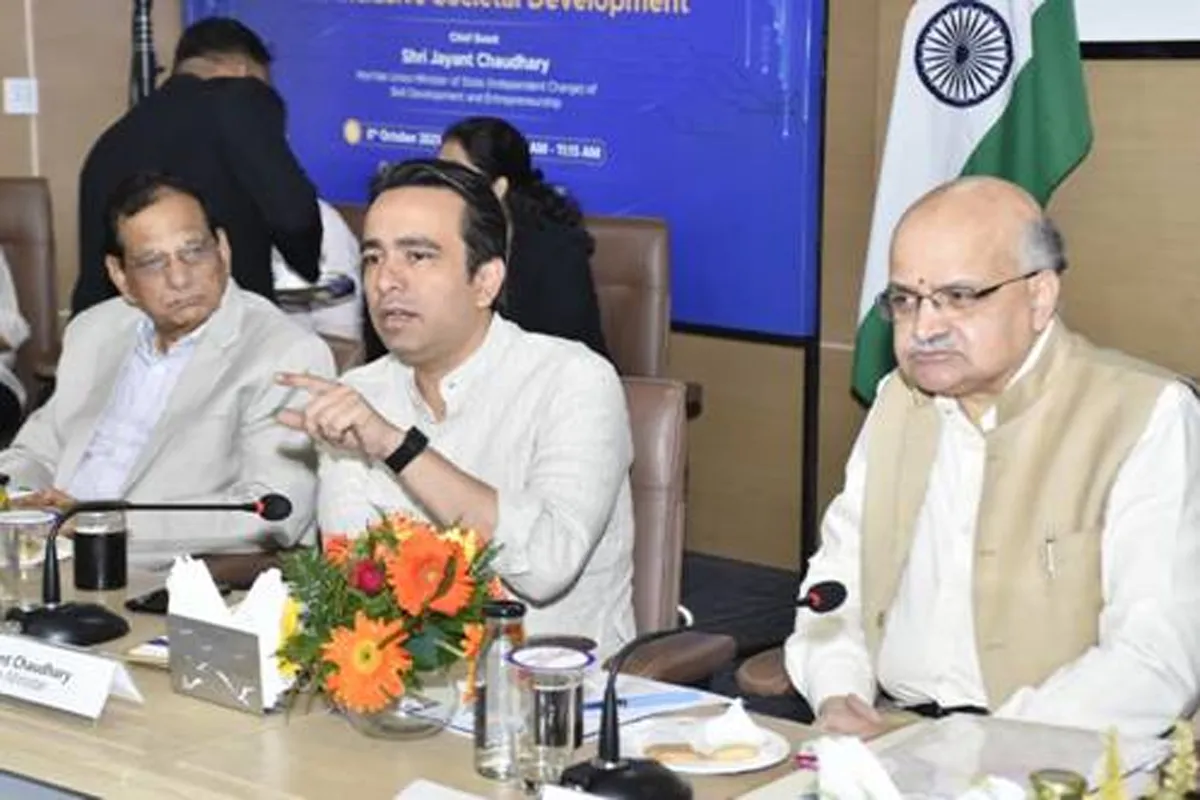
NITI Aayog launched its Frontier Tech Hub study, titled “AI for Inclusive Societal Development,” in partnership with Deloitte, at an event attended by senior government officials and industry leaders. The report explores how Artificial Intelligence (AI) and frontier technologies can transform the livelihoods of 490 million informal workers, the backbone of India’s economy.
The study was launched by Shri Jayant Chaudhary, Minister of State (Independent Charge) for Skill Development & Entrepreneurship and Minister of State for Education, along with NITI Aayog Vice Chairperson Shri Suman Bery. Distinguished attendees included Smt Debashree Mukherjee, Secretary, Ministry of Skill Development and Entrepreneurship; Ms Vandana Gurnani, Secretary, Ministry of Labour and Employment; Shri S. Krishnan, Secretary, Ministry of Electronics and Information Technology; Mr B. V. R. Subrahmanyam, CEO, NITI Aayog; and Ms Debjani Ghosh, Distinguished Fellow at NITI Aayog and Chief Architect of the Frontier Tech Hub.
The report represents the first systematic effort to map how AI can drive inclusion and productivity in the informal economy, which contributes nearly half of India’s GDP but remains largely outside formal structures of opportunity and protection.
Launching the study, Shri Jayant Chaudhary said the report aligns with the vision of Viksit Bharat 2047, providing a roadmap for using AI to make learning adaptive, accessible, and demand-driven. “Empowering India’s informal workers is not only an economic priority but a moral imperative,” he said. “By bringing together government, industry, and civil society, we will ensure that every worker—from farmers to artisans—has the skills and tools needed to thrive in tomorrow’s digital economy.”
The report highlights that AI alone cannot dismantle structural barriers in the informal sector. Without targeted investment, human intent, and ecosystem support, the transformative potential of AI will remain unrealised. To address this, NITI Aayog proposed Mission Digital ShramSetu—a national initiative to make AI accessible, affordable, and impactful for all workers. The mission will leverage technologies such as AI, blockchain, and immersive learning to address challenges like financial insecurity, limited market access, and lack of skills or social protection.
Mr B. V. R. Subrahmanyam, CEO of NITI Aayog, stressed that collaboration is “non-negotiable” if India is to truly transform the lives of its informal workers. “Only by uniting government, industry, academia, and civil society can we ensure that technology delivers real, lasting empowerment,” he said.
Ms Debjani Ghosh, Chief Architect of the Frontier Tech Hub, noted that for India to reach its Rs 2,500 trillion ($30 trillion) aspiration by 2047, inclusive digital growth is essential. “This roadmap puts informal workers at the centre of the AI conversation and outlines how to make these technologies accessible and affordable,” she added.
The study warns that if current trends persist, informal workers’ annual income could stagnate around USD 6,000, far below the USD 14,500 benchmark required for India to achieve high-income status. Immediate action, it concludes, is therefore critical to unlocking inclusive growth and building an equitable digital future.

NITI Aayog launched its Frontier Tech Hub study, titled “AI for Inclusive Societal Development,” in partnership with Deloitte, at an event attended by senior government officials and industry leaders. The report explores how Artificial Intelligence (AI) and frontier technologies can transform the livelihoods of 490 million informal workers, the backbone of India’s economy.The study was launched by Shri Jayant Chaudhary, Minister of State (Independent Charge) for Skill Development & Entrepreneurship and Minister of State for Education, along with NITI Aayog Vice Chairperson Shri Suman Bery. Distinguished attendees included Smt Debashree Mukherjee, Secretary, Ministry of Skill Development and Entrepreneurship; Ms Vandana Gurnani, Secretary, Ministry of Labour and Employment; Shri S. Krishnan, Secretary, Ministry of Electronics and Information Technology; Mr B. V. R. Subrahmanyam, CEO, NITI Aayog; and Ms Debjani Ghosh, Distinguished Fellow at NITI Aayog and Chief Architect of the Frontier Tech Hub.The report represents the first systematic effort to map how AI can drive inclusion and productivity in the informal economy, which contributes nearly half of India’s GDP but remains largely outside formal structures of opportunity and protection.Launching the study, Shri Jayant Chaudhary said the report aligns with the vision of Viksit Bharat 2047, providing a roadmap for using AI to make learning adaptive, accessible, and demand-driven. “Empowering India’s informal workers is not only an economic priority but a moral imperative,” he said. “By bringing together government, industry, and civil society, we will ensure that every worker—from farmers to artisans—has the skills and tools needed to thrive in tomorrow’s digital economy.”The report highlights that AI alone cannot dismantle structural barriers in the informal sector. Without targeted investment, human intent, and ecosystem support, the transformative potential of AI will remain unrealised. To address this, NITI Aayog proposed Mission Digital ShramSetu—a national initiative to make AI accessible, affordable, and impactful for all workers. The mission will leverage technologies such as AI, blockchain, and immersive learning to address challenges like financial insecurity, limited market access, and lack of skills or social protection.Mr B. V. R. Subrahmanyam, CEO of NITI Aayog, stressed that collaboration is “non-negotiable” if India is to truly transform the lives of its informal workers. “Only by uniting government, industry, academia, and civil society can we ensure that technology delivers real, lasting empowerment,” he said.Ms Debjani Ghosh, Chief Architect of the Frontier Tech Hub, noted that for India to reach its Rs 2,500 trillion ($30 trillion) aspiration by 2047, inclusive digital growth is essential. “This roadmap puts informal workers at the centre of the AI conversation and outlines how to make these technologies accessible and affordable,” she added.The study warns that if current trends persist, informal workers’ annual income could stagnate around USD 6,000, far below the USD 14,500 benchmark required for India to achieve high-income status. Immediate action, it concludes, is therefore critical to unlocking inclusive growth and building an equitable digital future.

Related Stories

Gold Stories

Next Story
Building Material

MCi Carbon, JSW Steel and JAKSON Green sign MoU

Australian clean technology company MCi Carbon, JSW Steel Limited and JAKSON Green Ltd. have signed a tripartite Memorandum of Understanding (MoU) to evaluate the technical and commercial feasibility of using MCi Carbon’s mineral carbonation technology to convert steel slag and CO₂ streams from JSW Steel’s operations in India into carbon-embedded materials.Under the agreement, JSW Steel will provide operational knowledge, representative slag samples and process information. JAKSON Green will coordinate the project, providing engineering, cost and logistics inputs, along with its engineer..

Next Story
Building Material

JSW Dulux launches Velvet Touch Eterna High Sheen

JSW Dulux (formerly Akzo Nobel India) has launched Velvet Touch™ Eterna High Sheen, a new addition to its premium Velvet Touch™ Eterna portfolio. The interior emulsion features a reflective finish, colour protection technology and a 12-year warranty.The product was unveiled in Kolkata in the presence of the company's sales leadership, distributors, dealers and channel partners from Eastern India. It is designed to provide a light-reflecting finish that adds depth and radiance to interior spaces.Commenting on the launch, Vandana Krishnia, Chief Marketing Officer, JSW Dulux Limited, said, â€..

Next Story
Real Estate

Concorde signs JDA for residential project in North Bengaluru

Bengaluru-based real estate developer Concorde has signed a Joint Development Agreement (JDA) for a premium residential project on a 3-acre land parcel in North Bengaluru. The development has an estimated potential of 400,000 sq ft and a Gross Development Value (GDV) of ₹4.5 billion.The project will add to Concorde's residential portfolio, with a focus on contemporary architecture, construction quality and lifestyle amenities.Commenting on the development, Anil RG, Managing Director, Concorde, said, “North Bengaluru is emerging as a significant growth destination, and this development mark..

Subscribe to Our Newsletter

Get daily newsletters around different themes from Construction world.

STAY CONNECTED

Advertisement

SPECIAL OFFER
QR Code