10 States Account for Nearly 70 Per Cent of India’s GDP
ECONOMY & POLICY

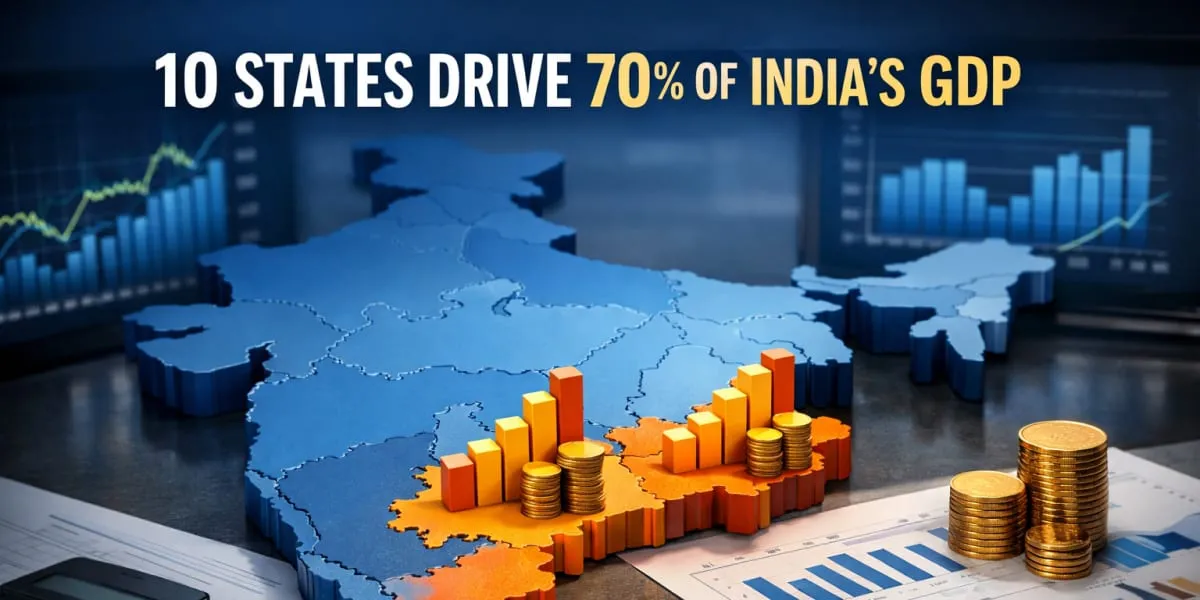
10 States Account for Nearly 70 Per Cent of India’s GDP

Rubix Data Sciences Pvt. Ltd. published a report titled State of the States; Assessing State-level Performance: Driving India’s Economic Transition that found the southern region contributed approximately 31 per cent of national output in FY25, marginally ahead of the northern region at 30 per cent. The study identified Tamil Nadu, Karnataka, Telangana and Andhra Pradesh among the top contributors, with strong decadal growth led by Karnataka at 7.8 per cent, Telangana at 7.1 per cent, Andhra Pradesh at 6.9 per cent and Tamil Nadu at 6.8 per cent. It noted that per capita Net State Domestic Product (NSDP) was highest in Telangana, Karnataka and Tamil Nadu.

Maharashtra remained the single largest contributor to national output despite its share falling to 13 per cent in FY25 while Gujarat recorded one of the fastest growth rates at 7.9 per cent. Capital expenditure (capex) remained concentrated with Uttar Pradesh, Maharashtra and Gujarat accounting for nearly 30 per cent of total capex. The report highlighted that industrial credit was also concentrated, with the West and the North each holding 34 per cent shares.

Gujarat, Maharashtra and Tamil Nadu together accounted for nearly 61 per cent of India’s goods exports, with the South increasing its share significantly to around 33 per cent. The analysis pointed to a gradual shift in investment geography as emerging states such as Odisha and Uttar Pradesh gained share in new investments. It found that the South led in personal loan distribution while the Northeast led social sector spending as a share of GDP.

The report described transformations in BIMARU states, noting substantial growth in Gross State Domestic Product (GSDP) and per capita income that positioned them as emerging economic contributors. Tourism patterns remained skewed towards the North, with Uttar Pradesh emerging as the leading domestic tourism hub and Maharashtra attracting the most foreign tourist arrivals. The authors concluded that India’s growth was expanding but remained concentrated among a few states and that long term economic resilience would depend on how effectively emerging regions sustained and scaled their momentum.

Rubix Data Sciences Pvt. Ltd. published a report titled State of the States; Assessing State-level Performance: Driving India’s Economic Transition that found the southern region contributed approximately 31 per cent of national output in FY25, marginally ahead of the northern region at 30 per cent. The study identified Tamil Nadu, Karnataka, Telangana and Andhra Pradesh among the top contributors, with strong decadal growth led by Karnataka at 7.8 per cent, Telangana at 7.1 per cent, Andhra Pradesh at 6.9 per cent and Tamil Nadu at 6.8 per cent. It noted that per capita Net State Domestic Product (NSDP) was highest in Telangana, Karnataka and Tamil Nadu. Maharashtra remained the single largest contributor to national output despite its share falling to 13 per cent in FY25 while Gujarat recorded one of the fastest growth rates at 7.9 per cent. Capital expenditure (capex) remained concentrated with Uttar Pradesh, Maharashtra and Gujarat accounting for nearly 30 per cent of total capex. The report highlighted that industrial credit was also concentrated, with the West and the North each holding 34 per cent shares. Gujarat, Maharashtra and Tamil Nadu together accounted for nearly 61 per cent of India’s goods exports, with the South increasing its share significantly to around 33 per cent. The analysis pointed to a gradual shift in investment geography as emerging states such as Odisha and Uttar Pradesh gained share in new investments. It found that the South led in personal loan distribution while the Northeast led social sector spending as a share of GDP. The report described transformations in BIMARU states, noting substantial growth in Gross State Domestic Product (GSDP) and per capita income that positioned them as emerging economic contributors. Tourism patterns remained skewed towards the North, with Uttar Pradesh emerging as the leading domestic tourism hub and Maharashtra attracting the most foreign tourist arrivals. The authors concluded that India’s growth was expanding but remained concentrated among a few states and that long term economic resilience would depend on how effectively emerging regions sustained and scaled their momentum.

Next Story
Infrastructure Urban

Greenply Advances Sustainability with ESG and Plantation Drive

Greenply Industries Limited has recently reinforced its sustainability commitment by integrating environmental, social and governance (ESG) principles across its operations. The company continues to align its growth strategy with environmental stewardship, resource efficiency and transparent governance.Guided by its ESG framework, Greenply focuses on measuring and managing its environmental and social impact while setting clear, measurable sustainability goals. This approach ensures transparency and drives continuous improvement across its business processes.A key highlight of its sustainabili..

Next Story
Infrastructure Urban

BIO-ROXX Boosts Efficiency at Mühlacker Biomethane Plant

The Mühlacker biomethane plant in Baden-Württemberg, Germany, has recently enhanced its operational efficiency by integrating the BIO-ROXX substrate preparation module from Wangen Pumps. The system improves substrate consistency, handles long fibres, and effectively removes solid contaminants, addressing the growing complexity of biogas feedstocks.The plant, established in 2007, processes around 30,000 tonnes of feedstock annually from over 120 suppliers, producing biomethane and fertilisers. With increasing use of long-fibre materials such as straw and manure, the existing dry infeed system..

Next Story
Infrastructure Urban

HIRECT Launches Copper Conductors for High-Power Transformers

Hind Rectifiers (HIRECT) has recently announced the commercial availability of advanced copper conductors from its expanded facility in Sinnar, Nashik. The new product portfolio includes Continuously Transposed Conductors (CTC), Paper Insulated Copper Conductors (PICC), and Enameled Paper Insulated Copper Conductors (EPICC), designed for high-power transformers, traction motors, and wound components.The conductors are engineered to support key infrastructure sectors such as power grids, railway systems, and industrial power networks, while also strengthening the company’s presence in global ..

Advertisement

Subscribe to Our Newsletter

Get daily newsletters around different themes from Construction world.

STAY CONNECTED

Advertisement

Advertisement

Advertisement