+
Amit Shah Chairs MHA Panel Meet on Forensics in A&N Islands
ECONOMY & POLICY

Amit Shah Chairs MHA Panel Meet on Forensics in A&N Islands

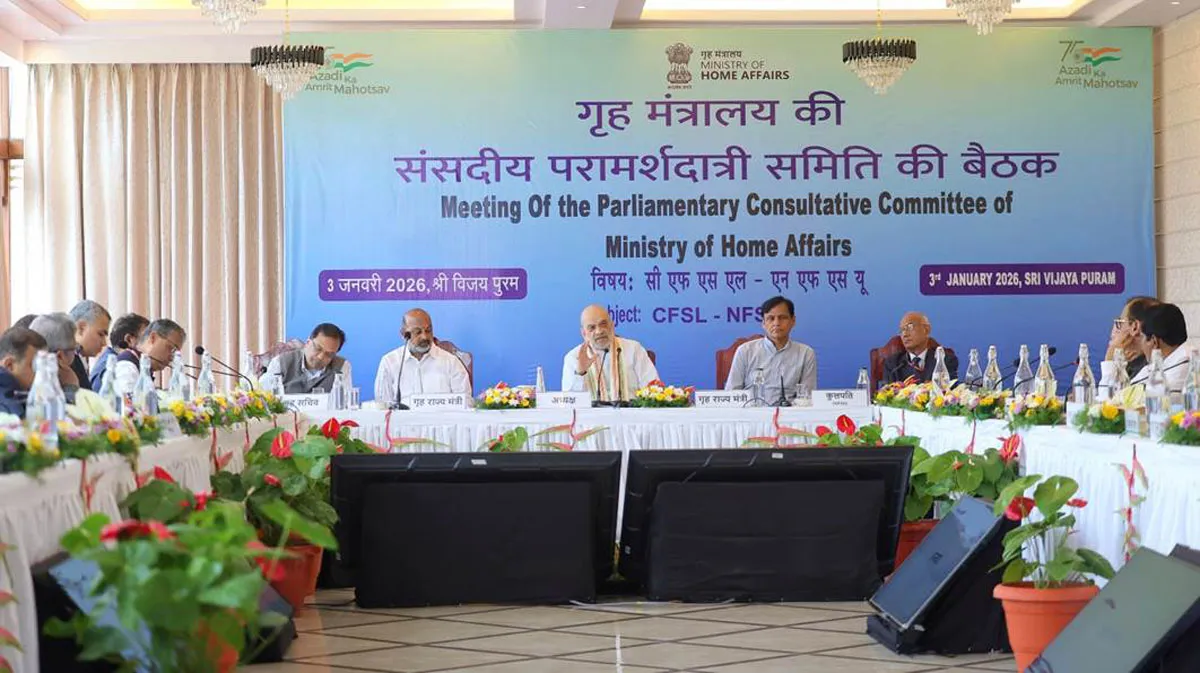
Union Home and Cooperation Minister Amit Shah chaired a meeting of the Parliamentary Consultative Committee of the Ministry of Home Affairs (MHA) at Sri Vijaya Puram in the Andaman and Nicobar Islands, with discussions centred on the Central Forensic Science Laboratory (CFSL) and the National Forensic Sciences University (NFSU).

The meeting was attended by Union Ministers of State for Home Affairs Nityanand Rai and Bandi Sanjay Kumar, members of the Parliamentary Consultative Committee, Union Home Secretary Govind Mohan, the Vice Chancellor of NFSU, the Director General of the Bureau of Police Research and Development (BPR&D), and other senior officials.

Addressing the committee, Shah said the MHA has held 12 such consultative meetings since 2019, yielding positive outcomes. He said it is Prime Minister Narendra Modi’s vision to ensure timely justice after the full implementation of the new criminal laws. Shah stated that the government aims to build a system by 2029 under which the entire judicial process—from registration of an FIR to adjudication by the Supreme Court—can be completed within three years. He added that reforms initiated since 2022 are aligned with this objective and are being monitored through a 360-degree review mechanism.

Shah said the government has been focusing on strengthening forensic capabilities since 2020, even before the new criminal laws came into force in July 2024. He noted that the impact of these reforms is already visible, citing cases in West Bengal and Bihar where convictions were secured within 62 days and 50 days respectively.

Highlighting past challenges, Shah said gaps in technology, weak chain of custody, shortage of skilled professionals, limited forensic infrastructure, and lack of national standards had earlier hampered investigations. He said forensic labs will now send reports directly to courts, with a copy to police, and that the Centre and states will invest ₹30,000 crore over five years to expand forensic infrastructure nationwide.

He added that reforms such as e-Summons, e-Sakshya, mandatory forensic visits for serious crimes, videography of seizures, and clear legal recognition of digital evidence will strengthen investigations, while provisions like e-FIR, Zero FIR and Trial in Absentia will improve access to justice, especially for women and the poor.

News source: PIB

Union Home and Cooperation Minister Amit Shah chaired a meeting of the Parliamentary Consultative Committee of the Ministry of Home Affairs (MHA) at Sri Vijaya Puram in the Andaman and Nicobar Islands, with discussions centred on the Central Forensic Science Laboratory (CFSL) and the National Forensic Sciences University (NFSU).The meeting was attended by Union Ministers of State for Home Affairs Nityanand Rai and Bandi Sanjay Kumar, members of the Parliamentary Consultative Committee, Union Home Secretary Govind Mohan, the Vice Chancellor of NFSU, the Director General of the Bureau of Police Research and Development (BPR&D), and other senior officials.Addressing the committee, Shah said the MHA has held 12 such consultative meetings since 2019, yielding positive outcomes. He said it is Prime Minister Narendra Modi’s vision to ensure timely justice after the full implementation of the new criminal laws. Shah stated that the government aims to build a system by 2029 under which the entire judicial process—from registration of an FIR to adjudication by the Supreme Court—can be completed within three years. He added that reforms initiated since 2022 are aligned with this objective and are being monitored through a 360-degree review mechanism.Shah said the government has been focusing on strengthening forensic capabilities since 2020, even before the new criminal laws came into force in July 2024. He noted that the impact of these reforms is already visible, citing cases in West Bengal and Bihar where convictions were secured within 62 days and 50 days respectively.Highlighting past challenges, Shah said gaps in technology, weak chain of custody, shortage of skilled professionals, limited forensic infrastructure, and lack of national standards had earlier hampered investigations. He said forensic labs will now send reports directly to courts, with a copy to police, and that the Centre and states will invest ₹30,000 crore over five years to expand forensic infrastructure nationwide.He added that reforms such as e-Summons, e-Sakshya, mandatory forensic visits for serious crimes, videography of seizures, and clear legal recognition of digital evidence will strengthen investigations, while provisions like e-FIR, Zero FIR and Trial in Absentia will improve access to justice, especially for women and the poor.News source: PIB

Next Story
Infrastructure Transport

Second Mountain Tunnel Breakthrough in Palghar Advances High Speed Rail

The Mumbai-Ahmedabad high speed rail (MAHSR) project reached a milestone with the breakthrough of a mountain tunnel in Palghar, Maharashtra. Mountain tunnel MT-six measures 454 metres long and 14.4 metres wide and will accommodate up and down tracks. The breakthrough follows MT-five near Saphale on second January 2026 and the MT-six excavation was completed from both ends using the New Austrian Tunnelling Method. The ministry reported that the tunnelling was completed within 12 months. The New Austrian Tunnelling Method is favoured for its flexibility in complex geology and irregular tunnel s..

Next Story
Infrastructure Transport

Modi Government Pushes Atmanirbhar Container Drive With BCSL MoU

The Union Government advanced a plan to create an integrated, domestically anchored container ecosystem with the signing of a Memorandum of Understanding to establish the Bharat Container Shipping Line (BCSL). The MoU was signed by key agencies including the Shipping Corporation of India and Container Corporation of India alongside major port authorities and Sagarmala Finance Corporation Limited under the Ministry of Ports, Shipping and Waterways, in the presence of senior ministers. The initiative aligns with the Container Manufacturing Assistance Scheme announced in the Union Budget 2026–2..

Next Story
Infrastructure Urban

Ministry Reports Gains In Mobility For Marginalised Communities

The Ministry of Social Justice and Empowerment is implementing skill development, education and rehabilitation schemes to promote socio-economic mobility and sustainable livelihoods for marginalised and disadvantaged communities across the country. Programmes target Scheduled Castes, Other Backward Classes, Economically Weaker Sections, De-notified Tribes and Safai Karamcharis through specialised implementing corporations and empanelled training institutes. Pradhan Mantri Dakshata Aur Kushalta Sampann Hitgrahi Yojana, or PM-DAKSH, provided skill training and placement support through the Nati..

Advertisement

Subscribe to Our Newsletter

Get daily newsletters around different themes from Construction world.

STAY CONNECTED

Advertisement

Advertisement

Advertisement

Open In App