Ashwini Vaishnaw Reviews Progress of DLI-Backed Chip Designers
ECONOMY & POLICY

Ashwini Vaishnaw Reviews Progress of DLI-Backed Chip Designers

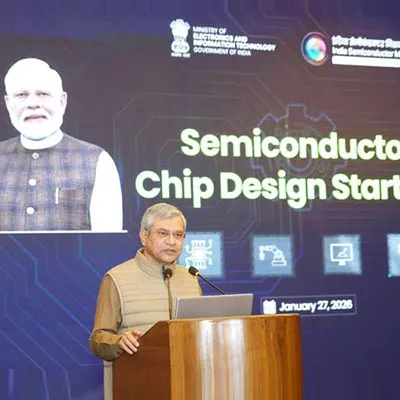
Union Minister for Electronics and Information Technology Ashwini Vaishnaw recently interacted with semiconductor chip design companies approved under the Design Linked Incentive (DLI) Scheme of the Semicon India Programme in New Delhi. The interaction focused on assessing progress, reviewing design innovations and reaffirming the Government’s commitment to building a strong, indigenous semiconductor design ecosystem.

The DLI-supported firms are engaged across a wide spectrum of chip design areas, including system-on-chips and ASICs for surveillance and networking, RISC-V-based processors, AI-enabled low-power chips for IoT and edge applications, telecom and wireless chipsets, power management ICs and mixed-signal designs. These efforts extend to strategic sectors such as automotive, energy, space and defence. Advanced EDA tools provided under the scheme have enabled about 2.25 crore tool-hours of usage, involving nearly 67,000 students and more than 1,000 startup engineers.

Addressing stakeholders, the Minister said the Government’s ecosystem-led, long-term approach to semiconductors is delivering tangible outcomes. He noted that the programme, conceptualised in 2022 under the vision of Narendra Modi, aims to transform India from a services-led economy into a product nation by building the entire semiconductor value chain.

Highlighting the success of the DLI Scheme, Vaishnaw said 24 startups are currently supported, several of which have completed tape-outs, validated products and achieved market traction. He added that the Government now plans to scale up the initiative, targeting at least 50 fabless semiconductor companies in the next phase.

The Minister outlined a focused strategy across six key design domains—compute systems, RF and wireless, networking, power management, sensors and memory—describing them as foundational to modern electronics. He also referred to infrastructure support, with SCL Mohali enabling 180-nanometre tape-outs and the upcoming Dholera fab supporting nodes up to 28 nanometres.

Looking ahead, Vaishnaw said India aims to design and manufacture chips for nearly 70–75 per cent of domestic applications by 2029, with Semicon 2.0 charting a roadmap towards advanced nodes of 3 nanometres and 2 nanometres. He also announced that the Government will institute Deep Tech Awards in 2026 to recognise innovation in semiconductors, AI, biotechnology, space and other critical technologies.

Union Minister for Electronics and Information Technology Ashwini Vaishnaw recently interacted with semiconductor chip design companies approved under the Design Linked Incentive (DLI) Scheme of the Semicon India Programme in New Delhi. The interaction focused on assessing progress, reviewing design innovations and reaffirming the Government’s commitment to building a strong, indigenous semiconductor design ecosystem. The DLI-supported firms are engaged across a wide spectrum of chip design areas, including system-on-chips and ASICs for surveillance and networking, RISC-V-based processors, AI-enabled low-power chips for IoT and edge applications, telecom and wireless chipsets, power management ICs and mixed-signal designs. These efforts extend to strategic sectors such as automotive, energy, space and defence. Advanced EDA tools provided under the scheme have enabled about 2.25 crore tool-hours of usage, involving nearly 67,000 students and more than 1,000 startup engineers. Addressing stakeholders, the Minister said the Government’s ecosystem-led, long-term approach to semiconductors is delivering tangible outcomes. He noted that the programme, conceptualised in 2022 under the vision of Narendra Modi, aims to transform India from a services-led economy into a product nation by building the entire semiconductor value chain. Highlighting the success of the DLI Scheme, Vaishnaw said 24 startups are currently supported, several of which have completed tape-outs, validated products and achieved market traction. He added that the Government now plans to scale up the initiative, targeting at least 50 fabless semiconductor companies in the next phase. The Minister outlined a focused strategy across six key design domains—compute systems, RF and wireless, networking, power management, sensors and memory—describing them as foundational to modern electronics. He also referred to infrastructure support, with SCL Mohali enabling 180-nanometre tape-outs and the upcoming Dholera fab supporting nodes up to 28 nanometres. Looking ahead, Vaishnaw said India aims to design and manufacture chips for nearly 70–75 per cent of domestic applications by 2029, with Semicon 2.0 charting a roadmap towards advanced nodes of 3 nanometres and 2 nanometres. He also announced that the Government will institute Deep Tech Awards in 2026 to recognise innovation in semiconductors, AI, biotechnology, space and other critical technologies.

Next Story
Infrastructure Urban

PM Modi Addresses India-EU Business Forum in New Delhi

Prime Minister Shri Narendra Modi recently addressed the India–European Union Business Forum at Bharat Mandapam, New Delhi, describing the current phase as a new era of alignment in India-EU relations. He noted that the presence of EU leaders as Chief Guests at India’s Republic Day and the conclusion of the largest Free Trade Agreement in India’s history reflect unprecedented strategic convergence between the two democratic partners. Highlighting economic ties, the Prime Minister said bilateral trade has doubled over the past decade to 180 billion euros, with EU investments in India exc..

Next Story
Infrastructure Energy

PM Modi Highlights Energy Opportunities at India Energy Week 2026

Prime Minister Narendra Modi recently addressed the inaugural ceremony of India Energy Week 2026 via video conferencing, describing India as a land of immense opportunity for the global energy sector. He noted that representatives from nearly 125 countries had gathered to deliberate on building an energy-secure and sustainable future, underlining the event’s growing stature as a global platform for dialogue and action. The Prime Minister highlighted that India’s position as the world’s fastest-growing major economy is driving sustained growth in energy demand, while also creating opport..

Next Story
Infrastructure Energy

India–EU Free Trade Agreement Marks Strategic Trade Breakthrough

India and the European Union have recently concluded the India–EU Free Trade Agreement (FTA), marking a major milestone in bilateral economic engagement. The agreement was jointly announced at the 16th India–EU Summit by Narendra Modi and Ursula von der Leyen, positioning the two blocs as trusted partners committed to open, rules-based and inclusive growth. The FTA follows sustained negotiations since talks were relaunched in 2022 and reflects a shared strategic vision between the world’s fourth- and second-largest economies, together accounting for about 25 per cent of global GDP and n..

Advertisement

Subscribe to Our Newsletter

Get daily newsletters around different themes from Construction world.

STAY CONNECTED

Advertisement

Advertisement

Advertisement

Advertisement

Open In App