+
Balrampur Chini Wins First Institutional Order From Lucknow Cantonment
ECONOMY & POLICY

Balrampur Chini Wins First Institutional Order From Lucknow Cantonment

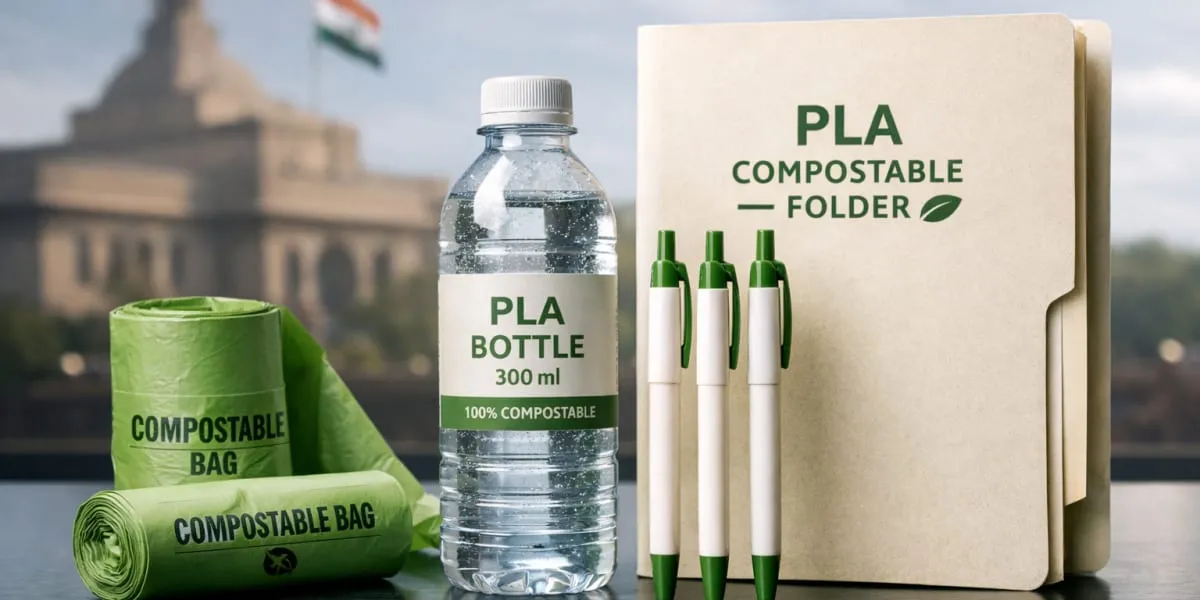
Balrampur Chini Mills Ltd has secured its first institutional order from the Lucknow Cantonment Board for a range of compostable bioplastic items produced from polylactic acid (PLA). The supply includes compostable garbage bags in two sizes, 300 ml PLA bottles, three-dimensional printed PLA compostable pens and PLA folders, all manufactured from renewable, bio-based PLA that is fully compostable and does not leave microplastics. The order marks the first official institutional procurement for the company’s PLA vertical, Balrampur Bioyug.

The Kolkata-headquartered company has diversified into the bioplastic business and is setting up a PLA manufacturing plant at Kumbhi in Uttar Pradesh with a total annual capacity of 80,000 tonnes (t). The plant is expected to be operational in October and Balrampur Chini anticipates scaling production to meet institutional demand. The regulatory filing on Monday stated that the vertical had secured the order from the cantonment board as part of its market entry strategy.

The Lucknow Cantonment spans 6,760 acres and is administered by a statutory board under the administrative control of the Director General of Defence Estates in the Ministry of Defence. Company executives described the order as signalling institutional trust in India’s emerging biopolymer capabilities and as evidence that sustainable materials are now viable for large-scale institutional use. The adoption of compostable PLA products across operational categories was cited as a response to concerns about single-use plastics and micro-plastic contamination, reinforcing a shift from fossil-based materials within institutional systems.

Balrampur Chini Mills is one of the largest integrated sugar companies in India with 10 sugar factories in Uttar Pradesh and an aggregate sugarcane crushing capacity of 80,000 t per day. The company also operates a distillery with capacity of 1,050 kilolitre per day and co-generation operations of 175.7 Megawatt (MW), which support its move towards circular and renewable feedstocks. The Lucknow order was described by the company as an initial institutional endorsement to be leveraged as it commercialises its PLA offerings.

Balrampur Chini Mills Ltd has secured its first institutional order from the Lucknow Cantonment Board for a range of compostable bioplastic items produced from polylactic acid (PLA). The supply includes compostable garbage bags in two sizes, 300 ml PLA bottles, three-dimensional printed PLA compostable pens and PLA folders, all manufactured from renewable, bio-based PLA that is fully compostable and does not leave microplastics. The order marks the first official institutional procurement for the company’s PLA vertical, Balrampur Bioyug. The Kolkata-headquartered company has diversified into the bioplastic business and is setting up a PLA manufacturing plant at Kumbhi in Uttar Pradesh with a total annual capacity of 80,000 tonnes (t). The plant is expected to be operational in October and Balrampur Chini anticipates scaling production to meet institutional demand. The regulatory filing on Monday stated that the vertical had secured the order from the cantonment board as part of its market entry strategy. The Lucknow Cantonment spans 6,760 acres and is administered by a statutory board under the administrative control of the Director General of Defence Estates in the Ministry of Defence. Company executives described the order as signalling institutional trust in India’s emerging biopolymer capabilities and as evidence that sustainable materials are now viable for large-scale institutional use. The adoption of compostable PLA products across operational categories was cited as a response to concerns about single-use plastics and micro-plastic contamination, reinforcing a shift from fossil-based materials within institutional systems. Balrampur Chini Mills is one of the largest integrated sugar companies in India with 10 sugar factories in Uttar Pradesh and an aggregate sugarcane crushing capacity of 80,000 t per day. The company also operates a distillery with capacity of 1,050 kilolitre per day and co-generation operations of 175.7 Megawatt (MW), which support its move towards circular and renewable feedstocks. The Lucknow order was described by the company as an initial institutional endorsement to be leveraged as it commercialises its PLA offerings.

Next Story
Infrastructure Urban

We’ve cut 50,000 tonnes of carbon emmissions since 2019

MatchLog is challenging a decades-old logistics norm and empty container miles by directly matching import flows with export demand. Indeed, the platform is unlocking measurable cost savings, cutting emissions and driving structural change in landside operations. Dhruv Taneja, Founder and Global CEO, outlines the quantified impact, adoption  journey and the evolving future of container reuse in an exclusive interview with Construction World. MatchLog has partnered with carriers such as Maersk, ONE and HMM in India. Could you share quantified outcomes from one specific corri..

Next Story
Infrastructure Transport

Airports: Capacity is Key

A lotus-inspired terminal design in Navi Mumbai International Airport. A terminal in a garden in Bengaluru’s Kempegowda International Airport. A peacock-inspired canopy in Chhatrapati Shivaji Maharaj International Airport. A nature-inspired terminal in Guwahati’s Lokpriya Gopinath Bordoloi International Airport.Truly, “India’s airports are no longer constrained by architectural ambition,” avers Ravikanth Mididhodi, Chief Technical Officer, J&F, a German-based engineering firm with over 25 years of global legacy in delivering advanced engineering and BIM services for air..

Next Story
Real Estate

In 2025, Amaravati attracted ₹ 28,075 crore in investments

In an exclusive interview with Construction World, Kanna Babu, IAS, Commissioner, Andhra Pradesh Capital Region Development Authority (APCRDA), reveals how Amaravati is entering a decisive new phase of capital city development. With 36 MoUs worth ₹ 45,589 crore, a ₹ 58,000 crore tender pipeline, and rising institutional investments, he explains the strategic execution, infrastructure rollout, and governance framework driving Amaravati’s emergence as a structured, investment-ready, and future-focused capital.APCRDA has recently secured major financial tie-ups, including loans from NA..

Advertisement

Subscribe to Our Newsletter

Get daily newsletters around different themes from Construction world.

STAY CONNECTED

Advertisement

Advertisement

Advertisement

Open In App