





Cabinet Approves Jaipur Metro Phase Two
ECONOMY & POLICY

Cabinet Approves Jaipur Metro Phase Two

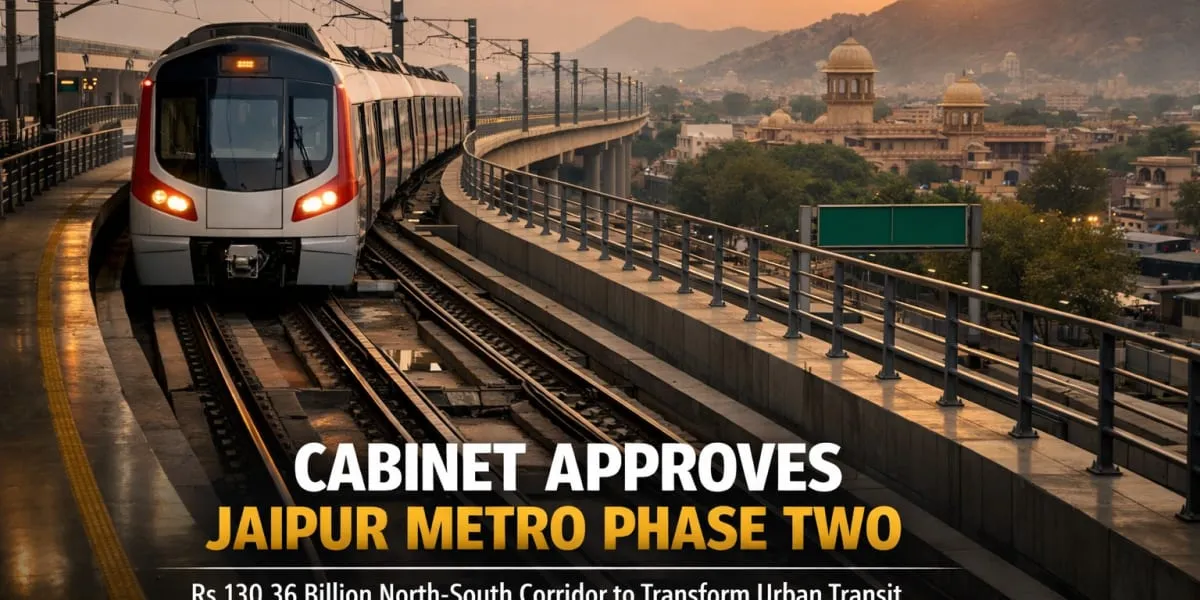
The Union Cabinet has approved the Jaipur Metro Phase Two project, a major infrastructure initiative intended to transform urban mobility in the Rajasthan capital. The project is estimated to cost Rs 130.38 bn and will extend the metro network significantly.

The scheme provides for a 41-kilometre north–south corridor from Prahladpura to Todi Mod with 36 stations, to be implemented by Rajasthan Metro Rail Corporation Limited (RMRCL), a 50:50 joint venture between the central and state governments. Jaipur Metro Phase One currently operates on the east–west axis from Mansarovar to Badi Chaupar, covering 11.64 km with 11 stations and the expansion will create a more comprehensive citywide transit system.

The corridor will link key economic and activity centres including Sitapura Industrial Area, VKIA, Jaipur Airport, Tonk Road, SMS Hospital and Stadium, Ambabari and Vidhyadhar Nagar. Underground stations are planned in the airport area and the design will provide interchanges and feeder systems to ensure seamless integration with the existing network.

Jaipur Metro Phase One records an average daily ridership of around 60,000 passengers, and Phase Two is expected to raise ridership substantially, increasing the share of public transport and reducing dependence on private vehicles. The project has undergone detailed appraisal including inter?ministerial consultations, review by the Network Planning Group and evaluation by the Public Investment Board, and it has demonstrated socio?economic viability with an Economic Internal Rate of Return of more than 14 per cent.

Funding will be arranged through equity contributions from the central and state governments, subordinate debt and multilateral financing in accordance with the Metro Rail Policy, 2017. The scheme is aligned with Rajasthan’s Transit?Oriented Development Policy?2025 and national sustainable transport objectives, and it is expected to reduce traffic congestion and vehicular emissions while supporting urban development.

Work is targeted for completion by September 2031 and the expanded network is projected to improve mobility for residents, workers and tourists, strengthening Jaipur’s position as a modern and future?ready city under the vision of Viksit Bharat. Implementation will follow standard project governance arrangements and timelines agreed by the implementing agencies.

The Union Cabinet has approved the Jaipur Metro Phase Two project, a major infrastructure initiative intended to transform urban mobility in the Rajasthan capital. The project is estimated to cost Rs 130.38 bn and will extend the metro network significantly. The scheme provides for a 41-kilometre north–south corridor from Prahladpura to Todi Mod with 36 stations, to be implemented by Rajasthan Metro Rail Corporation Limited (RMRCL), a 50:50 joint venture between the central and state governments. Jaipur Metro Phase One currently operates on the east–west axis from Mansarovar to Badi Chaupar, covering 11.64 km with 11 stations and the expansion will create a more comprehensive citywide transit system. The corridor will link key economic and activity centres including Sitapura Industrial Area, VKIA, Jaipur Airport, Tonk Road, SMS Hospital and Stadium, Ambabari and Vidhyadhar Nagar. Underground stations are planned in the airport area and the design will provide interchanges and feeder systems to ensure seamless integration with the existing network. Jaipur Metro Phase One records an average daily ridership of around 60,000 passengers, and Phase Two is expected to raise ridership substantially, increasing the share of public transport and reducing dependence on private vehicles. The project has undergone detailed appraisal including inter?ministerial consultations, review by the Network Planning Group and evaluation by the Public Investment Board, and it has demonstrated socio?economic viability with an Economic Internal Rate of Return of more than 14 per cent. Funding will be arranged through equity contributions from the central and state governments, subordinate debt and multilateral financing in accordance with the Metro Rail Policy, 2017. The scheme is aligned with Rajasthan’s Transit?Oriented Development Policy?2025 and national sustainable transport objectives, and it is expected to reduce traffic congestion and vehicular emissions while supporting urban development. Work is targeted for completion by September 2031 and the expanded network is projected to improve mobility for residents, workers and tourists, strengthening Jaipur’s position as a modern and future?ready city under the vision of Viksit Bharat. Implementation will follow standard project governance arrangements and timelines agreed by the implementing agencies.

Next Story
Resources

Jyoti Structures wins three CIDC Vishwakarma Awards

Jyoti Structures has received three awards at the 17th CIDC Vishwakarma Awards 2026, organised by the Construction Industry Development Council, recognising excellence across project execution, workforce and leadership.The company was honoured under Category G (Best Construction Projects) for the 400/220 kV D/C Goa–Tamnar Transmission Project in Goa, following a multi-stage evaluation covering performance, safety and quality benchmarks.In Category E2 (Artisans & Supervisors), four members from JSL’s site team working on the Torrent project were recognised, reflecting consistency in sit..

Next Story
Infrastructure Urban

Premier Energies Secures Rs 25,770 mn Orders In Q4

Premier Energies Limited has received orders aggregating to Rs 25,770 million (mn) in the fourth quarter of fiscal year 2026 for the supply of 1,600 megawatt (MW) solar cells and modules. Execution of these orders is scheduled across fiscal year 2027 and fiscal year 2028 and the contracts have been secured from a mix of domestic independent power producers, module manufacturers and engineering, procurement and construction contractors in India. Capacity increases support the order book, with cell capacity expected to reach 10.6 gigawatt (GW) by September 2026 and module manufacturing capacity ..

Next Story
Building Material

Steel Exchange India Reports Rs 280 mn Debt Repayment

Steel Exchange India Limited (SEIL), one of the leading integrated steel manufacturers in South India and the maker of SIMHADRI TMT, has reported the repayment of Rs 280 mn of debt over the last two quarters. The company informed exchanges under listing regulations that the repayment was part of scheduled deleveraging measures aimed at strengthening the balance sheet. The update followed credit facilities that were taken in September 2025 to support operations and growth initiatives. During the period October 2025 to March 2026 a partial redemption was executed with Rs 214.3 mn directed toward..

Advertisement

Subscribe to Our Newsletter

Get daily newsletters around different themes from Construction world.

STAY CONNECTED

Advertisement

Advertisement

Advertisement














