




+
Capacity Addition Crosses 52,537 MW In FY 2025-26
ECONOMY & POLICY

Capacity Addition Crosses 52,537 MW In FY 2025-26

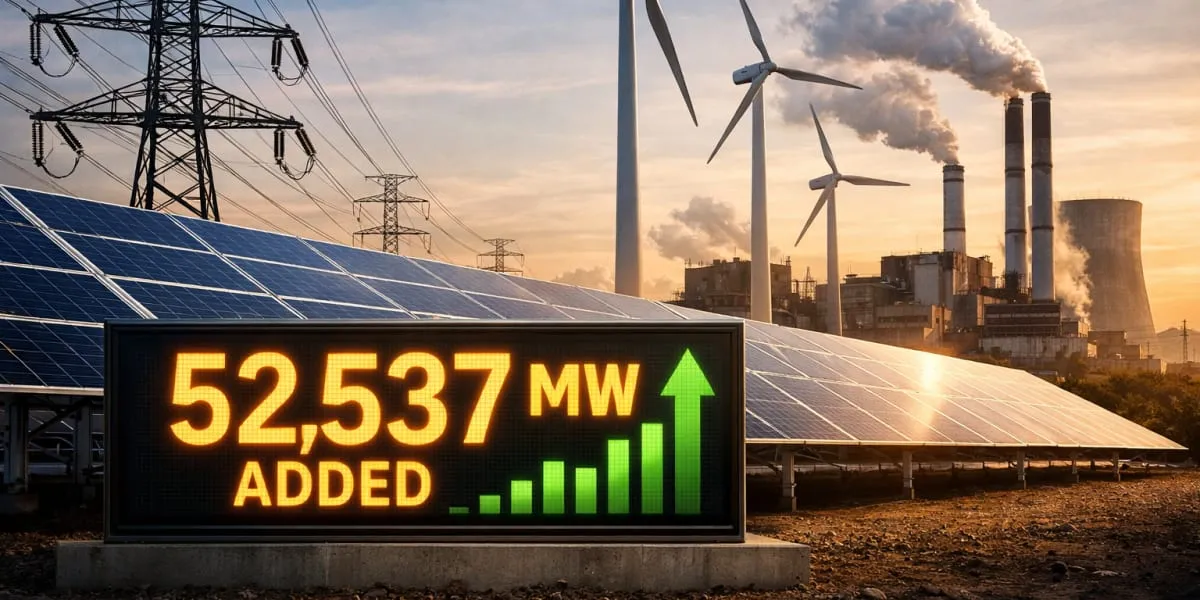
During the current financial year 2025-26 up to 31 January 2026 India added a record 52,537 megawatt (MW) of generation capacity from all sources, marking the largest annual increase on record. The figure represents an exceptional expansion of infrastructure and surpasses the previous peak of 34,054 MW achieved in FY 2024-25. This surge occurred within the first 10 months of the year and reflects accelerated deployment across technologies. The Ministry of Power released the consolidated figures.

Renewable energy sources accounted for 39,657 MW of the new capacity, with solar power contributing 34,955 MW and wind power 4,613 MW, indicating a clear tilt towards low carbon generation. The prominence of renewable additions underlines ongoing policy support and market activity that favour clean technologies. These additions form the bulk of the year to date growth in generation capacity. This distribution underscores the rapid expansion of solar capacity across regions.

Officials noted that the scale of additions implies an increase of more than 11 per cent in the country's total installed capacity during the period up to 31 January 2026. The accelerated pace of commissioning is likely to influence dispatch patterns, investment flows and grid planning as the system absorbs large increments of variable generation. Observers expect continued focus on integration measures and transmission augmentation to accommodate the new capacity. Policy signals and auction activity were cited as drivers of the pace.

As on 31 January 2026 India's total installed power generation capacity stood at 520,510.95 MW, comprising fossil fuel based capacity of 248,541.62 MW and non fossil fuel capacity of 271,969.33 MW. Non fossil fuel capacity includes nuclear generation of 8,780 MW and renewable energy sources totaling 263,189.33 MW. The composition highlights the growing share of non fossil fuel technologies in the overall mix. The evolution of the mix will determine future operational and investment priorities.

During the current financial year 2025-26 up to 31 January 2026 India added a record 52,537 megawatt (MW) of generation capacity from all sources, marking the largest annual increase on record. The figure represents an exceptional expansion of infrastructure and surpasses the previous peak of 34,054 MW achieved in FY 2024-25. This surge occurred within the first 10 months of the year and reflects accelerated deployment across technologies. The Ministry of Power released the consolidated figures. Renewable energy sources accounted for 39,657 MW of the new capacity, with solar power contributing 34,955 MW and wind power 4,613 MW, indicating a clear tilt towards low carbon generation. The prominence of renewable additions underlines ongoing policy support and market activity that favour clean technologies. These additions form the bulk of the year to date growth in generation capacity. This distribution underscores the rapid expansion of solar capacity across regions. Officials noted that the scale of additions implies an increase of more than 11 per cent in the country's total installed capacity during the period up to 31 January 2026. The accelerated pace of commissioning is likely to influence dispatch patterns, investment flows and grid planning as the system absorbs large increments of variable generation. Observers expect continued focus on integration measures and transmission augmentation to accommodate the new capacity. Policy signals and auction activity were cited as drivers of the pace. As on 31 January 2026 India's total installed power generation capacity stood at 520,510.95 MW, comprising fossil fuel based capacity of 248,541.62 MW and non fossil fuel capacity of 271,969.33 MW. Non fossil fuel capacity includes nuclear generation of 8,780 MW and renewable energy sources totaling 263,189.33 MW. The composition highlights the growing share of non fossil fuel technologies in the overall mix. The evolution of the mix will determine future operational and investment priorities.

Next Story
Real Estate

Casagrand Launches Keystone In Tiruppur

Casagrand has launched Casagrand Keystone, a gated residential development at Rakkiyapalayam, off Avinashi Road, in Tiruppur. Spread across 2.2 acres, the B+G+5 structure comprises 142 units of 2 and 3 BHK homes, supported by 48 indoor and outdoor amenities. The project is introduced at a starting price of Rs 5,199 per sq. ft. The development allocates 1.3 acres to open space, including a central park of about 24,500 sq. ft. A 6,800 sq. ft. clubhouse includes a multipurpose hall, mini theatre and indoor recreation facilities. Other amenities include a 5,100 sq. ft. swimming pool, poolside par..

Next Story
Real Estate

Premium homes account for half of India’s housing sales in 2025

Knight Frank India, in its latest report on India’s office and residential property market, has highlighted a significant shift in housing demand, with homes priced above Rs 10 million accounting for 50 per cent of total residential sales across the top eight cities in 2025. The findings underscore the growing dominance of premium housing in the country’s real estate landscape.Out of 348,247 residential units sold during the year, approximately 175,091 units were in the Rs 10 million-plus category, marking a 14 per cent year-on-year increase. The data reflects changing buyer preferences, w..

Next Story
Infrastructure Energy

Xbattery launches XB-5K energy storage system for homes, offices

Xbattery, a Hyderabad-based deep-tech company specialising in next-generation energy storage and battery management technologies, has introduced its flagship XB-5K, a scalable 5kWh energy storage system designed for homes and offices in India.The XB-5K is built on the company’s indigenously developed BharatBMS platform, described as India’s first universal high-voltage battery management system architecture aimed at reducing import dependence and improving after-sales service capabilities. The launch comes as India seeks to strengthen domestic manufacturing and address reliance on imported..

Advertisement

Subscribe to Our Newsletter

Get daily newsletters around different themes from Construction world.

STAY CONNECTED

Advertisement

Advertisement

Advertisement

Open In App














