






CAQM Orders Closure of 16 NCR Industrial Units
ECONOMY & POLICY

CAQM Orders Closure of 16 NCR Industrial Units

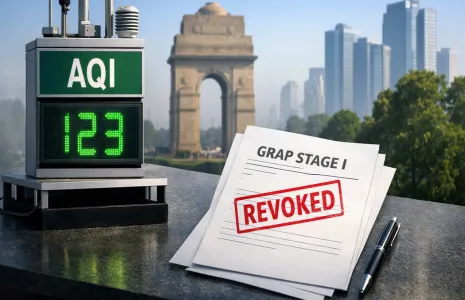
The Commission for Air Quality Management (CAQM) recently directed the closure of 16 industrial units across the National Capital Region after inspections revealed gross and persistent violations of environmental norms. The action is part of CAQM’s intensified enforcement drive to curb air pollution and ensure strict compliance with statutory directions.

Of the affected units, one is located in Uttar Pradesh (NCR), one in Rajasthan (NCR), while the remaining 14 operate in Haryana’s Sonipat district. The inspections identified serious lapses, including operation without mandatory Consent to Establish and Consent to Operate, non-installation or malfunctioning of air pollution control devices, use of unapproved fuels, operation during restricted GRAP periods, non-compliant diesel generator sets, and visible emissions from industrial processes.

CAQM stated that several units were functioning in blatant disregard of extant statutes and environmental directions. The Commission has ordered immediate closure of the defaulting units until full compliance is achieved and reiterated that strict enforcement, including closure and other penal actions as per law, will continue against violators.

The Commission for Air Quality Management (CAQM) recently directed the closure of 16 industrial units across the National Capital Region after inspections revealed gross and persistent violations of environmental norms. The action is part of CAQM’s intensified enforcement drive to curb air pollution and ensure strict compliance with statutory directions. Of the affected units, one is located in Uttar Pradesh (NCR), one in Rajasthan (NCR), while the remaining 14 operate in Haryana’s Sonipat district. The inspections identified serious lapses, including operation without mandatory Consent to Establish and Consent to Operate, non-installation or malfunctioning of air pollution control devices, use of unapproved fuels, operation during restricted GRAP periods, non-compliant diesel generator sets, and visible emissions from industrial processes. CAQM stated that several units were functioning in blatant disregard of extant statutes and environmental directions. The Commission has ordered immediate closure of the defaulting units until full compliance is achieved and reiterated that strict enforcement, including closure and other penal actions as per law, will continue against violators.

Next Story
Real Estate

Union Budge: Infra-Led Urban Shift

The Union Budget FY27 reinforces infrastructure-led urbanisation as the backbone of India’s real estate and housing growth. Higher public capital expenditure, City Economic Regions, risk-mitigation mechanisms and REIT-led asset monetisation are being widely viewed as long-term enablers, even as the industry continues to seek sharper supply-side reforms and affordability-focused measures. Here are a few industry insights:Dr Niranjan Hiranandani, Chairman, NAREDCO & Hiranandani Group“The Union Budget 2026-27 is growth-oriented and stability-focused, supporting consumption and aiming to s..

Next Story
Infrastructure Urban

Budget 2026 Charts Path for Infrastructure-Led, Tech-Driven Growth

The Union Budget 2026–27 signals strong continuity in India’s macroeconomic strategy, anchored in elevated public capital expenditure, fiscal discipline, and a sharper focus on manufacturing, infrastructure, and regional development. With capital outlay pegged at ₹12.2 lakh crore and a fiscal deficit target of around 4.3 per cent, the Budget balances growth ambition with stability, offering long-term visibility to investors and project developers.A dominant theme is the centrality of infrastructure as a multiplier for economic expansion. Public capex now accounts for over 3.3 per cent of..

Next Story
Infrastructure Energy

Tata Power Arm Crosses 10 GW EPC Milestone

Tata Power Renewable Energy Ltd (TPREL) has achieved a major milestone by executing 10 gigawatts of engineering, procurement and construction (EPC) renewable energy projects to date, reinforcing its position in India’s clean energy infrastructure sector. According to the company, the executed portfolio comprises 4.2 gigawatts of in-house projects and 5.8 gigawatts of third-party projects. Of the total 10 gigawatts commissioned so far, 9.7 gigawatts are solar projects and 290 megawatts are wind projects. In the first nine months of FY26, TPREL commissioned 1.88 gigawatts of EPC renewable en..

Advertisement

Subscribe to Our Newsletter

Get daily newsletters around different themes from Construction world.

STAY CONNECTED

Advertisement

Advertisement

Advertisement

Advertisement

Open In App














