Centre Invites Bids For Rare Earth Magnet Unit Under Rs 72.8 bn Scheme
ECONOMY & POLICY

Centre Invites Bids For Rare Earth Magnet Unit Under Rs 72.8 bn Scheme

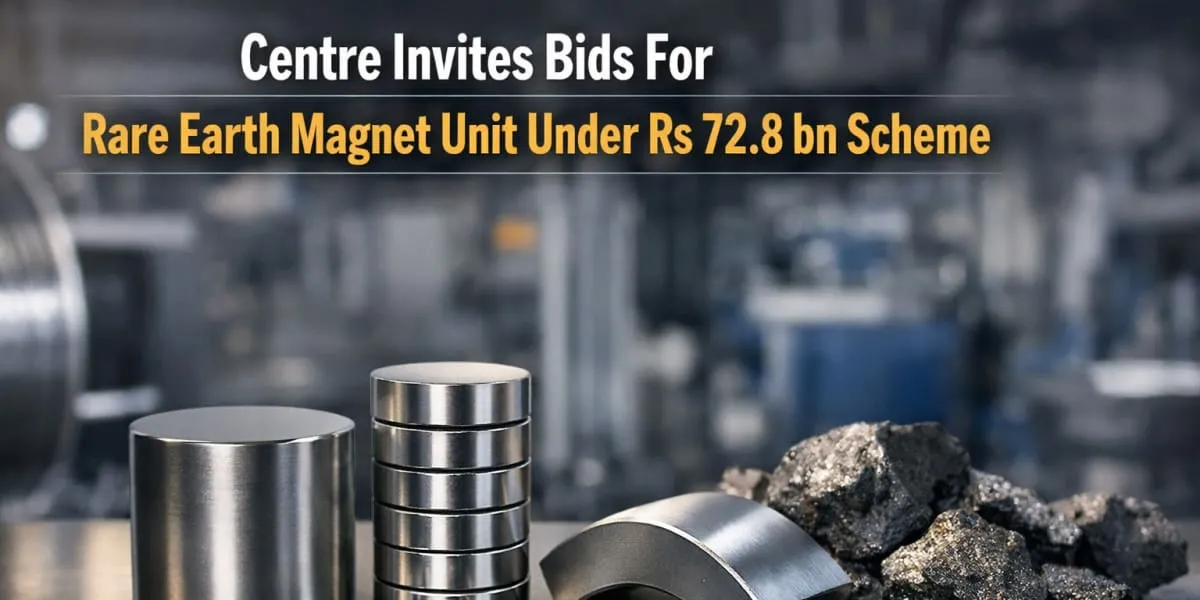
The Ministry of Heavy Industries has issued a request for proposal to invite bids to establish domestic manufacturing facilities for rare earth permanent magnets, advancing India's push for a self-reliant supply chain in critical minerals. The RFP calls for integrated Sintered Neodymium-iron-boron (NdFeB) Rare Earth Permanent Magnet units, with a total capacity of 6,000 metric tonnes per annum (t). The ministry indicated the bidding will be conducted online through a two-stage technical and financial process on the central public procurement portal.

Tender documents were made available from March 20, with a pre-bid meeting scheduled for seven April and bid submissions closing on May 28; technical bids are slated to be opened on May 29. Each manufacturing unit is expected to be allocated a capacity between 600 and 1,200 metric tonnes per annum (t), and applicants must propose integrated sintered NdFeB production lines. The ministry set out timelines and compliance requirements in the RFP and advised bidders to use the portal for both stages.

The move follows the Union Cabinet's approval in November 2025 of a Rs 72.8 billion (bn) scheme to promote domestic manufacturing of sintered rare earth magnets and reduce import dependence. Under the scheme the ministry said companies will be eligible for a capital subsidy of Rs 7.5 billion (bn) and a sales-linked incentive of Rs 64.5 billion (bn), with limited assured supply of NdPr oxide from IREL (India) Ltd for the three lowest bidders. The support is aimed at developing end-to-end capacity in the magnet value chain.

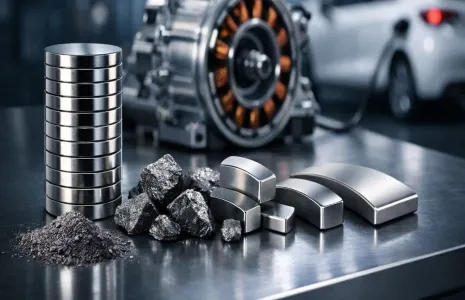
Rare earth permanent magnets are high-strength components used in electric vehicles, wind turbines, high-end electronics and aerospace and defence systems, and are critical to advanced manufacturing. India holds six point twenty seven per cent of global rare earth reserves but accounts for zero point eighty three per cent of production, leaving the country heavily dependent on imports, according to industry reporting. The government framed the push after China, which supplies around 68.6 per cent of global production, restricted exports of several rare earth elements and related magnets last year.

The Ministry of Heavy Industries has issued a request for proposal to invite bids to establish domestic manufacturing facilities for rare earth permanent magnets, advancing India's push for a self-reliant supply chain in critical minerals. The RFP calls for integrated Sintered Neodymium-iron-boron (NdFeB) Rare Earth Permanent Magnet units, with a total capacity of 6,000 metric tonnes per annum (t). The ministry indicated the bidding will be conducted online through a two-stage technical and financial process on the central public procurement portal. Tender documents were made available from March 20, with a pre-bid meeting scheduled for seven April and bid submissions closing on May 28; technical bids are slated to be opened on May 29. Each manufacturing unit is expected to be allocated a capacity between 600 and 1,200 metric tonnes per annum (t), and applicants must propose integrated sintered NdFeB production lines. The ministry set out timelines and compliance requirements in the RFP and advised bidders to use the portal for both stages. The move follows the Union Cabinet's approval in November 2025 of a Rs 72.8 billion (bn) scheme to promote domestic manufacturing of sintered rare earth magnets and reduce import dependence. Under the scheme the ministry said companies will be eligible for a capital subsidy of Rs 7.5 billion (bn) and a sales-linked incentive of Rs 64.5 billion (bn), with limited assured supply of NdPr oxide from IREL (India) Ltd for the three lowest bidders. The support is aimed at developing end-to-end capacity in the magnet value chain. Rare earth permanent magnets are high-strength components used in electric vehicles, wind turbines, high-end electronics and aerospace and defence systems, and are critical to advanced manufacturing. India holds six point twenty seven per cent of global rare earth reserves but accounts for zero point eighty three per cent of production, leaving the country heavily dependent on imports, according to industry reporting. The government framed the push after China, which supplies around 68.6 per cent of global production, restricted exports of several rare earth elements and related magnets last year.

Next Story
Infrastructure Energy

Power Mech Enters Urban Mobility With Rs 2.96 bn Mumbai Monorail Contract

Power Mech said it has secured a contract worth Rs 2.96 billion (Rs 2.96 bn) to deliver work on the Mumbai Monorail, marking the company's formal entry into urban mobility. The award was described as a significant contract for the firm and follows its focus on infrastructure projects. Shares of the company rose on the announcement as investors reacted to the new order. The contract will expand Power Mech's engineering and construction portfolio into urban transit systems and provides the company with exposure to the fast growing urban mobility segment in metropolitan areas. The work is expecte..

Next Story
Infrastructure Urban

Yogi Orders Expert Panel On Smart Meter Overbilling

The Uttar Pradesh chief minister ordered the formation of an expert panel to investigate widespread complaints of overbilling linked to newly installed smart meters. The panel was instructed to review meter data, examine installation practices and identify technical or procedural causes behind discrepancies in consumer bills. The state energy department was asked to prioritise the inquiry and to coordinate with distribution companies to ensure rapid access to required records and equipment. The committee was directed to conduct technical audits of meters and to establish whether faults, calibr..

Next Story
Infrastructure Energy

Power Firms Seek Relaxation Of HERC Fuel Surcharge Rules

Uttar Haryana Bijli Vitran Nigam (UHBVN) and Dakshin Haryana Bijli Vitran Nigam (DHBVN) have approached the Haryana Electricity Regulatory Commission (HERC) seeking relaxation of rules that govern recovery of fuel and power purchase costs. The distribution companies have filed petitions proposing amendments to Regulation sixty eight of the Multi-Year Tariff (MYT) Regulations, 2024 for financial year 2025-26, and have asked the regulator to consider alternative recovery mechanisms to the current monthly arrangement. Under the existing framework, additional costs arising from fuel and power purc..

Advertisement

Subscribe to Our Newsletter

Get daily newsletters around different themes from Construction world.

STAY CONNECTED

Advertisement

Advertisement

Advertisement