Centre Notifies TOD Policy 2026 To Boost Affordable Housing
ECONOMY & POLICY

Centre Notifies TOD Policy 2026 To Boost Affordable Housing

The Ministry of Housing and Urban Affairs (MoHUA) has notified the Transit Oriented Development policy and charges, 2026, for Delhi to enable higher density near metro corridors and expand affordable housing. The announcement at a joint press conference by the minister, the Delhi chief minister and the lieutenant governor noted that TOD was envisaged in the Master Plan of Delhi 2021 but implementation had been delayed by hurdles. The regulations aim to coordinate development and mobility planning.

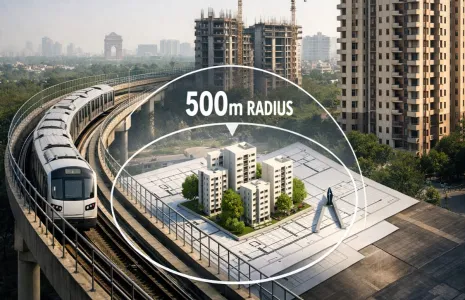
The corridor-based policy designates 207 sq. km around transit lines, defined as 500 m on either side of operational or proposed metro corridors and a 500 m radius around Regional Rapid Transit System (RRTS) and railway stations, primarily for planned redevelopment and affordable housing. About 80 sq. km that had been excluded earlier, including land pooling areas, low-density residential zones and unauthorised colonies, have now been brought within the TOD purview. The government also issued the Regulations for Transit-Oriented Development and Charges, 2026.

The policy permits TOD along both operational and proposed corridors and is intended to support new metro corridors with coordinated development of housing and infrastructure, which officials said will boost metro ridership and urban livability. Citizens proposing to develop land in TOD zones will be able to apply for approvals and pay charges at one point only, avoiding separate approaches to municipal and utility agencies, and the procedure will be time-bound. The framework aims to streamline approvals and delivery.

Smaller plots of 2000 sq. m may be developed under TOD provisions and a maximum floor area ratio (FAR) of up to 500 is permitted on plots of 2000 sq. m and above with an 18 m road. 65 per cent of the total permissible FAR has been mandatorily earmarked for residential use, with dwelling units indicated at a built-up area of 100 sq. m (< 99 sq. m), thereby targeting affordable housing along transit corridors. Simplified TOD charges of Rs 10,000 per sq. m will be levied and proceeds will be placed in a ring-fenced escrow for TOD development.

The Ministry of Housing and Urban Affairs (MoHUA) has notified the Transit Oriented Development policy and charges, 2026, for Delhi to enable higher density near metro corridors and expand affordable housing. The announcement at a joint press conference by the minister, the Delhi chief minister and the lieutenant governor noted that TOD was envisaged in the Master Plan of Delhi 2021 but implementation had been delayed by hurdles. The regulations aim to coordinate development and mobility planning. The corridor-based policy designates 207 sq. km around transit lines, defined as 500 m on either side of operational or proposed metro corridors and a 500 m radius around Regional Rapid Transit System (RRTS) and railway stations, primarily for planned redevelopment and affordable housing. About 80 sq. km that had been excluded earlier, including land pooling areas, low-density residential zones and unauthorised colonies, have now been brought within the TOD purview. The government also issued the Regulations for Transit-Oriented Development and Charges, 2026. The policy permits TOD along both operational and proposed corridors and is intended to support new metro corridors with coordinated development of housing and infrastructure, which officials said will boost metro ridership and urban livability. Citizens proposing to develop land in TOD zones will be able to apply for approvals and pay charges at one point only, avoiding separate approaches to municipal and utility agencies, and the procedure will be time-bound. The framework aims to streamline approvals and delivery. Smaller plots of 2000 sq. m may be developed under TOD provisions and a maximum floor area ratio (FAR) of up to 500 is permitted on plots of 2000 sq. m and above with an 18 m road. 65 per cent of the total permissible FAR has been mandatorily earmarked for residential use, with dwelling units indicated at a built-up area of 100 sq. m (< 99 sq. m), thereby targeting affordable housing along transit corridors. Simplified TOD charges of Rs 10,000 per sq. m will be levied and proceeds will be placed in a ring-fenced escrow for TOD development.

Next Story
Infrastructure Transport

AFCONS & Navayuga set world records with Missing Link Expressway

Maharashtra’s most ambitious greenfield bypass — a 13.3-km alignment carrying twin record-setting tunnels and India’s tallest cable-stayed road bridge — was thrown open to traffic on Maharashtra Day, finally completing the Mumbai–Pune Expressway after a 23-year wait. CW reports…The 650-m cable-stayed bridge over Tiger Valley at sunset — the package executed by Afcons Infrastructure Ltd carries 182-m pylons, the tallest on any Indian road bridge.On 1 May 2026, Chief Minister Devendra Fadnavis, flanked by Deputy Chief Ministers Eknath Shinde and Sunetra Pawar (representing the late..

Next Story
Infrastructure Transport

Mumbai–Pune Missing Link boosts realty prospects

The recently opened ‘missing link’ on the Mumbai–Pune Expressway is set to significantly transform connectivity between the two cities by reducing travel time and bypassing the challenging ghat section. The new alignment, featuring tunnels and viaducts, is designed to improve safety, ease congestion and ensure a smoother, faster commute for both passenger and commercial traffic.With improved travel efficiency, the corridor is expected to strengthen intercity movement, encouraging more frequent travel for work, leisure and logistics. This enhanced accessibility is likely to benefit real e..

Next Story
Infrastructure Urban

How Hormuz is Hijacking Indian Highways

At the recently held RAHSTA Round Table on 29th April in Pune, and earlier during our webinars for Cement Expo by Indian Cement Review and by FIRST Construction Council on manufacturing construction equipment for the world, one thread lay common: the industry is being subjected to a cost-push chain reaction moving from crude oil → freight/insurance → steel, cement fuel, bitumen, polymers, packaging, logistics and finally project margins. Indeed, the West Asia crisis caused by the war and the Hormuz Strait blockade, which does not directly concern us, has turned around and hit us. If the wa..

Advertisement

Subscribe to Our Newsletter

Get daily newsletters around different themes from Construction world.

STAY CONNECTED

Advertisement

Advertisement

Advertisement