CSIR-NIScPR and INSA Organised Science Communication Workshop
ECONOMY & POLICY

CSIR-NIScPR and INSA Organised Science Communication Workshop

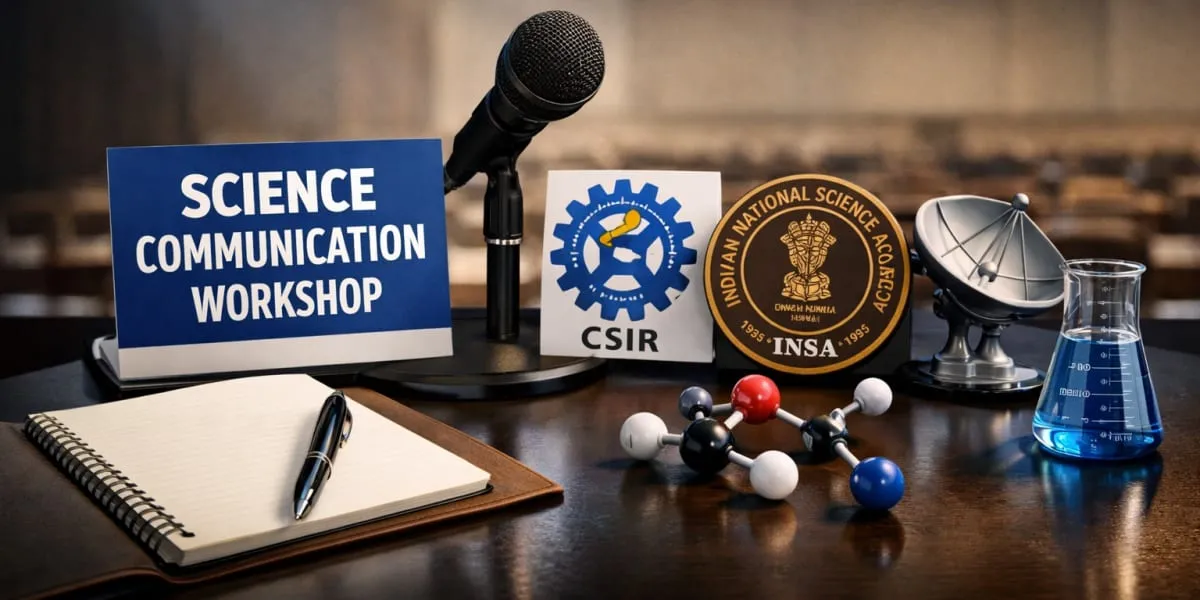
As part of the National Science Day celebrations in 2026, a capacity building workshop on creative ways of communicating science was held at Vigyan Bhawan in New Delhi. The event was jointly organised by the CSIR-National Institute of Science Communication and Policy Research and the Indian National Science Academy. The workshop was convened to strengthen the practice of science communication and to introduce contemporary approaches for engaging diverse audiences.

The workshop was inaugurated by Prof Shekhar C. Mande, President of the Indian National Science Academy, who emphasised the need to bridge the gap between research and society and to foster inclusive scientific growth. In her welcome address Dr Geetha Vani Rayasam, Director of CSIR-NIScPR, outlined the institute's role in science communication and policy research and underscored the importance of creative and multilingual strategies to make scientific knowledge accessible. Organisers positioned the event as a platform to translate research outputs into formats suitable for different public audiences.

Technical sessions featured a range of speakers who examined storytelling, audience centric communication, popular science writing and digital tools. Prof Sharmistha Banerjee of the University of Hyderabad highlighted the role of narrative techniques in reaching lay audiences while Dr H. S. Sudhira of Gubbi Labs discussed the potential of artificial intelligence to simplify complex concepts. Senior scientists from CSIR-NIScPR described media formats, including magazines, books and research journals, and explained regional outreach initiatives. Speakers also addressed the role of social media and provided practical guidance on dos and don'ts in science communication to encourage reflective practice among participants.

A pre workshop survey and interactive exercises were conducted to capture attendee perspectives and expectations, and organisers reported active engagement throughout the sessions. Around 150 students from colleges of Delhi University and the Indian Institute of Mass Communication participated, reflecting strong academic interest in building communication skills. The workshop aimed to equip attendees with contemporary tools, digital strategies and hands on insights to strengthen India's science communication ecosystem in alignment with the vision of Viksit Bharat 2047.

As part of the National Science Day celebrations in 2026, a capacity building workshop on creative ways of communicating science was held at Vigyan Bhawan in New Delhi. The event was jointly organised by the CSIR-National Institute of Science Communication and Policy Research and the Indian National Science Academy. The workshop was convened to strengthen the practice of science communication and to introduce contemporary approaches for engaging diverse audiences. The workshop was inaugurated by Prof Shekhar C. Mande, President of the Indian National Science Academy, who emphasised the need to bridge the gap between research and society and to foster inclusive scientific growth. In her welcome address Dr Geetha Vani Rayasam, Director of CSIR-NIScPR, outlined the institute's role in science communication and policy research and underscored the importance of creative and multilingual strategies to make scientific knowledge accessible. Organisers positioned the event as a platform to translate research outputs into formats suitable for different public audiences. Technical sessions featured a range of speakers who examined storytelling, audience centric communication, popular science writing and digital tools. Prof Sharmistha Banerjee of the University of Hyderabad highlighted the role of narrative techniques in reaching lay audiences while Dr H. S. Sudhira of Gubbi Labs discussed the potential of artificial intelligence to simplify complex concepts. Senior scientists from CSIR-NIScPR described media formats, including magazines, books and research journals, and explained regional outreach initiatives. Speakers also addressed the role of social media and provided practical guidance on dos and don'ts in science communication to encourage reflective practice among participants. A pre workshop survey and interactive exercises were conducted to capture attendee perspectives and expectations, and organisers reported active engagement throughout the sessions. Around 150 students from colleges of Delhi University and the Indian Institute of Mass Communication participated, reflecting strong academic interest in building communication skills. The workshop aimed to equip attendees with contemporary tools, digital strategies and hands on insights to strengthen India's science communication ecosystem in alignment with the vision of Viksit Bharat 2047.

Next Story
Real Estate

Housing Sales Dip 7 per cent QoQ Across Top Cities

India’s housing market saw a 7 per cent quarter-on-quarter decline in sales across the top seven cities in Q1 2026, with approximately 1,01,675 units sold compared to 1,08,970 units in Q4 2025, according to ANAROCK Group. However, on a yearly basis, sales rose 9 per cent, indicating continued underlying demand.The total sales value stood at around Rs 1.51 trillion, reflecting a 5 per cent quarterly drop but a 6 per cent annual increase. Mumbai Metropolitan Region and Bengaluru together accounted for nearly 48 per cent of total sales, while Chennai recorded the highest quarterly decline at 18..

Next Story
Real Estate

Birla Estates Enters Mumbai Redevelopment

Birla Estates has announced its entry into Mumbai’s redevelopment segment with a luxury residential project in Khar West, developed in partnership with Parinee Real Estate Builders. The project will redevelop Anmol Co-operative Housing Society and Bhartiya Bhavan Co-operative Housing Society, marking the company’s first redevelopment initiative in the Mumbai Metropolitan Region.Spread across 1.3 acres, the development will offer a saleable area of 2.9 lakh sq ft with an estimated revenue potential of Rs 17 billion. Positioned in one of Mumbai’s prime residential micro-markets, the projec..

Next Story
Infrastructure Urban

Hitachi, MUFG Expand EV Financing Model

Hitachi and MUFG Bank have expanded their NextGen business co-creation model to accelerate decarbonised mobility by financing electric vehicles and charging infrastructure. The renewed collaboration aims to address key barriers to electrification, including limited access to capital and the need for integrated energy solutions.Building on earlier partnerships, the expanded model extends beyond battery-focused solutions to include electric mobility assets, charging systems and energy management infrastructure across global markets. The initiative will leverage structured financing through speci..

Advertisement

Subscribe to Our Newsletter

Get daily newsletters around different themes from Construction world.

STAY CONNECTED

Advertisement

Advertisement

Advertisement