CUMI Starts Cutting And Grinding Wheel Production At Hosur
ECONOMY & POLICY

CUMI Starts Cutting And Grinding Wheel Production At Hosur

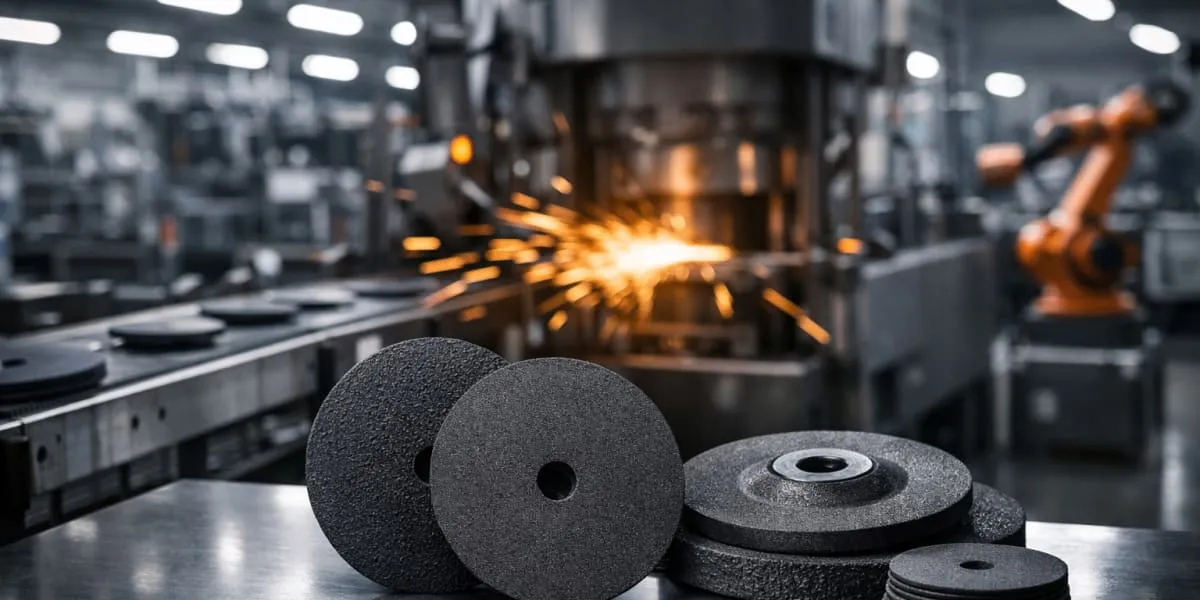
Carborundum Universal Limited (CUMI) has commenced commercial production of cutting and grinding thin wheels at its Hosur facility, marking the relocation and commissioning of manufacturing lines acquired from DRONCO GmbH of Germany in 2023. The commissioning increases CUMI India’s total annual cutting and grinding wheel manufacturing capacity from 45 mn wheels to over 90 mn wheels. The new facility will supply industrial applications across fabrication, engineering and construction.

The plant incorporates a state-of-the-art mixing unit with SCADA based process controls, automated press lines integrated with unmanned oven handling and curing systems referred to as U-Lines, and an ambient control system that ensures stability in raw material characteristics. These features support consistent product performance while strengthening cost competitiveness and process utilisation. The facility has received certification from the Organisation for the Safety of Abrasives (oSa), recognising conformity with international safety standards for cutting and grinding tools.

Production at Hosur is expected to meet demand across fabrication, general engineering and construction sectors and to support aftermarket requirements for automotive and industrial components. The plant was established with an investment of Rs 830 mn and at peak capacity utilisation is expected to generate turnover of about Rs 1.6 bn. CUMI highlighted that the adoption of DRONCO technology will enable higher throughput and improved product consistency.

Carborundum Universal Limited, established in 1954, is a materials sciences engineering solutions provider and is part of the 125-year-old Murugappa Group. CUMI reported consolidated revenue of Rs 48.34 bn and profit after tax of Rs 2.93 bn for the financial year 2024-25 and has a workforce of over 10,000 employees worldwide. The company exports to over 60 countries across six continents and continues to develop solutions in abrasives, electrominerals, ceramics and refractories to serve diverse industries.

Carborundum Universal Limited (CUMI) has commenced commercial production of cutting and grinding thin wheels at its Hosur facility, marking the relocation and commissioning of manufacturing lines acquired from DRONCO GmbH of Germany in 2023. The commissioning increases CUMI India’s total annual cutting and grinding wheel manufacturing capacity from 45 mn wheels to over 90 mn wheels. The new facility will supply industrial applications across fabrication, engineering and construction. The plant incorporates a state-of-the-art mixing unit with SCADA based process controls, automated press lines integrated with unmanned oven handling and curing systems referred to as U-Lines, and an ambient control system that ensures stability in raw material characteristics. These features support consistent product performance while strengthening cost competitiveness and process utilisation. The facility has received certification from the Organisation for the Safety of Abrasives (oSa), recognising conformity with international safety standards for cutting and grinding tools. Production at Hosur is expected to meet demand across fabrication, general engineering and construction sectors and to support aftermarket requirements for automotive and industrial components. The plant was established with an investment of Rs 830 mn and at peak capacity utilisation is expected to generate turnover of about Rs 1.6 bn. CUMI highlighted that the adoption of DRONCO technology will enable higher throughput and improved product consistency. Carborundum Universal Limited, established in 1954, is a materials sciences engineering solutions provider and is part of the 125-year-old Murugappa Group. CUMI reported consolidated revenue of Rs 48.34 bn and profit after tax of Rs 2.93 bn for the financial year 2024-25 and has a workforce of over 10,000 employees worldwide. The company exports to over 60 countries across six continents and continues to develop solutions in abrasives, electrominerals, ceramics and refractories to serve diverse industries.

Next Story
Infrastructure Transport

Sector 51-52 Metro skywalk in Noida remains shut despite being ready for over a year

Thousands of commuters travelling between Delhi Metro Rail Corporation’s (DMRC) Sector 52 station and Noida Metro Rail Corporation’s (NMRC) Sector 51 station continue to face daily inconvenience as the 300-metre air-conditioned skywalk connecting the two stations remains closed, despite being completed over a year ago, according to a report.The Noida Metro Rail Corporation built the foot overbridge to enable a seamless interchange between the Delhi Metro and Noida Metro networks. However, pending finishing work and a structural obstruction have delayed its opening.Krishna Karunesh, Chief E..

Next Story
Infrastructure Transport

Maharashtra clears Metro Line 5A, expansion of Mumbai Metro Line 5

The Maharashtra government has approved the expansion of Mumbai Metro Line 5 along with a new integrated corridor, Metro Line 5A, forming a combined 34.2-km metro network across the Thane-Bhiwandi-Kalyan-Ulhasnagar belt. The integrated project has been cleared at an estimated cost of ₹18,130.55 crore, according to a government resolution (GR).Metro Line 5 was originally approved in October 2017 as a 24.9-km fully elevated corridor with 17 stations connecting Thane, Bhiwandi and Kalyan, with an initial project cost of ₹8,416.51 crore. The corridor is being developed in two phases.The first ..

Next Story
Infrastructure Transport

Bengaluru Metro expansion seen driving office demand

Bengaluru’s expanding metro network is expected to emerge as a major catalyst for real estate growth, with the Yellow and Pink Lines likely to boost both office demand and residential prices across key micro-markets, according to a report by Colliers India.The report estimates that over the next two years, Bengaluru could witness an additional 5–7 million sq ft of Grade A office space demand across the Central Business District (CBD), Secondary Business District (SBD) and Electronic City. Improved metro connectivity and reduced commute times are expected to drive higher occupier interest a..

Advertisement

Subscribe to Our Newsletter

Get daily newsletters around different themes from Construction world.

STAY CONNECTED

Advertisement

Advertisement

Advertisement