



Delhi To Pilot Civic Tech Solutions From Delhi Next
ECONOMY & POLICY

Delhi To Pilot Civic Tech Solutions From Delhi Next

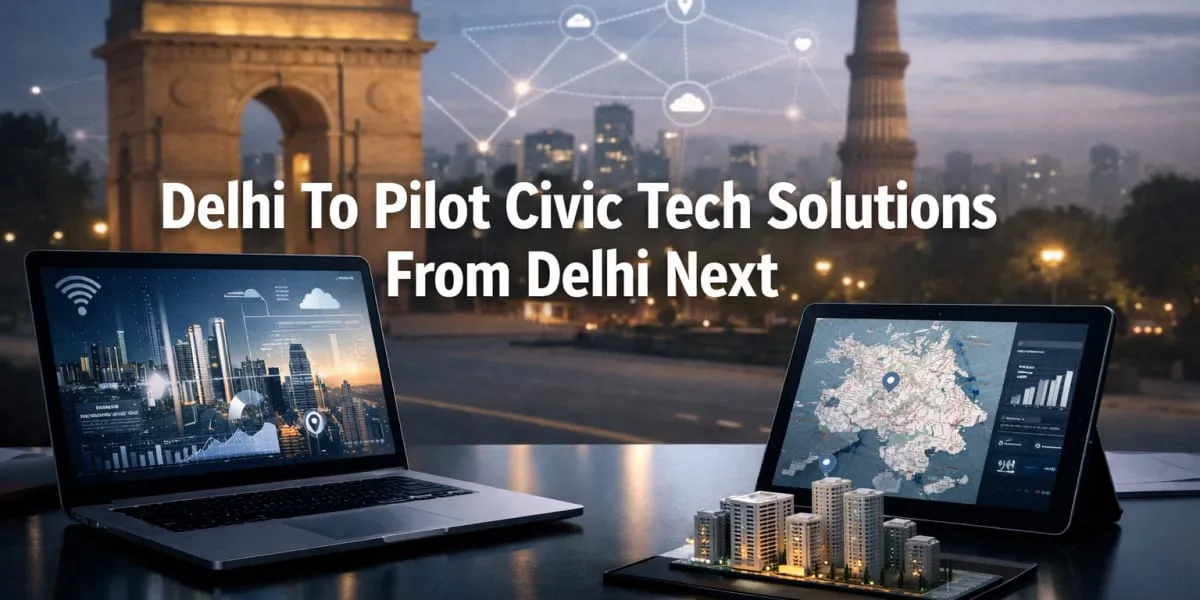
The Delhi government will pilot several technology-led civic solutions developed under Delhi Next Code, Create & Change, the Chief Minister said after the programme concluded. Positioned as one of India’s largest civic-tech innovation initiatives, Delhi Next reached more than 10 million (mn) young people across the country and invited students, developers, start-ups and young innovators to devise practical solutions for major urban governance challenges.

Officials said the top 60 teams were selected after multiple evaluation rounds and presented their proposals before government representatives, domain experts and mentors. The shortlisted innovations addressed areas such as traffic management, waterlogging prevention, pollution control, digital governance systems, citizen grievance redressal and public service accessibility.

The Chief Minister indicated that the government will work with relevant departments to implement selected projects as pilot initiatives and that participating teams will receive technical mentorship, policy guidance and a structured implementation framework to help convert prototypes into deployable civic solutions. The approach is intended to bridge the gap between grassroots innovation and public administration and to fast track practical interventions.

Programme organisers and associated experts said civic-tech partnerships are becoming increasingly important for authorities seeking improved efficiency, accountability and citizen engagement. Technology-enabled interventions can help municipal and state agencies respond more effectively to congestion, flooding, pollution and delays in public services, and successful pilots could be scaled across different departments and districts in the capital.

The initiative also aims to create sustained engagement between the government and the innovation ecosystem by encouraging young professionals to contribute towards governance reforms and smart-city development. The Chief Minister thanked participating teams and urged the youth to actively support efforts to build a Viksit Delhi, stressing that innovation, collaboration and civic participation will be critical to improving the quality of life for residents.

The Delhi government will pilot several technology-led civic solutions developed under Delhi Next Code, Create & Change, the Chief Minister said after the programme concluded. Positioned as one of India’s largest civic-tech innovation initiatives, Delhi Next reached more than 10 million (mn) young people across the country and invited students, developers, start-ups and young innovators to devise practical solutions for major urban governance challenges. Officials said the top 60 teams were selected after multiple evaluation rounds and presented their proposals before government representatives, domain experts and mentors. The shortlisted innovations addressed areas such as traffic management, waterlogging prevention, pollution control, digital governance systems, citizen grievance redressal and public service accessibility. The Chief Minister indicated that the government will work with relevant departments to implement selected projects as pilot initiatives and that participating teams will receive technical mentorship, policy guidance and a structured implementation framework to help convert prototypes into deployable civic solutions. The approach is intended to bridge the gap between grassroots innovation and public administration and to fast track practical interventions. Programme organisers and associated experts said civic-tech partnerships are becoming increasingly important for authorities seeking improved efficiency, accountability and citizen engagement. Technology-enabled interventions can help municipal and state agencies respond more effectively to congestion, flooding, pollution and delays in public services, and successful pilots could be scaled across different departments and districts in the capital. The initiative also aims to create sustained engagement between the government and the innovation ecosystem by encouraging young professionals to contribute towards governance reforms and smart-city development. The Chief Minister thanked participating teams and urged the youth to actively support efforts to build a Viksit Delhi, stressing that innovation, collaboration and civic participation will be critical to improving the quality of life for residents.

Related Stories

Gold Stories

Next Story
Infrastructure Urban

KONE Opens India's First Digital Experience Centre in Pune

KONE, a global elevator and escalator manufacturer, has inaugurated its first Digital Experience Centre (DEC) in India, located in Pune. The facility aims to showcase how artificial intelligence (AI), connectivity and data-driven technologies can enhance customer experiences and improve building operations.The centre was inaugurated by Jussi Herlin, Executive Vice Chair, KONE Corporation; Philippe Delorme, President and CEO, KONE; and Nandan Nilekani, Co-founder and Chairman of the Board, Infosys.Designed as an interactive customer environment, the facility demonstrates digital solutions cover..

Next Story
Infrastructure Urban

CII GreenCo Launches Circularity Guidelines for Indian Industry

The Confederation of Indian Industry (CII) GreenCo Council has launched the CII GreenCo Circularity Guidelines – Pilot Version at the 17th CII GreenCo Waste & Resource Management Summit 2026 in Chennai. The initiative aims to strengthen resource efficiency, waste reduction and circular economy practices across Indian manufacturing and process industries.The guidelines introduce a structured framework with circularity indices covering raw materials, consumables, packaging and other resource inputs. These indicators will help industries assess existing practices, identify opportunities to ..

Next Story
Infrastructure Energy

Global Electronics Association Launches IPC-1783-CO2E Standard

The Global Electronics Association has introduced IPC-1783-CO2E, a new international standard aimed at improving consistency, transparency and comparability in product carbon footprint reporting across the electronics manufacturing industry.The standard, titled International Standard for Data Collection and Reporting of CO2 Equivalent (CO2e) Emissions for the Electronics Manufacturing Supply Chain, provides industry-specific guidance for collecting, estimating and reporting carbon emissions data.With increasing regulatory requirements and customer expectations, electronics manufacturers face c..

Advertisement

Subscribe to Our Newsletter

Get daily newsletters around different themes from Construction world.

STAY CONNECTED

Advertisement

SPECIAL OFFER
QR Code











