+
DPGS Releases Rs102 Million For Over 1,500 Delhi Parks
ECONOMY & POLICY

DPGS Releases Rs102 Million For Over 1,500 Delhi Parks

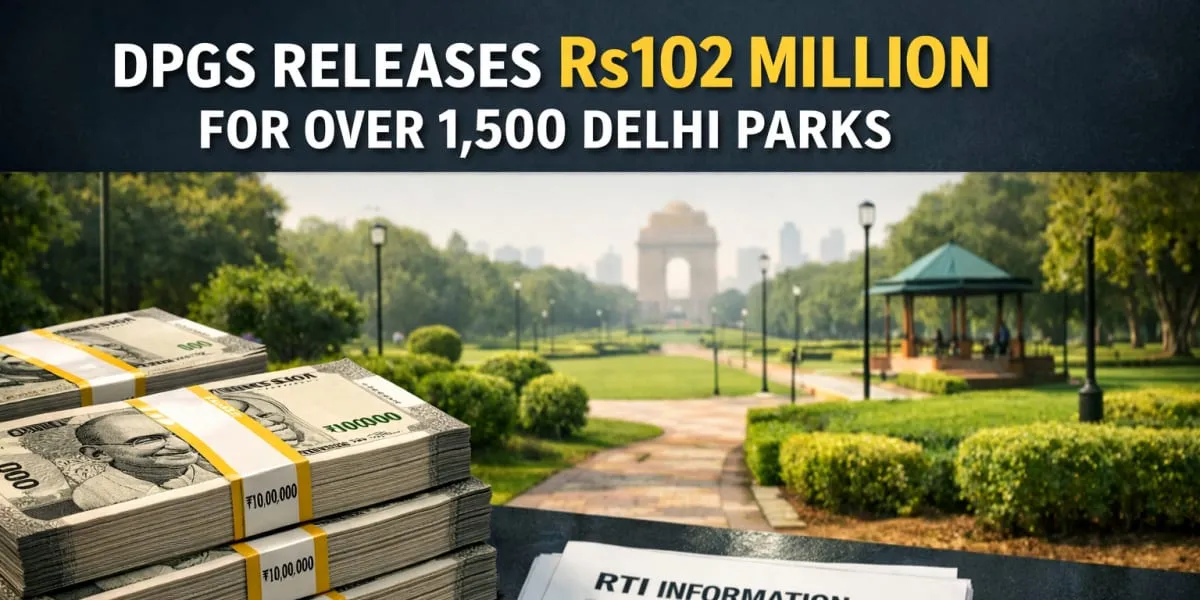
An RTI reply has shown that DPGS released Rs102 million (Rs102 mn) for more than 1,500 parks across Delhi up to January 20. The information emerged from the response to a right to information request and details the cumulative funds released until that date. The RTI reply did not include a breakdown of allocations to individual parks.

The total released amount converts from the reported figure of 10.2 crore to Rs102 million, following standard conversion measures. One crore is treated as ten million in this conversion. Dividing the aggregate figure by the number of parks yields an average disbursement of Rs68,000 per park. This average serves only as an arithmetic illustration and does not reflect the variation that might exist between localities.

The disclosure under the RTI offers a snapshot of funding flows to urban green areas and provides a basis for public scrutiny of civic expenditure. The DPGS was identified in the reply as the releasing authority, and the figures cover the period up to January 20 as stated. Further details on project-wise spending were not supplied in the response.

The RTI reply may prompt requests for more granular data from residents and civic groups seeking to assess maintenance and development outcomes. Officials or the DPGS could be asked to publish a detailed list of releases and corresponding works to enhance transparency. Until such detail is provided, the aggregate sums remain the principal publicly available measure of funding.

The RTI reply forms part of the public record and can be cited in follow up enquiries by media or residents seeking accountability. Civic groups may press for an itemised ledger showing dates of releases and corresponding expenditure heads. Greater detail would enable more precise assessment of how funds translate into improvements at park level.

An RTI reply has shown that DPGS released Rs102 million (Rs102 mn) for more than 1,500 parks across Delhi up to January 20. The information emerged from the response to a right to information request and details the cumulative funds released until that date. The RTI reply did not include a breakdown of allocations to individual parks. The total released amount converts from the reported figure of 10.2 crore to Rs102 million, following standard conversion measures. One crore is treated as ten million in this conversion. Dividing the aggregate figure by the number of parks yields an average disbursement of Rs68,000 per park. This average serves only as an arithmetic illustration and does not reflect the variation that might exist between localities. The disclosure under the RTI offers a snapshot of funding flows to urban green areas and provides a basis for public scrutiny of civic expenditure. The DPGS was identified in the reply as the releasing authority, and the figures cover the period up to January 20 as stated. Further details on project-wise spending were not supplied in the response. The RTI reply may prompt requests for more granular data from residents and civic groups seeking to assess maintenance and development outcomes. Officials or the DPGS could be asked to publish a detailed list of releases and corresponding works to enhance transparency. Until such detail is provided, the aggregate sums remain the principal publicly available measure of funding. The RTI reply forms part of the public record and can be cited in follow up enquiries by media or residents seeking accountability. Civic groups may press for an itemised ledger showing dates of releases and corresponding expenditure heads. Greater detail would enable more precise assessment of how funds translate into improvements at park level.

Next Story
Infrastructure Urban

Implementation Status of Jal Jeevan Mission

Since August 2019 the Government has implemented Jal Jeevan Mission to provide assured potable water through household tap connections in rural India. At the start of the mission only 32.3 million (mn) rural households, representing 16.7 per cent, were reported to have tap water connections. States and union territories have reported that 125.8 mn additional rural households have since been provided with tap connections. As a result, of about 193.6 mn rural households roughly 158.2 mn, or 81.71 per cent, are reported to have tap water supply at home.\n\nThe State, district and village level st..

Next Story
Infrastructure Urban

Jal Jeevan Mission Reaches Eighty One Per Cent Rural Coverage

The Government reported substantial progress under the Jal Jeevan Mission, launched in August 2019 to provide tap water to every rural household. At launch only 32.3 million (mn) rural households had tap connections and states and Union territories reported provision of 125.8 mn additional households by March 2026. Consequently, out of about 193.6 mn rural households around 158.2 mn, or 81.71 per cent, are reported to have tap water at home. The Finance Minister announced extension of the mission until 2028 in the 2025-26 budget speech. The Swachh Bharat Mission Grameen, launched in October 20..

Next Story
Infrastructure Urban

Empowering Local Governance for Sustainable Rural Water Supply

The Ministry of Jal Shakti has aligned the Jal Jeevan Mission (JJM) with the 73rd Amendment to strengthen village level planning and community ownership of water supply. Gram Panchayats, village water and sanitation committees and Pani Samitis are to plan, implement, manage and maintain piped water systems, with gram sabha processes formalising handover and oversight. Implementation support agencies including non government organisations, community based organisations and self help groups have been empanelled to train local committees and promote women participation. Under JJM, the department ..

Advertisement

Subscribe to Our Newsletter

Get daily newsletters around different themes from Construction world.

STAY CONNECTED

Advertisement

Advertisement

Advertisement