+
Gravita Expands Lead Recycling Capacity At Mundra Plant
ECONOMY & POLICY

Gravita Expands Lead Recycling Capacity At Mundra Plant

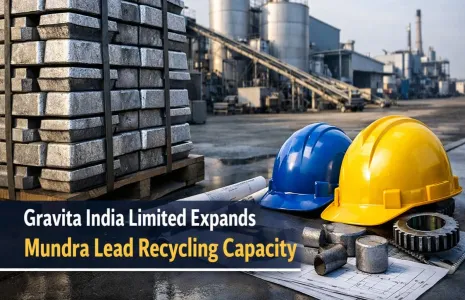
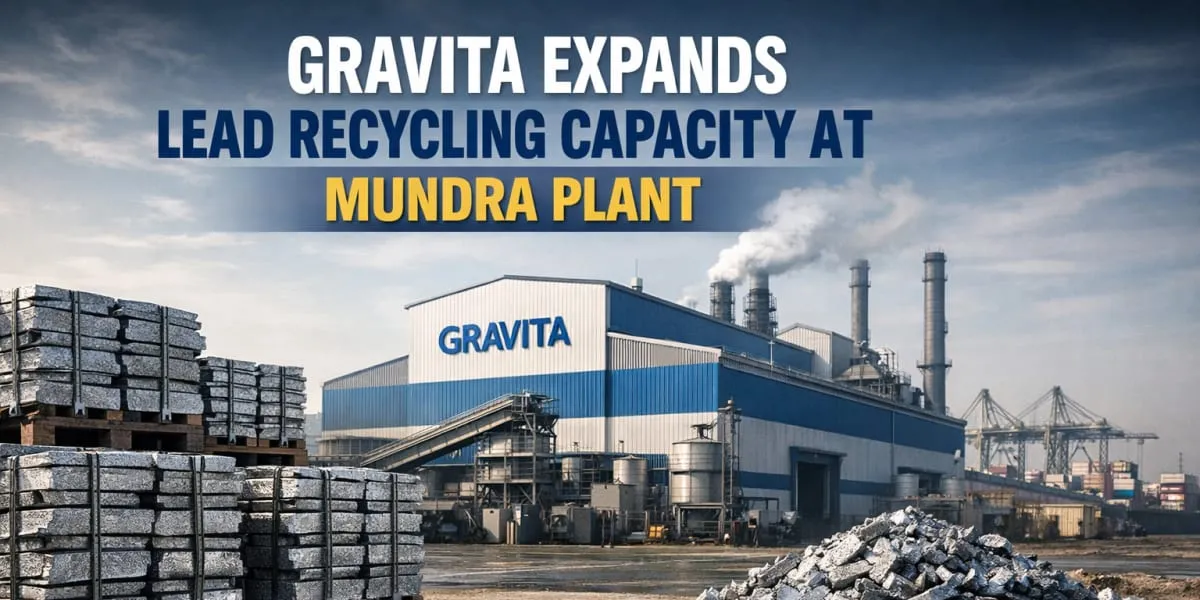
Gravita India Limited has increased the lead recycling capacity of its Mundra facility in Gujarat by 80,300 metric tonnes per annum (t), bringing the unit's total capacity to 145,100 metric tonnes per annum (t). The company stated the expansion forms part of its strategy to strengthen recycling capabilities and meet rising domestic and international demand for sustainable lead products. The capacity increase was completed at the Mundra plant, which benefits from strategic proximity to the port and established logistics links.

The company has invested Rs 490 million (mn) in procurement and commissioning for the expansion, funding the project from internal accruals. Management indicated that the enhancement will enable improved operational efficiencies and optimisation of supply chains for both raw material sourcing and export fulfilment. The investment underscores a focus on scaling production to support key export markets and long-term growth.

The expanded facility is expected to support more efficient processing cycles and better serve customers with high-quality recycled lead supplied in a responsible manner consistent with circular economy principles. The Mundra expansion is intended to reduce transit times and logistics costs while maintaining environmental and safety standards across operations. The company noted that greater capacity at a port-proximate site will facilitate responsiveness to international demand. Operational teams will focus on process standardisation and quality control to ensure consistent output and compliance with environmental norms.

Gravita is presented as a leading global recycling company with 13 eco-conscious, state-of-the-art manufacturing facilities worldwide and a recycling heritage of three decades. Post expansion, the company's total installed recycling capacity stands at 425,959 t per annum. The business operates across six verticals and serves customers in over 70 countries as it pursues sustainable growth. The company plans to leverage the expanded capacity to advance product quality and circular business initiatives without compromising safety.

Gravita India Limited has increased the lead recycling capacity of its Mundra facility in Gujarat by 80,300 metric tonnes per annum (t), bringing the unit's total capacity to 145,100 metric tonnes per annum (t). The company stated the expansion forms part of its strategy to strengthen recycling capabilities and meet rising domestic and international demand for sustainable lead products. The capacity increase was completed at the Mundra plant, which benefits from strategic proximity to the port and established logistics links. The company has invested Rs 490 million (mn) in procurement and commissioning for the expansion, funding the project from internal accruals. Management indicated that the enhancement will enable improved operational efficiencies and optimisation of supply chains for both raw material sourcing and export fulfilment. The investment underscores a focus on scaling production to support key export markets and long-term growth. The expanded facility is expected to support more efficient processing cycles and better serve customers with high-quality recycled lead supplied in a responsible manner consistent with circular economy principles. The Mundra expansion is intended to reduce transit times and logistics costs while maintaining environmental and safety standards across operations. The company noted that greater capacity at a port-proximate site will facilitate responsiveness to international demand. Operational teams will focus on process standardisation and quality control to ensure consistent output and compliance with environmental norms. Gravita is presented as a leading global recycling company with 13 eco-conscious, state-of-the-art manufacturing facilities worldwide and a recycling heritage of three decades. Post expansion, the company's total installed recycling capacity stands at 425,959 t per annum. The business operates across six verticals and serves customers in over 70 countries as it pursues sustainable growth. The company plans to leverage the expanded capacity to advance product quality and circular business initiatives without compromising safety.

Next Story
Infrastructure Urban

Implementation Status of Jal Jeevan Mission

Since August 2019 the Government has implemented Jal Jeevan Mission to provide assured potable water through household tap connections in rural India. At the start of the mission only 32.3 million (mn) rural households, representing 16.7 per cent, were reported to have tap water connections. States and union territories have reported that 125.8 mn additional rural households have since been provided with tap connections. As a result, of about 193.6 mn rural households roughly 158.2 mn, or 81.71 per cent, are reported to have tap water supply at home.\n\nThe State, district and village level st..

Next Story
Infrastructure Urban

Jal Jeevan Mission Reaches Eighty One Per Cent Rural Coverage

The Government reported substantial progress under the Jal Jeevan Mission, launched in August 2019 to provide tap water to every rural household. At launch only 32.3 million (mn) rural households had tap connections and states and Union territories reported provision of 125.8 mn additional households by March 2026. Consequently, out of about 193.6 mn rural households around 158.2 mn, or 81.71 per cent, are reported to have tap water at home. The Finance Minister announced extension of the mission until 2028 in the 2025-26 budget speech. The Swachh Bharat Mission Grameen, launched in October 20..

Next Story
Infrastructure Urban

Empowering Local Governance for Sustainable Rural Water Supply

The Ministry of Jal Shakti has aligned the Jal Jeevan Mission (JJM) with the 73rd Amendment to strengthen village level planning and community ownership of water supply. Gram Panchayats, village water and sanitation committees and Pani Samitis are to plan, implement, manage and maintain piped water systems, with gram sabha processes formalising handover and oversight. Implementation support agencies including non government organisations, community based organisations and self help groups have been empanelled to train local committees and promote women participation. Under JJM, the department ..

Advertisement

Subscribe to Our Newsletter

Get daily newsletters around different themes from Construction world.

STAY CONNECTED

Advertisement

Advertisement

Advertisement